Get Full Government Meeting Transcripts, Videos, & Alerts Forever!
Get email alerts on the Unauthorized Camping topic
No spam. Unsubscribe anytime.
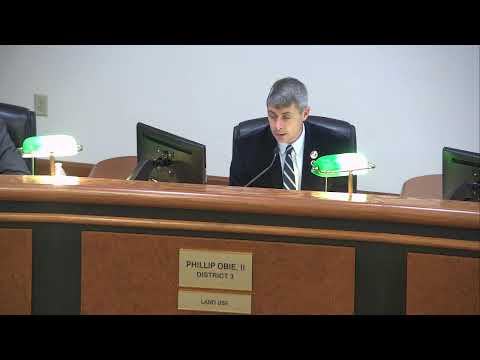
Berkeley County committee backs camping ordinance to curb unauthorized parking-lot encampments; members raise homelessness concerns
Summary
Bill 25-06, aimed at restricting unauthorized camping on county property and easements, advanced in committee. The ordinance sets penalties and is modeled on ordinances used by nearby jurisdictions; councilmembers pressed staff about impacts on people without housing and on enforcement practices.
The Berkeley County committee approved advancing Bill 25-06, an ordinance that would prohibit unauthorized camping on county property, easements and parking areas and establish penalties for violations.
The committee voted to consider the ordinance; the motion carried by voice vote.
County staff said the ordinance is intended to address encampments that affect private landowners, create public‑health risks and obstruct county operations. “This does not affect the campgrounds in Berkeley County. This is, to help with encampments, parking lot, camping,” a county presenter said, adding that the measure targets situations such as people squatting on easements and in parking lots.
On enforcement, staff described a process of posting notice and then pursuing criminal charges for continued violations. “It will give us the means to go in. We'll post, let them know then it is a criminally charged offense if they continue to,” the staff member said.
Councilmembers queried whether the ordinance would be aimed at people experiencing homelessness. “So it's it's mainly towards the homeless is what I'm—” one councilmember asked. Staff answered that the rule is not intended to criminalize homelessness per se but to address persistent encampments and related public‑health hazards; the presenter said officials try to avoid jailing and use other interventions where possible. “The jailing is not 1 of those mechanisms,” the presenter said.
The discussion noted the ordinance is modeled on a recently adopted town ordinance in Monks Corner and on similar local efforts. Councilmembers also asked about penalties; staff said the maximum fine for the violation would be $500.
The motion to advance Bill 25-06 passed by voice vote; the transcript does not record a roll‑call tally. The ordinance will return for subsequent readings where enforcement language and exceptions are expected to be clarified.