Get Full Government Meeting Transcripts, Videos, & Alerts Forever!
Get email alerts on the Public Safety Nuisance Business topic
No spam. Unsubscribe anytime.
Berkeley County committee advances nuisance-business ordinance after debate on definitions and owner accountability
Summary
A Berkeley County Council committee approved a first-step action on Bill 25-05 to create criteria for designating "nuisance" businesses, focusing on nightclubs and repeat public-safety incidents. Council members pressed staff on how the ordinance would be defined and enforced and asked how much control property owners have over patrons.
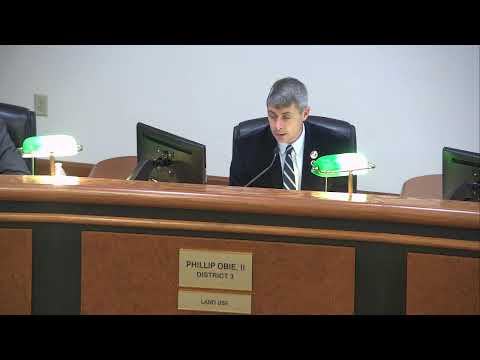
Berkeley County Council’s Committee on Justice and Public Safety approved moving forward with Bill 25-05, an ordinance intended to define and address “nuisance” businesses, after a discussion about how the new rules would be applied and enforced.
The committee voted to consider the ordinance prior to first reading; the motion carried by voice vote.
The ordinance is aimed at businesses that generate repeated law‑enforcement calls, reports of shootings, or other public‑safety incidents. A county staff presenter said the measure was developed so officials “could, in a sense, go in and inspect,” describing criteria that would include call volumes, reports generated and repeated violent incidents. “The ordinances will be clearly defined, and it has to deal with what is the primary purpose of the business,” the staff member said.
Council members asked how the ordinance would identify businesses and who would make the determination. “So who determines that it's a nuisance business? Who who comes up with that to start with?” one councilmember asked during the discussion. County staff responded that the ordinance establishes criteria and that enforcement would focus on businesses that meet those criteria, and that the county planned to work with owners on prevention measures.
Several members raised concerns about distinguishing a business’s responsibility for patrons’ actions versus circumstances beyond a proprietor’s control. “...sometimes a fellow around a business has some consequences beyond his control,” one member said, urging clear, well‑delineated acts for the ordinance. Staff answered that where repetitive incidents occur, businesses would be expected to use security, video surveillance or other measures to address problems.
The presenter also said the county modeled the ordinance in part on Spartanburg County’s approach and that the policy would focus on businesses—particularly nightclubs—rather than on private residences or unrelated commercial activity.
The motion to advance Bill 25-05 passed by voice vote; the record does not show a roll‑call tally.
The ordinance will return for further readings and formal adoption steps before becoming county law.
The committee’s action followed public and council interest in a tool for addressing recurring safety issues at particular commercial locations; proponents said the measure allows the county to intervene earlier and to require mitigation steps from owners when problems recur.