Get Full Government Meeting Transcripts, Videos, & Alerts Forever!
Get email alerts on the Wastewater Project Rates topic
No spam. Unsubscribe anytime.
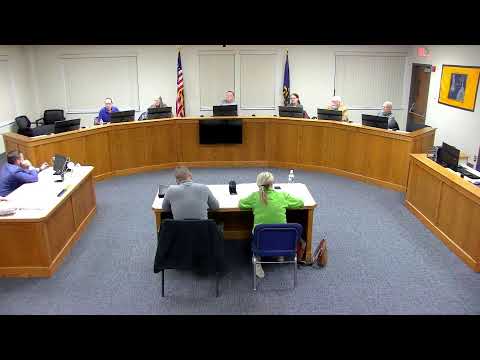
Board discusses Plymouth interlocal agreement, rate study and funding scenarios for wastewater project
Summary
Board members and consultants reviewed engineering progress, a draft interlocal agreement with the city of Plymouth and a financial consultant’s rate study showing monthly bill estimates with and without grant funding; no formal action was taken.
Marshall County board members and their consultants spent the bulk of the meeting discussing progress on an engineering plan, an interlocal agreement with the city of Plymouth and a financial analysis of customer rates under different funding scenarios. No formal vote was taken on the project; staff and consultants are continuing negotiations and funding work.
JPR and engineering staff reported they are preparing plan sheets and producing property-specific sketches to include in packets to property owners. The drafting team is running trial packets and the goal is to send finalized packets to property owners by the end of the month. Board members said an internal review meeting was planned to assess the sketch packets and the overall packet format before broader distribution.
On the interlocal agreement with Plymouth, staff said they would like the agreement “done” before March so it can be used to demonstrate local approvals when applying for State Revolving Fund (SRF) funding. Staff warned that “done” can mean different degrees of completion because interlocal agreements require local approvals, a signature authorization process (the board said the board would need to appoint a signer, likely the board’s chair) and typically a nonresponsive attorney general review under the applicable statute’s 60-day window. Staff said the town council and board of public works in Plymouth would also have to approve the agreement.
Financial consultant Baker Tilly presented a rate restudy that compared three charging alternatives (inside user rates, outside user rates and a wholesale rate) under two funding scenarios: no grant and with grant funding. The study used two sets of assumptions presented in the meeting: - No-grant monthly bill estimates as presented: inside user $226.08 per month; outside user $229.08 per month; proposed wholesale $221.04 per month. - With a proposed grant (study assumptions stated as approximately $15,000,000 to $15,625,000 in different places), monthly estimates dropped to roughly inside user $110.87 per month; outside user $113.87 per month; proposed wholesale $105.83 per month.
The consultant noted several major variables that will affect final rates: the total amount of grant funding obtained, the assumed buy-in fee (listed in the study documents as $17,150 in the nonconstruction costs section) and the bond term used for financing (the study compared 20-year and 35-year bond terms; a 35-year term would reduce monthly customer charges). Baker Tilly also advised that JPR expects the project to be bid in at least two phases to increase contractor competition and to pursue multiple funding cycles, improving the chance of securing grant dollars.
Board members asked whether the county would proceed with the project without grant money; consultants said a no-grant scenario would likely require phasing the project rather than building the entire scope at once. The Alliance of Indiana Rural Water was cited as tracking federal funding availability; consultants said water and wastewater SRF project funds were, at the time of discussion, expected to remain available despite earlier reporting that some funds might be held.
Next steps described in the discussion included: staff attending a follow-up meeting with Plymouth officials (city attorney, mayor, public works/wastewater staff) to clarify rates and draft terms; finalizing property-owner packets and sketches; refining the buy-in assumptions; and pursuing SRF grant opportunities. The group discussed possibly calling a special meeting if necessary to approve an interlocal agreement before the next regular meeting, should timing require it.
No formal motions were made on the interlocal agreement or the rate study during this session.