Get Full Government Meeting Transcripts, Videos, & Alerts Forever!
Get email alerts on the K 12 Education Student Spotlight topic
No spam. Unsubscribe anytime.
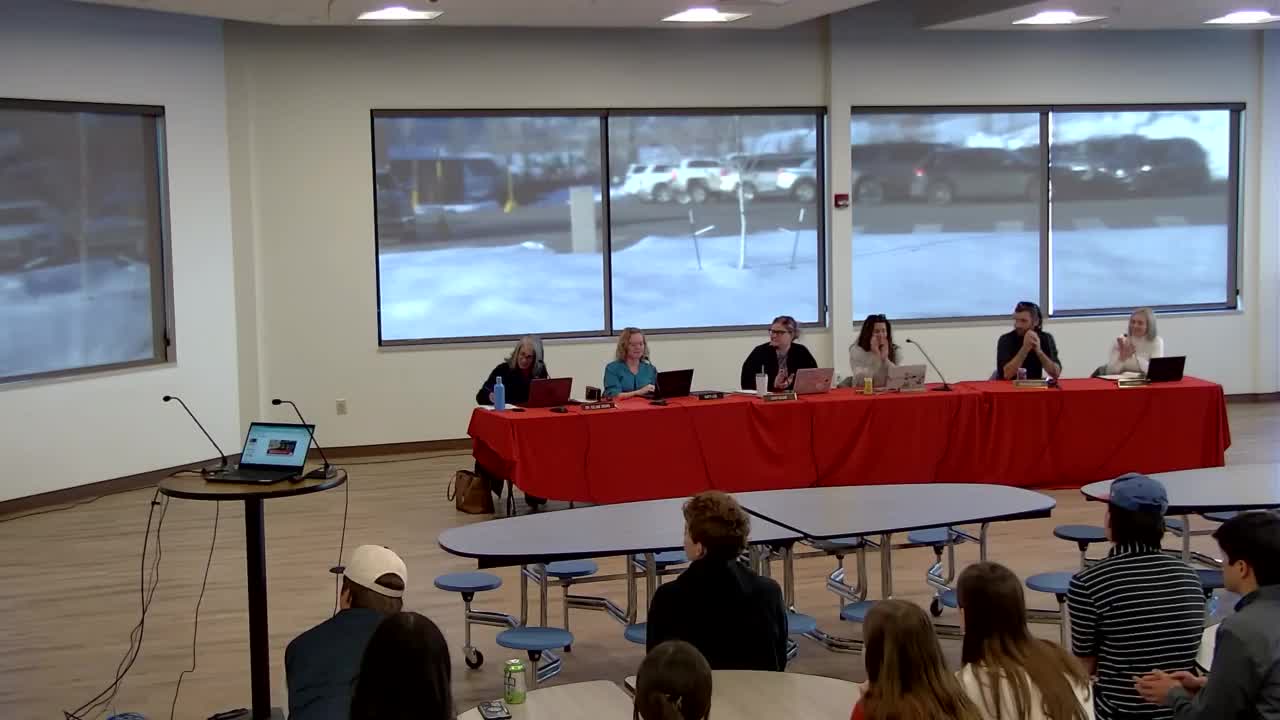
Students describe school-culture changes, cellphone policy and new CTE offerings at Steamboat Springs High School spotlight
Summary
Students and staff told the Steamboat Springs School Board on Feb. 10 that new social-emotional learning practices, a revised cellphone policy and expanded CTE and concurrent-enrollment options are changing student engagement and postsecondary readiness.
Steamboat Springs High School students told the Steamboat Springs School Board on Feb. 10 that recent changes at the high school — including a stricter cellphone policy, restorative accountability projects and expanded career and technical education classes — have increased classroom focus and student engagement.
The presentations took place during the board's "SSHS spotlight," where a group of student leaders and staff members described how the school is implementing SEL (spirit, accountability, inclusion, leadership) principles across classrooms, athletics and extracurriculars.
Student leaders said the cellphone policy, adopted after district discussion and a trip to Summit to observe stricter models, has become ‘‘the new normal.’’ Madeline Erbs, a junior and member of the Sailor Senate, said of the classroom effect: "I think there's a lot more focus in the classroom." She described fewer visible phones and more cross-grade interaction in the commons area after the policy took effect.
Students also described alternatives to suspension called "accountability projects." Jackson Hammond First said students who make choices that require discipline now complete a presentation describing "what they did, what they learned from it, and who was impacted," and deliver it to staff and, when appropriate, parents. He said the approach keeps students in school and emphasizes reflection over exclusion.
Several students highlighted CTE and concurrent-enrollment opportunities. Gabriela Garcia Amanderas, enrolled in engineering CAD and construction technology, said both courses offer industry certifications and hands-on instruction. Jack Fisher, who plans to attend the University of Colorado Boulder, said concurrent enrollment has allowed him to accumulate roughly 28 college credit hours and estimated that saved him about $15,000 in tuition and fees.
Coach Wendy Hall, who was introduced at the meeting as a longtime coach and district graduate, described how athletics programs apply the same SEL principles to build team culture, grow participation (she cited 60 girls trying out for volleyball last year) and create development teams so students who would otherwise be cut can continue to practice and improve.
Superintendent Celine Wicks and high school staff framed the student remarks as part of broader efforts to make school environments more inclusive and purposeful. Wicks thanked students and staff for the presentations and invited further questions from the board.
Board members commended the students and administrators for the culture and program changes. Board member Cresta (last name not specified in the transcript) thanked students for sharing lived experience from the building and offered continued engagement between the board and Sailor Senate.
The spotlight segment concluded after roughly an hour of student and staff remarks. Several board members noted concurrent-enrollment and CTE growth as district priorities to monitor going forward.