Get Full Government Meeting Transcripts, Videos, & Alerts Forever!
Get email alerts on the Payments In Lieu Of Taxes topic
No spam. Unsubscribe anytime.
Springfield committee hears Collins Center on PILOTs, aims to draft permanent policy and seek state grant
Summary
The Springfield Pilot Revenue Committee on Feb. 10 heard a presentation from the Collins Center on structuring payments-in-lieu-of-taxes (PILOT) agreements and discussed creating a permanent pilot policy, a standing committee, and a grant-funded contract to develop a scope of work.
The Springfield Pilot Revenue Committee on Feb. 10 heard a presentation from the Collins Center on structuring payments-in-lieu-of-taxes (PILOT) agreements and discussed creating a permanent pilot policy, a standing committee, and a grant-funded contract to develop a scope of work.
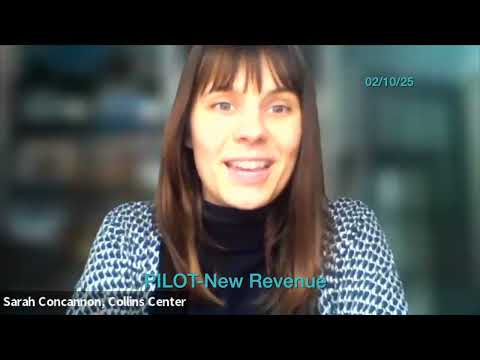
The Collins Center’s Sarah Conkannon, a presenter for the center, told the committee, “we're here to talk about the call center and talk about the work that the finance team does and the work that we are, have been doing and and can do vis a vis pilot, programs.” Steve Cirillo, a Collins Center staff member with prior municipal finance experience, summarized his practice negotiating PILOTs and recommended written contracts, a value‑based methodology and mechanisms to phase in payments over time.
Why it matters: Committee members said Springfield is seeking new recurring revenue sources to ease budget pressure. The Collins Center advised that one-time lump-sum payments do not solve long-term budget gaps and recommended structuring PILOTs so revenue grows with property values and inflation. Committee members discussed applying for the state Division of Local Services Community Compact Best Practices grant to pay for consulting and a formal scope of work.
Collins Center background and recommendations
Conkannon told the committee the Collins Center was created by the state legislature in 2008 to provide technical assistance to cities and towns across Massachusetts. Cirillo described negotiating more than two dozen PILOT agreements during his municipal career and said a written agreement places the arrangement in contract law and provides greater collection options than informal understandings. “A pilot is a voluntary agreement,” Cirillo said, adding that a written contract makes the municipality’s expectations clear.
Cirillo recommended basing PILOT targets on service‑use and property value rather than an arbitrary dollar amount. He described a formula used in Boston and Brookline that targets about 25% of what a tax‑exempt parcel would have paid if taxable, noting that basing payments on value lets the payment amount grow over time with property values and inflation. He also described an approach some cities use that charges smaller parcels a lower percentage (Cirillo cited 15% as an example) while larger institutions pay the higher target.
The presenters emphasized three recurring points: - Use a written contract rather than informal “handshake” agreements. - Base payments on a clear methodology tied to value and service usage so revenue can be forecastable and grow with inflation. - Treat tax‑exempt parcels under a single neutral policy so the city negotiates from a consistent framework.
Negotiation tactics and equity
Cirillo and Conkannon told the committee that municipalities often bring large institutions to the table by prioritizing targets and offering phased increases—starting at a low percentage and stepping up annually toward the target rate—to make negotiations less disruptive for nonprofit partners. Cirillo said some Brookline agreements started at 1% and phased up to 25%, and that phasing can be an effective way to secure initial written commitments. Conkannon added that cities should prioritize a few parcels where momentum and leverage are likely to produce early successes.
Examples, concerns and legal context
Speakers referenced several jurisdictional examples: Cirillo cited Boston and Brookline formulas, Cambridge’s large‑dollar lump‑sum approach, and an Amherst College agreement reported as $2.5 million over three years. Cirillo cautioned that those large one‑time payments can be helpful in the short term but do not provide the consistent revenue stream municipalities need.
Committee members raised special categories: charter schools, religious institutions (including the Diocese of Boston), major hospitals and higher‑education institutions, and housing entities that receive federal funding. Richard Allen, former treasurer, said Springfield has had pilot agreements in the past with the Mental Health Association and noted that some legacy agreements remain in force. The City Solicitor (name not specified) and others noted that some agreements can be complicated by federal funding rules (HUD) or by statutory exemptions for certain public housing authorities (cited as Chapter 121B in discussion).
On in‑kind community benefits versus cash, Cirillo warned that in‑kind services can be difficult to quantify and may not address structural budget deficits. “The purpose for a pilot program is to generate revenue, ongoing and consistent revenue for the community for now and into the future,” he said.
Grant timeline, next steps and committee direction
The Collins Center told the committee the Division of Local Services Community Compact Best Practices grant historically opens after the state budget is final and is competitive on a first‑come, first‑served basis; the presenters suggested preparing a scope of work before the grant opens. Conkannon said the Collins Center can help municipalities prepare a scope and noted the grant cycle typically covers two years.
Committee members proposed a July 1 internal deadline to finalize partners and budgets and said they intend to seek roughly $50,000 for consulting and related expenses so the mayor’s office can submit the grant application quickly when it opens. Jay (staff member identified in the meeting) was named as the initial contact to coordinate Collins Center work and city submissions.
Formal action and outstanding issues
No formal motions or votes were recorded during the meeting. Committee members agreed to continue the work: draft a permanent pilot policy, form a standing pilot committee, prepare a grant scope of work (target date discussed), and explore contracting the Collins Center and other specialists for technical, assessing, and legal work. Speakers repeatedly emphasized that PILOT agreements are voluntary and that municipal leverage—timing, permitting, or legislative support—often affects negotiation outcomes.
The meeting closed with the committee planning further drafting work and follow‑up meetings with Collins Center staff to prepare the grant application and draft policy language.