Get Full Government Meeting Transcripts, Videos, & Alerts Forever!
Get email alerts on the Water Systems topic
No spam. Unsubscribe anytime.
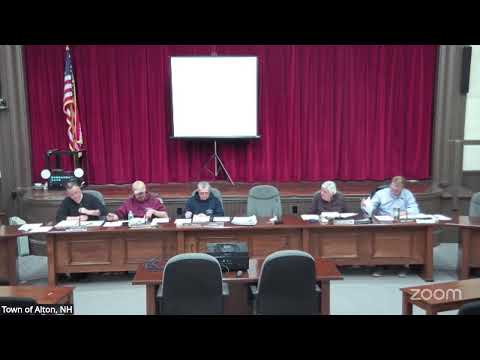
Consultants outline multimillion-dollar needs for Alton water system; selectmen accept $30,000 DES grant for tank study
Summary
Consultants from Ty and Bond told the Alton Selectmen on Feb. 11 that the town’s drinking-water system faces a mix of deferred maintenance and assets that need targeted replacement, and that addressing the work will require prioritization, additional funding and continued meter installation.
Consultants from Ty and Bond told the Alton Selectmen on Feb. 11 that the town’s drinking-water system faces a mix of deferred maintenance and assets that need targeted replacement, and that addressing the work will require prioritization, additional funding and continued meter installation.
Ty and Bond’s project manager, Dan Roop, said the firm completed an inventory and condition assessment of Alton’s distribution and vertical assets and used a risk-based method to prioritize projects. “The town received an $88,000 grant for Ty and Bond to complete this work, working with Courtney and her department,” Roop said.
Roop and the team emphasized the Bay Hill storage tank as a top concern after reviewing in-tank inspection videos that show floor cracks, wall cracks and interior corrosion. Product engineer Jess de Jesus described the inspection findings and the firm’s approach to ranking assets by probability and consequence of failure. The consultants recommended an alternatives analysis to decide whether to repair or replace Bay Hill and asked the town to evaluate fire flow, capacity and redundancy across the system.
Rate specialist Joshua Bouchard presented a funding model that contrasted a conservative, short-term funding approach with an extended-planning alternative. “We’re looking at a rate increase this year of 75%,” Bouchard said, calling that a “big scary number” in the worst-case, five-year funding scenario that assumed no grant funding. Under that same scenario the consultants estimated roughly $13.7 million in projects (escalated for inflation in the model) and said delaying projects to a 10-year plan increased the total to about $20 million because of inflation and added risk of asset failure.
To lessen the burden on lower-income households, Bouchard’s alternative staggers projects and spreads costs over a longer period; he also recommended finishing the meter-installation program so billing better matches usage. Town staff reported 532 metered connections and 232 unmetered, and that about 250 meters had been installed in-house so far.
Hannah Milne, a Ty and Bond staff engineer, described a separate New Hampshire Department of Environmental Services (DES) water-system sustainability grant that the town recently won. “We were awarded the maximum grant amount of $30,000,” Milne said, and explained the planned scope: a tank storage-capacity analysis, a tank life-cycle analysis (repair versus replacement), and a hydraulic-deficiency analysis to check fire flow, dead ends and water quality. Milne said the grant requires a $15,000 town match (cash or in-kind) and has a projected completion date of late 2026.
After discussion, a selectman moved and another seconded a motion to accept the DES $30,000 sustainability grant and authorize the town administrator to sign the paperwork. The motion passed on a voice vote.
The consultants and town staff recommended next steps: use the DES grant to complete the Bay Hill alternatives analysis, pursue additional funding sources (including reapplying for SRF loan assistance), complete the meter program to improve equity in billing, and perform a follow-up rate evaluation after meters are installed.
The presentation produced multiple technical recommendations: prioritized main replacements on Main Street, Bay Hill Road and Levy Park; chemical-feed upgrades and standing day tanks at Jonesfield and Lehi Park wells; electrical upgrades at both wells; and immediate attention to the Bay Hill tank. The consultants stressed that their initial financial model assumed projects over $100,000 would be debt-funded on a 20-year term at 5% interest, while smaller projects would be funded from rates or enterprise capital.
Selectmen and staff repeatedly cautioned that the modeling showed a range of outcomes depending on grant success and sequencing: a five-year, no-grant scenario produced very large near-term rate increases; spreading projects to 10 years reduced annual increases but raised total project cost and failure risk. Town staff and the consultants said they would use the grant-funded analysis to refine cost estimates and update the SRF application to seek lower-cost financing if possible.
The board voted to accept the $30,000 New Hampshire DES Water System Sustainability Grant and authorized the town administrator to sign the grant paperwork. The award will fund the alternatives and hydraulic analyses that will guide decisions about Bay Hill and distribution-system investments.
Next steps listed by staff and the consultants include completing the alternatives analyses under the DES grant, continuing the meter-installation program, pursuing additional grants/SRF funding, and returning to selectmen with refined project schedules and a follow-up rate study.