Get Full Government Meeting Transcripts, Videos, & Alerts Forever!
Get email alerts on the Comprehensive Plan Placemaking topic
No spam. Unsubscribe anytime.
Spokane County launches placemaking, resiliency charrettes as part of 2026 comprehensive plan update
Summary
Spokane County planning staff outlined a months‑long outreach and policy process to reshape development rules, hold three February charrettes for priority areas and fold outcomes into the 2026 comprehensive plan and development regulations.
Spokane County planning staff told the Planning Commission on Jan. • that it will use a series of public charrettes and an updated policy “pattern language” to guide a 2026 rewrite of the county comprehensive plan and associated development regulations.
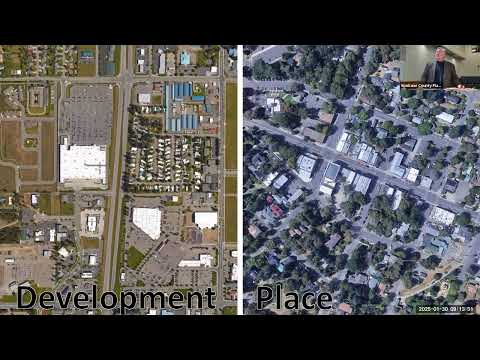
The planning presentation, led by Scott Chesky of county planning staff, said the effort aims to “build neighborhoods rather than just plat subdivisions” by integrating land use, transportation, infrastructure and public space in three priority areas: the West Plains, the North Mead corridor and the East Valley. Chesky described the charrettes as hands‑on workshops that will inform policy options and later regulatory changes.
Chesky said the county will run three public workshops in February, take public feedback into March and return in April with refined alternatives. The county’s goal is to convert that feedback into a “pattern language” of policies and then draft development regulations in 2026. “When we’re rewriting our regs that have really not been touched in 20 years, 25 years, we want to use that to promote growth, promote quality development in our neighborhoods,” Chesky said.
Why it matters: the county is attempting a comprehensive reorientation of how it plans growth, beyond revising maps. Commissioners and members of the public framed the work as addressing affordability, infrastructure costs and environmental risk — not simply zoning text changes. Planners said the process is intended to guide investment so projects become financially feasible while protecting agricultural and resource lands.
Key takeaways from the presentation
- Schedule and outreach: County staff and a consultant team will hold three charrettes in February for the West Plains, North Mead and East Valley priority areas, follow with synthesis sessions March 11–12, and present refined alternatives in April. The county plans to fold the preferred pattern language into the 2026 comprehensive plan and development regulations.
- Scope and examples: Staff showed examples ranging from higher‑density multifamily to integrated live/work campuses. Chesky said the strategy includes mixing uses, adding nonmotorized connections and using amenities (for example, stormwater features) to deliver multiple public benefits.
- Affordability and master plans: Commissioners and attendees discussed master‑planned communities as one tool to reduce entry‑level costs. A commissioner noted that some master‑planned developments elsewhere have achieved lower entry prices by allocating higher net densities (15–20 units per acre). Chesky said the county’s ongoing UGA (urban growth area) capacity work and next year’s regulations will examine whether similar models can be implemented locally without making projects financially unviable.
- Environmental and safety concerns: Commissioners asked how the county will address wildfire risk and PFAS contamination in areas such as the West Plains. Chesky said those topics are part of the resiliency work: “PFAS, like the pandemic, is something nobody even thought of 10 years ago… The scope of that is certainly beyond the planning department’s portfolio, but recognizing what’s there and trying to bring solutions to bear is very much part of our recommendation,” he said. He added that if soils and hydrology prove certain parcels unsuitable for development, the county would consider exclusion or long‑term remediation strategies.
- Regulatory implementation and permitting timing: Multiple commissioners and builders emphasized that regulations must reduce carrying costs and permit delays. One commissioner noted that faster, clearer permitting can lower the up‑front carrying cost that developers face between entitlement and occupancy. Chesky said a primary objective of the rewrite is to make the development review process more predictable for investors, architects and builders.
Context and next steps
Chesky and staff said the county’s policy audit and EIS scoping for the comprehensive plan update will proceed in the coming weeks and months, coordinated with the city. The planning staff expects to present a land capacity report to the steering committee in March and shared that the county is aiming to have the draft policy alternatives established through 2025, and development regulations written in 2026.
Ending
County staff invited commissioners and the public to attend the February workshops in person or virtually; staff said attendees will work at tables with maps and provide feedback that the consulting team will synthesize into an interim report and subsequent policy alternatives.