Get Full Government Meeting Transcripts, Videos, & Alerts Forever!
Get email alerts on the Student Spotlight topic
No spam. Unsubscribe anytime.
Steamboat Springs High students describe culture, phone-policy effects and expanded CTE at school board meeting
Summary
Students from Steamboat Springs High School told the school board that a new cell-phone policy, restorative accountability projects, and expanded career and technical education have improved classroom focus and student engagement. Multiple students described leadership work and concurrent-enrollment benefits to the board.
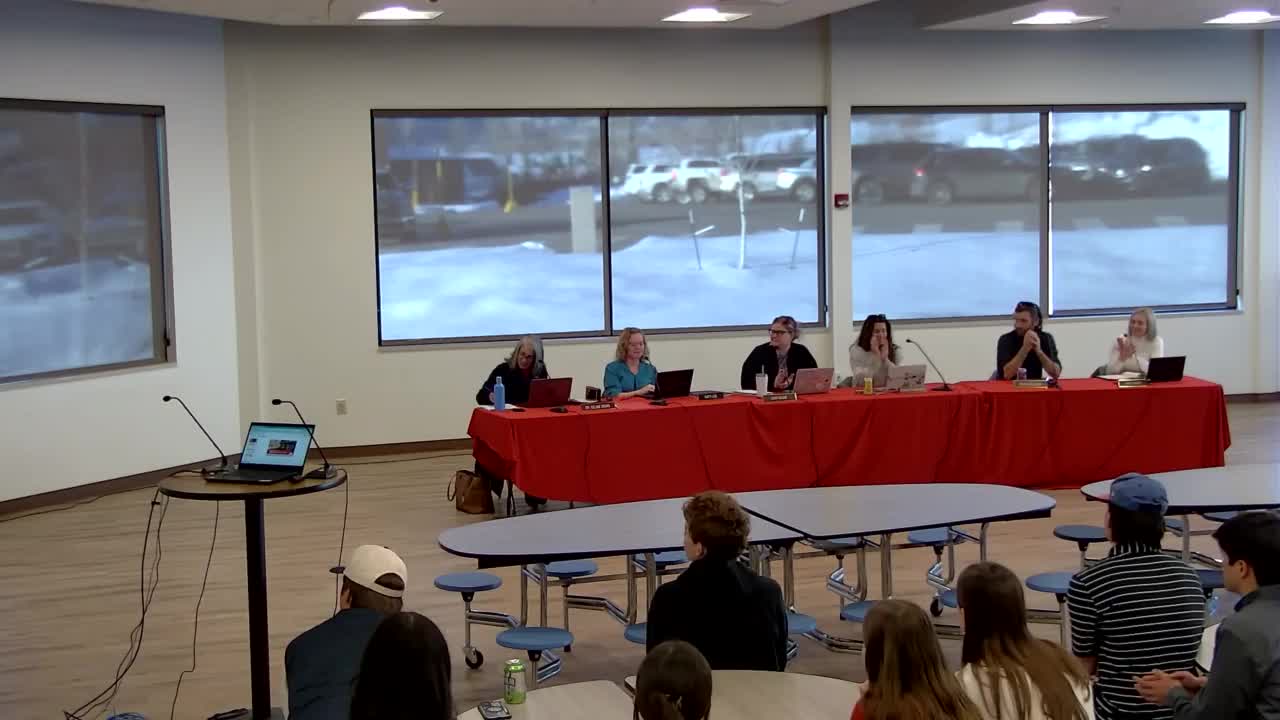
Steamboat Springs High School students told the Steamboat Springs School Board on Feb. 10 that recent schoolwide changes — including a stricter cell-phone policy, restorative accountability projects and growth in career and technical education (CTE) — have strengthened school culture and classroom focus.
At a student spotlight presentation, senior class president Ricky Hernandez said the high school “truly just feels like we're one big family” and credited teachers, counselors and student leaders with building support systems. Principal Jay Hamrick introduced a group of students who described projects and programs they helped lead.
Student leaders described the phone policy as a particular turnaround. Madeline Erbs, who worked on the policy through the Sailor Senate, said the change was a “compromise we came to” with other schools and that the result is fewer visible phones in class and more student interaction in common spaces: “I've seen maybe one Yonder bag in the month in my classes, and I really haven't heard any complaints about it anymore.”
Students also described alternatives to traditional suspension. Jackson explained the school’s use of “accountability projects” — classroom-based presentations in which students describe what happened, what they learned and who was affected — and said the projects keep students connected to learning while making them reflect on choices.
Several students highlighted CTE and concurrent-enrollment opportunities. Gabriela Garcia Amanderas described taking Engineering CAD and Construction Technology, noting students can earn industry certifications: “Overall, the classes are hands on. They really show you how to try different strategies.” Jack Fisher said concurrent enrollment has saved him money and eased his transition to college: “Over the last three years ... I've racked up 28 hours. So about my whole freshman year. So that's really exciting. And then with that, 28 credit hours, I've saved myself a little bit over $15,000 in tuition.”
Coach and former teacher Wendy Hall, who was introduced during the spotlight, described how athletics programs have used explicit norms, team “contracts” and development teams to expand participation and build leadership across grade levels. Hall said the program once added a development team so that 60 students who tried out could continue to participate and practice.
Board members praised the students and administrators and asked follow-up questions. Cresta (board member) offered to meet with senior class leaders, and other trustees and the superintendent, Dr. Celine Wicks, thanked students and staff for the presentation.
The students’ remarks were presented as part of the meeting’s Reports and Communications section and were followed by the district’s strategic-plan focus area updates.