Get Full Government Meeting Transcripts, Videos, & Alerts Forever!
Get email alerts on the Comprehensive Plan Update topic
No spam. Unsubscribe anytime.
Port Richey planning board reviews comprehensive-plan amendments on water, coastal resilience and wetlands
Summary
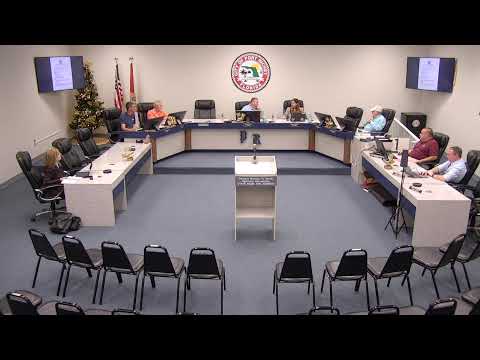
Port Richey’s Planning & Zoning Board spent its Feb. 11 workshop reviewing proposed updates to the city’s comprehensive plan prompted by the 2023 evaluation and appraisal report, discussing new coastal-resiliency policies, a reduction in the potable-water level-of-service standard, requirements for biological surveys on larger parcels, and language to promote living shorelines and dredging of local waterways.
Port Richey’s Planning & Zoning Board spent its Feb. 11 workshop reviewing proposed updates to the city’s comprehensive plan prompted by the 2023 evaluation and appraisal report, discussing new coastal-resiliency policies, a reduction in the potable-water level-of-service standard, requirements for biological surveys on larger parcels, and language to promote living shorelines and dredging of local waterways.
Tammy Brown, the city’s on-call planner with Brown Consulting of Safety Harbor, opened the workshop by grounding the board in state law: “In the state of Florida, we have a Community Planning Act, which is in Chapter 163, Part II of the Florida Statutes,” she said, and summarized the purpose of a comprehensive plan as a long-range vision tool implemented through regulations, budgets and project decisions.
The board’s discussion focused on several substantive proposed changes. Brown highlighted a technical change to the potable-water level-of-service standard — lowering the per-capita planning figure from 105 gallons per day to 96 gallons per day — and said the change reflects the city manager’s new water-supply facilities work plan and regional water-supply planning by the Southwest Florida Water Management District. She also noted that a previous statutory requirement that comprehensive plans be “financially feasible” has been removed from state law and no longer appears in the draft plan.
Coastal and conservation elements drew extended attention. Brown said the draft adds coastal‑resiliency goals informed by the city’s vulnerability assessment and adaptation plan, and includes “peril of flood” policies intended to keep development and public investments out of areas exposed to sea-level rise and storm surge. Board members pressed staff for clearer definitions and implementation steps: several asked whether words such as “promote,” “support” and “encourage” in policy text create different levels of commitment, and Brown replied these terms are largely aspirational but can be used to support grant applications or future code changes.
Wetlands and biological protection provisions were debated. The draft would treat wetlands containing threatened or endangered species as Category 1 and would require a qualified biological survey for parcels larger than 5 acres. Brown and board members discussed enforcement and the practical implication that finding a small occurrence of a protected species could restrict filling or redevelopment in that area; Brown said she would research state and regional permitting implications and report back.
The board also reviewed a legacy policy calling for continued dredging of Miller’s Bayou and the city’s canals “to restore a minimum depth of 4 feet below mean sea level.” Members said securing federal, state and county funding will be necessary to keep the dredging program on schedule. Related marine- and shoreline-management language in the draft encourages marine-patrol enforcement of boat traffic to reduce shoreline erosion and protect wildlife.
On water conservation and new-development standards, Brown pointed to an objective to develop and enforce water-efficient landscaping standards and cited the Florida Water Star program as an example that developers can use to reduce irrigation demand. Board members raised questions about how these standards would apply to redevelopment and to flood-damaged properties rebuilt under current building-code thresholds.
The workshop returned repeatedly to adaptation and infrastructure strategy. Board members and Brown discussed options including elevating buildings, adjusting road crowns, identifying locations for stormwater retention, and using public-acquisition programs to convert chronically flooded properties to nondevelopable open space. Brown said such measures are intended to inform grant applications and capital‑improvement planning rather than impose immediate new mandates on property owners.
Other draft elements reviewed included encouragement of green infrastructure (green roofs, green walls), integrated pest‑management cautions for green-wall implementation, and a proposal that new or redeveloped overnight accommodation facilities submit a city-approved hurricane‑evacuation plan. Board members asked staff to clarify whether short‑term rentals would be captured by any new requirements and to check state preemption rules for short‑term‑rental regulation.
Procedural items: the board accepted the minutes from the Sept. 17 meeting (motion passed; members present at roll call: Chairman Sean Gould, Randy Stout, Michael Perez and Ronald McDonald; Member Laurie Simpson was recorded absent). The board agreed to schedule the next public‑hearing workshop on the comprehensive-plan amendments for March 11 at 1 p.m.
The board directed staff to refine language and return with clarifications on: how the plan’s policy words (promote/support/encourage) should be used, the practical implications of treating wetlands with listed species as Category 1, the mechanics and thresholds for biological surveys, and more precise code or capital-improvement language to support coastal resiliency and future road and drainage projects. Brown said she would gather follow-up details and bring revised language to a subsequent workshop.
The workshop closed after additional questions on floodplain standards, temporary post-disaster permitting approaches, and resilience measures; the board voted to adjourn.