Get Full Government Meeting Transcripts, Videos, & Alerts Forever!
Get email alerts on the Capital Improvement Plan topic
No spam. Unsubscribe anytime.
Fall River council adopts five-year capital plan after debate over ARPA limits, fire apparatus funding
Summary
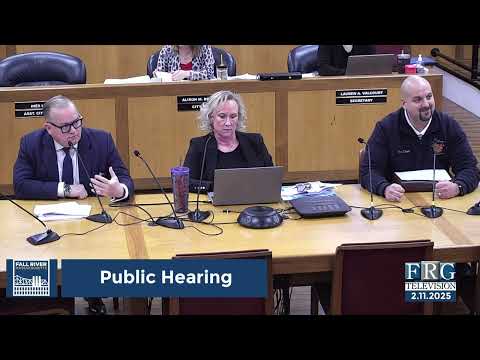
Fall River City Council on Feb. 11 adopted a five‑year Capital Improvement Plan after a public hearing and extended discussion about ARPA limits, the timing of fire‑engine replacements and how EMS enterprise revenue is used.
Fall River City Council on Feb. 11 adopted a five‑year Capital Improvement Plan after a public hearing and extended discussion about how federal American Rescue Plan Act restrictions, ARPA spending deadlines and existing funding choices shaped project timing and priorities.
The hearing and subsequent Committee on Finance review featured extended exchanges among city officials, school leaders, public safety chiefs and councilors on whether prior ARPA allocations should have paid for fire apparatus and on how EMS enterprise revenues should contribute to facilities and apparatus needs.
Bridget Allman, director of financial services, and Seth Aiken, city administrator, opened the public hearing and framed the CIP as a five‑year forecast that balances limited resources, multiple funding sources and project timing. Aiken said the capital budget is “derived from the capital improvement plan” and noted projects often span multiple years.
The central dispute at the hearing concerned ARPA rules and engine procurement. City Administrator Seth Aiken told the council that “one of the limitations on ARPA funding precluded us from buying fire engines,” and that the city had instead used other sources when ARPA funds could not be applied.
Fall River’s fire chief (identified in the hearing) told councilors the useful frontline life of a fire engine is roughly two decades and said the department plans to space replacements to avoid a single large purchase cycle: “Traditionally, we've gotten about 20 to 25 years out of a fire engine frontline,” the chief said. The chief and other public safety leaders explained long manufacturer lead times and a national backlog make immediate bulk purchases impractical.
Councilors pressed the administration on choices made during the ARPA spending process: one councilor said the city used ARPA on discretionary items and left what he characterized as more urgent capital needs — including multiple engine replacements and large window projects at the Globe fire station — to later funding. Financial staff and the chief described both categorical limits in ARPA guidance and practical problems meeting ARPA deadlines if engines had been ordered.
EMS funding, leasing and enterprise accounting drew sustained scrutiny. Aiken and Allman explained EMS capital purchases are funded through the EMS enterprise account rather than the general fund; the administration said EMS has used lease‑purchase agreements to replace ambulances and other specialized vehicles and that those leases can reduce near‑term cash strain. Aiken noted EMS enterprise funds pay indirect charges back to the general fund.
Councilors raised fairness questions about EMS units occupying firehouses while the city shoulders fire station maintenance and apparatus procurement. The fire chief and Aiken said EMS contributes to some facility costs — for example, center‑station upgrades are being paid in part from EMS enterprise funds because EMS occupies much of that space — but that historic arrangements mean the allocation of facility costs is complex and requires review.
At the hearing a councilor asked the administration and the fire chief to study a new revenue approach: charging fees tied to commercial or large‑scale real‑estate transactions and dedicating receipts to a reserve for fire apparatus. The councilor framed the proposal as a way to reduce repeated reliance on one‑time sources such as free cash and bonding: “The primary focus is to have a reserve account set aside for fire department apparatus,” the councilor said. The administration agreed to examine practices in other cities and report back.
School department officials, represented at the hearing by Ken Pacheco, discussed priorities inside the district’s project list. Pacheco described an ongoing envelope rehabilitation at the Durfee/Globe complex and said the district staggers intrusive work such as asbestos abatement and fire‑suppression installation to avoid displacing students: “There are some work I can't do like, to inconvenience the building, like, one right after another,” Pacheco said, adding that the district hopes MSBA and state programs will cover a substantial share of large renovations.
Councilors also asked about other CIP items and inactive capital lines, including $204,000 labeled for streets and highways, a proposed $20 million Eastern Avenue reconstruction item, and a line item for park equipment and multiple Huskler mower replacements. Financial staff said planners are working to reassign or ready inactive funds and that some work — design, bidding and seasonal constraints — delays execution until warmer months.
Public‑safety planning for anticipated waterfront development was another concern. The fire chief said the department has contracted a private consultant to analyze five years of call data and model scenarios for station placement and apparatus needs related to planned waterfront and MBTA‑area development; the chief said results would be available in several months.
Councilors and staff repeatedly emphasized constraints on timing and funding: ARPA deadlines for obligation and expenditure, the need to encumber funds before federal deadlines, MSBA timing for school grants, and the seasonal or intrusive nature of some building work that must be phased to avoid displacing students.
Votes at a glance
- Capital Improvement Plan (five‑year CIP): adopted by City Council. The council approved the CIP after the public hearing and committee review.
- Item 17 — John DeCosta, 209 Adams Street, removal of curbing (curb opening extended from 20 ft to 28 ft): order granting permission adopted.
- Item 18 — ICC Investments LLC, 146 Eighteenth Street, removal of curbing (new opening on Eighteenth Street combined 39 ft 6 in): order granting permission adopted.
- Item 19 — Aileen Coutinho Souza (doing business as CNA Auto Body), license to operate auto body shop at 83 Mulberry St.: license approved.
- Items 15 & 16 — City citations recognizing Bristol Community College Student Veterans of America chapter (national finalist): adopted together.
- Appointments and confirmations — Ben Feidelberg (Redevelopment Authority) and Joseph Perera (Zoning Board of Appeals) confirmed.
- Property dispositions — 112 Flint St. (former Duval School) and 138 Hartwell St. (former Sylvia School) declared surplus and referred to the Committee on Real Estate.
- Donation — Acceptance of up to $25,000 annually from Deborah and Richard Danner to Fall River Public Library: adopted.
- Zoning amendment for A2 Apartment District (per planning board recommendation): approved.
- Community Preservation Act appropriation ($1,816,444): referred to finance committee.
- Ordinance creating library positions (museum security officer; processing archivist): advanced per committee action.
- Conveyance and lease amendment between Fall River Redevelopment Authority and School Department: adopted.
- Revocation of secondhand article store license for Joey A. Pacheco (255 South Main): adopted.
- Traffic commission code amendments: advanced to local legislation committee.
- Several resolutions and committee actions were granted leave to withdraw as reflected in committee reports; committee minutes and other routine items were accepted or placed on file.
What the hearing changed and next steps
The council adopted the CIP but asked the administration for two short studies and follow‑ups: (1) a benchmarking study of how peer communities charge and direct fees for commercial or large real‑estate transactions toward public‑safety capital and (2) an apparatus‑placement and workload analysis from the private consultant contracted by the fire department. The administration committed to report back in coming weeks and to provide more detailed cost breakdowns for major line items raised in the hearing.
Councilors repeatedly stressed that the CIP reflects both broad community needs and tight choices: projects span multiple funding sources — ARPA, MSBA, CPA, Chapter 90, enterprise funds and bonds — and staff warned that federal deadlines and grant timing can force phasing decisions independent of stated local priorities.
The council closed the hearing and moved on to routine business; multiple non‑CIP votes and referrals were taken before adjournment.
Ending note
City officials and councilors described the CIP adoption as a working plan rather than a finished agenda: several council members asked for follow‑up detail on large or contentious items and encouraged staff to find matching grants and creative revenue mechanisms to reduce future one‑time funding cycles.