Get Full Government Meeting Transcripts, Videos, & Alerts Forever!
Get email alerts on the State Budget topic
No spam. Unsubscribe anytime.
Oregon Department of Energy budget centers on incentives, CREP expansion and federal grants; fee bill would ratify program fees
Summary
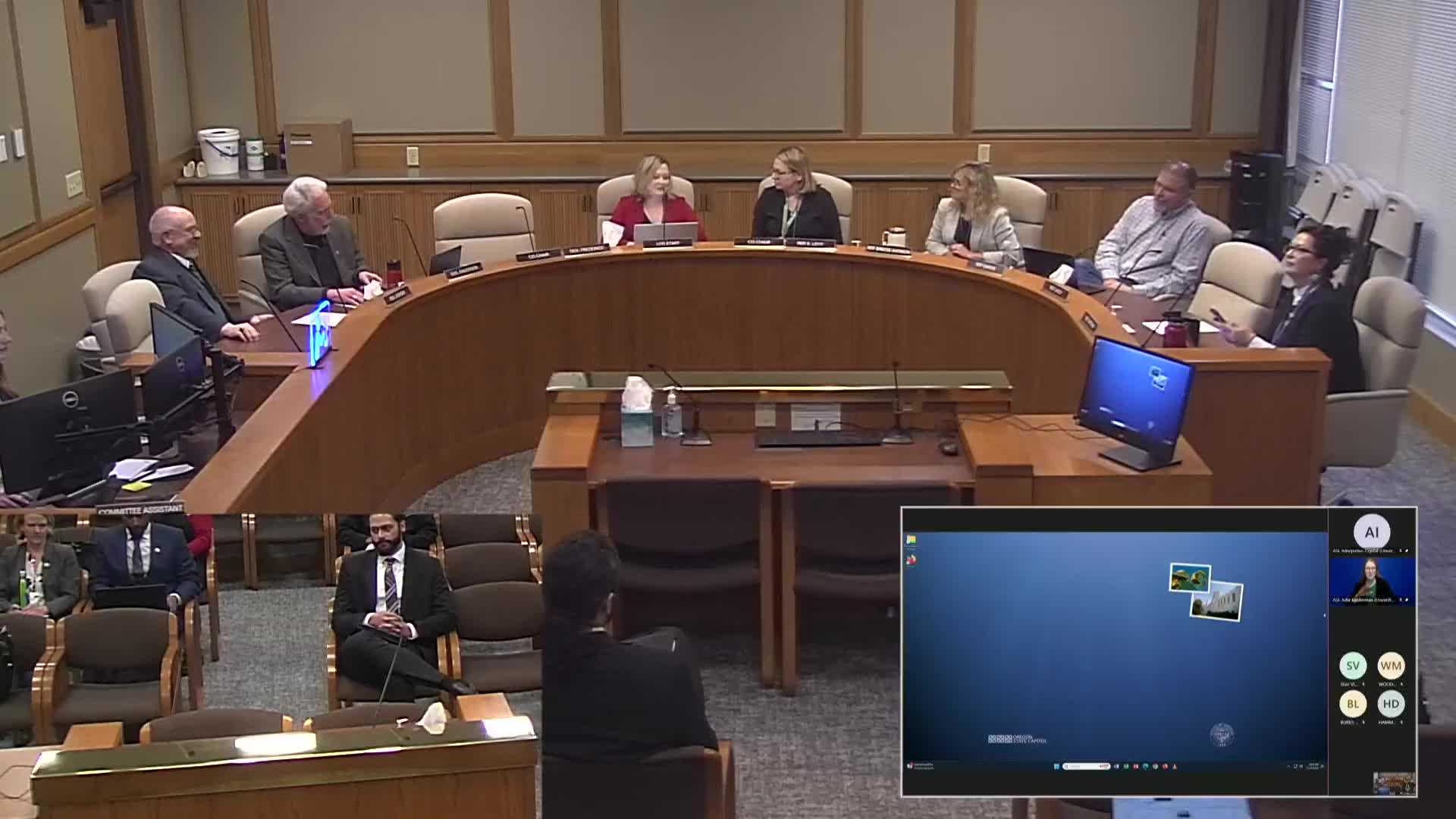
The Oregon Department of Energy presented the governor’s recommended budget and related fee changes Monday during an informational hearing on SB 5518 and SB 5519 before the Senate Ways and Means Subcommittee on Natural Resources.
The Oregon Department of Energy presented the governor’s recommended budget and related fee changes Monday during an informational hearing on SB 5518 and SB 5519 before the Senate Ways and Means Subcommittee on Natural Resources.
The governor’s recommended budget for the 2025–27 biennium would put ODOE’s total funds budget at about $200,000,000, including about $25,000,000 newly deposited into the Community Renewable Energy Grant program, agency representatives told the subcommittee. "Under the governor's recommended budget for the 25, 27 biennium, Odo's overall budget is about $200,000,000," Michael Williams, speaking for the Oregon Department of Energy, said during the presentation.
Why it matters: the budget and companion fee bill fund incentive programs that provide rebates and construction grants to communities, utilities and other entities and sustain staffing to administer those programs. Agency leaders said many state-funded incentive programs were originally supported by one-time general fund deposits; federal grants (from IIJA and the Inflation Reduction Act) are now a growing share of ODOE’s portfolio but availability is fluid.
Budget highlights and incentives
Seone Philip Muyalla of the Chief Financial Office summarized the funding picture, saying the agency’s roughly $200 million budget reflects significant one-time general fund deposits that are recorded as other funds within the agency budget. She noted "a new investment of $25,000,000 into community renewable energy grants." Janine Benner, director of the Oregon Department of Energy, and other staff described continued funding to carry forward previously appropriated one-time grants, additional staffing for grant administration and support for federal grant matches.
The department identified the Energy Development Services (EDS) Division as the main vehicle for incentive programs; EDS accounts for a large portion of ODOE’s budget and would receive roughly $140,000,000 under the governor’s proposal to make federal and state incentives available and to repay debt service. ODOE told the committee it expects the EDS division to be staffed by 17 FTE in the coming biennium.
CREP and federal grants
The governor’s budget includes an additional $25,000,000 for the Community Renewable Energy Grant program (CREP). Agency staff said CREP provides planning grants (up to $100,000) and construction grants (up to $1,000,000) to tribes, consumer-owned utilities and public bodies outside Portland, and that interest in CREP has consistently exceeded available funding: across three rounds the department received 95 eligible applications and awarded 94 projects in 28 counties. A construction project in Ontario and rooftop-plus-storage work at the Gloria Center in Dallas were cited as completed examples supported by CREP.
Agency staff also described several federal awards that will supplement state programs, but stressed the federal picture is uncertain. Michael Williams and Director Benner said ODOE has been awarded, among other federal funds, funds for home energy rebates and grid resilience: the department cited $113,000,000 for two home energy rebate programs, a $197,000,000 climate pollution reduction grant that will fund efficiency incentives, and an $86,600,000 Solar for All award administered with partners. For a grid-resilience competitive grant, ODOE expects to provide about $18,900,000 to 13 utilities in 17 counties and is finalizing performance agreements with U.S. DOE and subrecipients.
Federal funding uncertainty
Officials repeatedly cautioned that federally funded programs are subject to changing federal guidance and administration. "If the federal funding goes away, we will not be able to run those programs," Benner said in response to committee questions about dependence on federal dollars. Committee members and staff said they are tracking federal obligations and reimbursements closely.
Loans, debt service and program transitions
The department described the inactive Small-Scale Energy Loan Program (SELP) as still significant to the budget because of outstanding loans and debt service. In response to follow-up questions, agency staff provided updated figures: ODOE said there are currently 48 active loans in SELP and reported an outstanding portfolio figure of about $63,300,000; the department expects about 37 open loans and roughly $42,400,000 outstanding by the end of the 2025–27 biennium.
Fees and SB 5519
SB 5519, the companion fee bill, would ratify fee changes and align program revenues and expenses. Agency staff explained that program fees and the Energy Supplier Assessment (ESA) remain important revenue sources for operations. ODOE estimates the ESA under the governor’s proposal would be about $18,600,000 (roughly an 18 percent increase over the current biennium), driven in part by inflation and personal service cost increases at current service levels. ODOE said the ESA is assessed annually to fuel providers and utilities based on gross operating revenues; by statute the assessment cannot exceed 0.375% of net gross operating revenues.
On self-directed project fees, ODOE noted it recently increased the fee for self-directed large consumer projects from 2% to 4% and that SB 5519 would ratify that adjustment. Agency staff told the committee the self-directed fee increase is expected to raise additional revenue for program administration and that the fee change is reflected in the fee bill.
Energy security, siting and other divisions
The department also reviewed other divisions and responsibilities. The Nuclear Safety and Energy Security Division staffs Oregon’s representation on the Hanford Cleanup Board and leads emergency planning for nuclear and fuel incidents; Max Woods, assistant director for nuclear safety and energy security, said the agency serves as the state’s emergency support function for fuel (ESF-12) and focuses on jet fuel, gasoline, diesel and propane for emergency planning. The Energy Facility Siting Division reported continued growth in proposed and approved solar and battery storage projects and said it will add compliance capacity if workload requires it.
Performance measures and community outreach
ODOE presented key performance measures including home energy scoring. The department reported 6,608 home energy scores in 2023 (below a 7,500 target) and said that scoring activity is driven by local ordinances and housing market activity. Director Benner highlighted the agency’s Community Navigator program and said it has brought about $18,000,000 in grant funding to rural environmental justice communities.
Next steps
The subcommittee closed the informational meeting and the department announced a public hearing the following day to take public testimony on the bills. The presentation provided detail for committee members to use during that hearing and in committee deliberations; no formal votes were taken at the informational session.