Get Full Government Meeting Transcripts, Videos, & Alerts Forever!
Get email alerts on the Sb 124 Estate Tax topic
No spam. Unsubscribe anytime.
Committee hears divided testimony on SB 124 to raise estate-tax exemption and index it to inflation
Summary
Supporters including bank and small-business groups told the Senate Finance and Revenue Committee that Oregon’s $1 million estate-tax exemption and current rates harm family businesses and farmers; opponents urged retention of revenue for social programs and questioned revenue loss estimates. No vote was taken at the hearing.
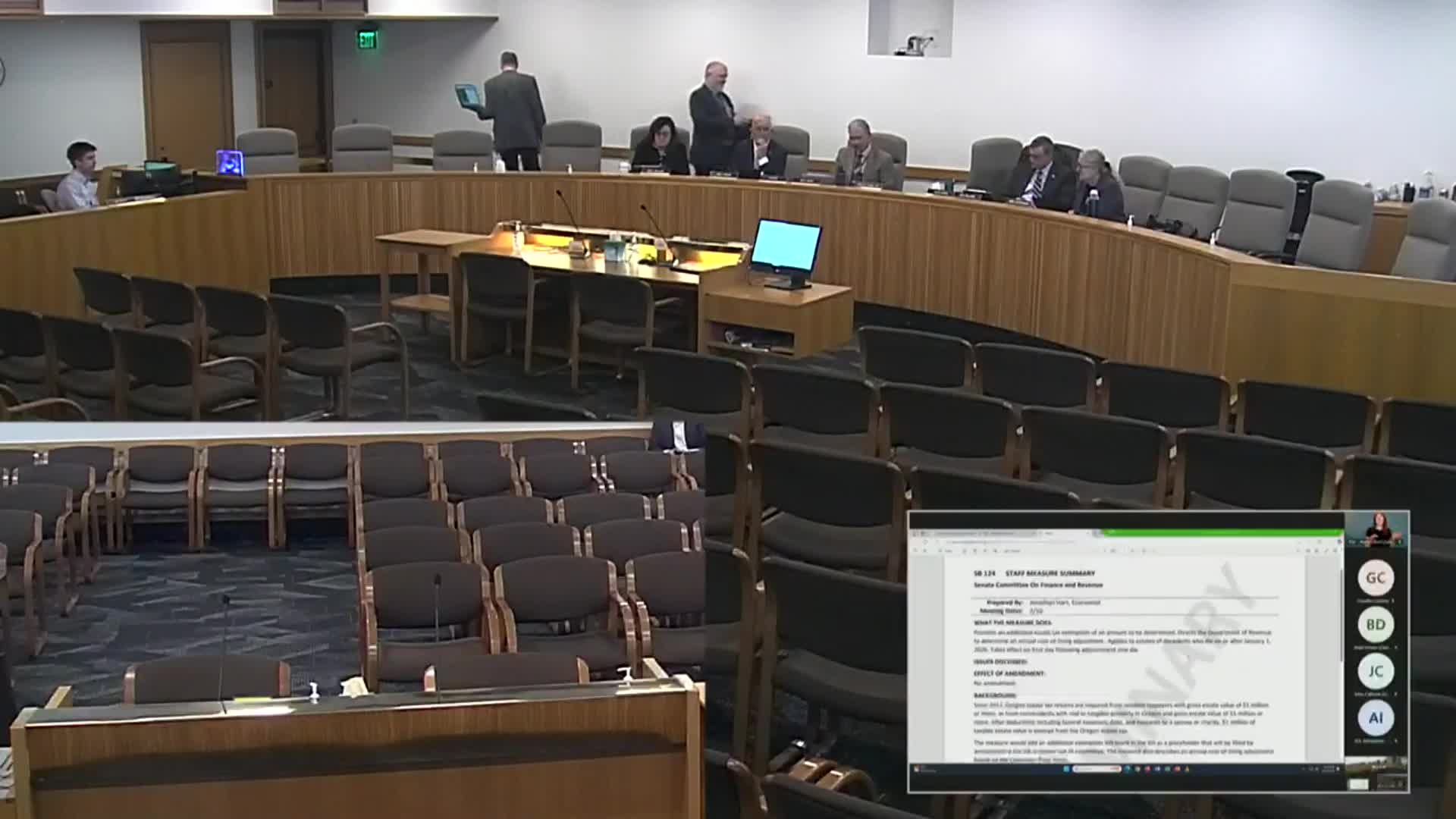
On Feb. 10, 2025, the Oregon Senate Committee on Finance and Revenue held a public hearing on Senate Bill 124, a bill that would establish an additional estate-tax exemption (amount to be determined in the bill text), require the Department of Revenue to determine annual cost-of-living adjustments and apply the change to estates of decedents who die on or after Jan. 1, 2026.
Proponents from banking and business groups told the committee the state’s low $1 million exemption and top rates (testimony cited a 10–16% range) are forcing some family-owned businesses, especially asset-rich/cash-poor operations, to restructure, sell or take on debt to pay taxes. Scott Bruin, president and CEO of the Oregon Bankers Association, said the tax “disrupts families, disrupts businesses, disrupts jobs,” and argued SB 124’s combination of a higher exemption and lower rates would support small-business viability.
Anthony Smith, Oregon state director for the National Federation of Independent Business, said the number of taxpayers subject to the estate tax has nearly doubled in recent years and pointed to rising property values as a driver: “Imagine the average small business person who in addition to their home also owns their business and in many cases the real property that business sits on and therein lies the problem.” Smith advocated indexing the exemption for inflation and discussed “portability” measures to reduce marriage penalties.
Oregon Business and Industry’s Derek Sangstrom also testified in support, urging the committee to “provide substantial relief to a growing number of Oregon families who pay this estate tax every year.” Brad Dennis, a witness appearing remotely, urged the panel to set the new exemption at $7 million, saying that level would move Oregon away from being the most punitive state and could encourage in-migration of wealthy retirees.
Opponents said cutting the estate tax would reduce general-fund revenue and worsen inequalities. John Calhoun of Tax Fairness Oregon said changing the estate tax would be “a gift to this very small group” while people in need would see fewer resources; he warned the state’s biennial estate-tax collections (testimony cited about $700 million) are material to the general fund. Jody Weiser, who said she speaks for herself and has a taxable Oregon estate, described estate taxation as a means of taxing untaxed capital gains and urged caution about revenue loss proposals.
Steven Wright testified in opposition to SB 124’s broad exemption language because it would reduce revenues; he said he would support the bill’s indexing provision only if the committee simultaneously considered adjustments to other taxes and benefits for low-income recipients. Several witnesses urged simplifying “portability” for married couples so that unused exemptions could transfer automatically.
Committee members asked about historic federal and state law changes. Witnesses and staff noted that Oregon’s estate tax was once a “pickup” credit tied to federal law until changes in 2001 (federal EGTRRA) and that Oregon rewrote its statute in 2011 to implement a multi-bracket structure and to retain definitions tied to federal language. Witnesses cited the federal exemption (testimony noted $13,990,000 for 2025) to highlight the gap with Oregon’s $1,000,000 threshold.
The hearing collected a range of proposals (raise exemption, index for inflation, add portability, tighten gift tax rules, and address natural-resource provisions enacted in 2023). No committee vote occurred; the chair closed the hearing and announced the committee would meet again on Feb. 12, 2025 to continue estate-tax work.