Get Full Government Meeting Transcripts, Videos, & Alerts Forever!
Get email alerts on the Ogecc Budget Ops topic
No spam. Unsubscribe anytime.
Oregon Government Ethics Commission seeks sustained funding as complaints, trainings surge
Summary
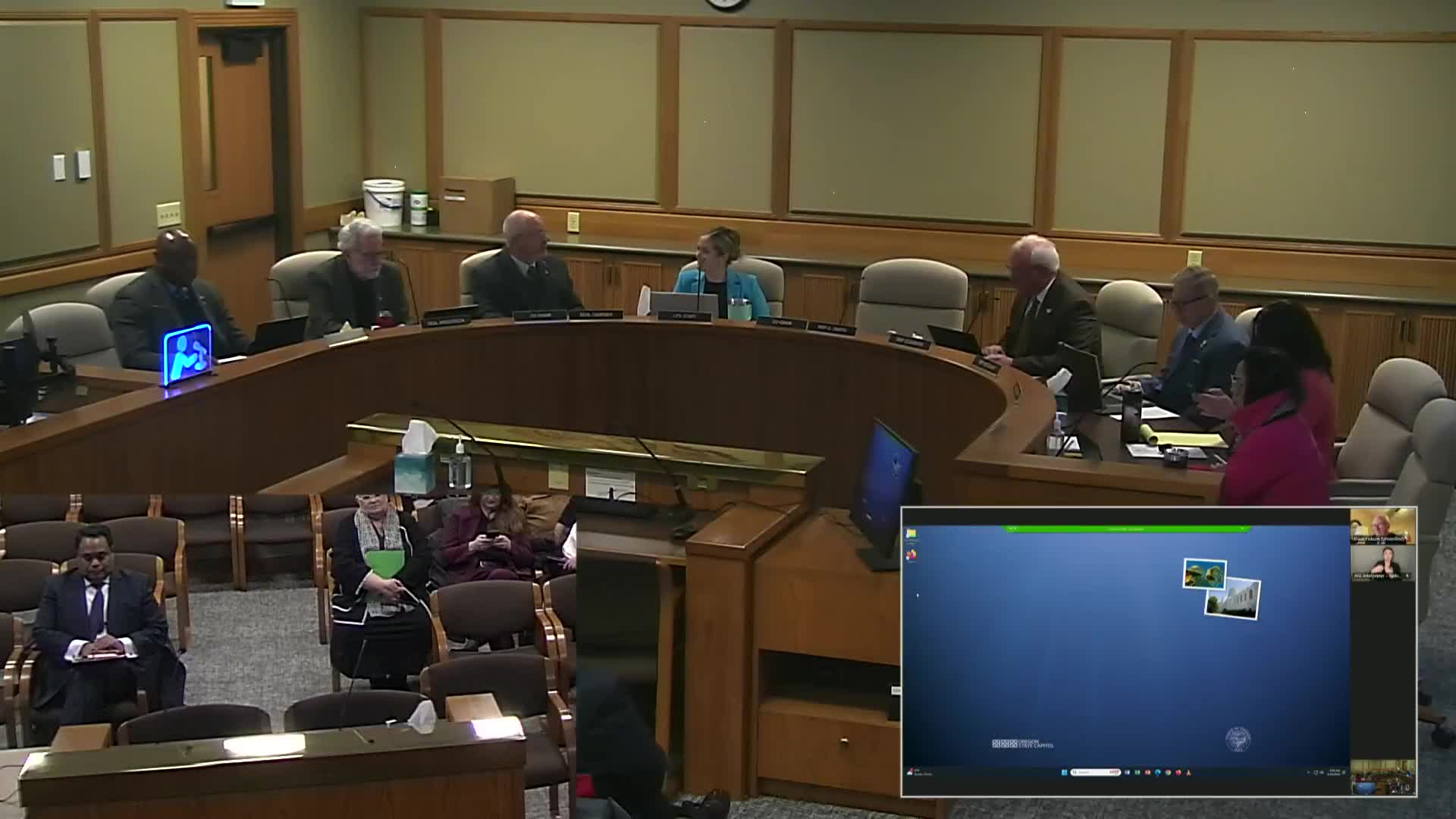
The General Government subcommittee for Ways and Means heard Tuesday that the Oregon Government Ethics Commission’s workload has grown sharply and that the governor’s recommended budget in Senate Bill 5522 would maintain current services while adding targeted investments.
The General Government subcommittee for Ways and Means heard Tuesday that the Oregon Government Ethics Commission’s workload has grown sharply and that the governor’s recommended budget in Senate Bill 5522 would maintain current services while adding targeted investments.
“Today you have a public hearing on Senate Bill 5522, the appropriation bill for the Oregon Government Ethics Commission,” Jason Chromley of the Department of Administrative Services' Chief Financial Office told the subcommittee as he opened the agency budget overview. Chromley said the commission’s request reflects three drivers: more requests for written advice and training, an expanded scope from recent legislation, and continued needs to upgrade the commission’s case-management and electronic filing systems.
The commission’s executive director, Susan Myers, told lawmakers the agency is 100% other‑funded and that revenues come from assessments split roughly 50/50 between state agencies (assessed by FTE) and local governments (assessed via municipal audit fee levels supplied by the Secretary of State). Myers said the commission spends about 60% of its budget on personal services (staffing), and the governor’s recommendation holds the agency at current service level while funding four policy option packages the commission requested.
Why it matters: In 2023–24 the Legislature broadened the commission’s role, adding public‑meetings law enforcement and permitting the agency to provide advice on the full public‑meetings statute. Commissioners and staff told the subcommittee that creating an enforcement and statewide‑training apparatus for a law that previously had no state enforcement significantly increased both training demand and caseload.
Training and advice: Stephanie Heffner, the commission’s curriculum and training coordinator, said the agency trained 16,920 individuals in 2024 and expanded the mix of monthly webinars, in‑person sessions, and agency‑specific trainings for school districts and municipal associations. “We offer monthly trainings...and currently we’re offering weekly, if not more frequently, online webinars on public‑meetings law,” Heffner said, noting the agency caps many webinars at 50 participants so trainers can collect required pre‑ and post‑training data.
Heffner and Becky Mason, the commission’s policy and agency programs manager, described additional investments the agency is seeking for software and hardware to support on‑demand trainings and polling of large online audiences. Mason told the committee that the electronic filing system work was delayed after recent statutory changes (including changes to statements of economic interest reporting), and that the vendor recommended moving toward a cloud‑based case management and electronic filing solution.
Complaints and enforcement: The commission reported receiving 566 written complaints in 2024; staff screened 294 as non‑jurisdictional and treated the remaining 272 as potentially within jurisdiction. Myers explained that public‑meetings complaints tend to generate multiple member‑level case openings because the statute gives the commission jurisdiction over individual members rather than whole bodies; that reporting practice inflates the apparent share of public‑meetings matters in raw counts. The commission said its preliminary review timelines remain within statutory limits (60 days for ethics and public‑meetings matters; 135 days for lobby cases) and that investigations run up to 180 days unless resolved by stipulated final orders.
Costs and collections: The agency told members that penalties paid by filers are remitted to the state general fund; the commission does not retain penalty revenue. Jason Chromley and agency staff said assessments on state agencies are indexed to FTE (about $35 per FTE in 2023–25 rising to about $42 per FTE in the 2025–27 estimate) and local assessments follow municipal audit fee tiers; small entities with prior‑year expenditures under approximately $50,000 may not be assessed. The commission reported Department of Justice (DOJ) review fees have risen, with an average monthly DOJ bill around $23,000–$25,000 and single months as high as roughly $36,000.
Staffing and growth: Staff said the commission now has a 15‑member workforce split across administration, training/curriculum (a coordinator plus four trainers) and compliance/enforcement (a coordinator plus four investigators). The 2023 legislative changes and the public‑meetings mandate added five positions and modest office expansion, the agency said.
Cost containment and cuts: The agency presented contingency options should the subcommittee require cuts. Its 5% reduction scenario would eliminate an administrative specialist position and reduce one trainer to 50% time — steps the agency said would “hamstring” training capacity. The commission said many core costs (DOJ fees, DAS IT, case‑management hosting) are not reducible without cutting essential services.
Commission chair David Fiskum, appearing remotely, framed the agency’s role in educational terms: “This position carries what I would say is a, quote, ‘sacred trust,’ to educate public officials on ethics laws,” Fiskum said, adding that enforcement sometimes serves education as well.
What’s next: The subcommittee closed the public hearing on Senate Bill 5522 and the agency staff said they would provide follow‑up answers on a few technical questions (for example, which state agencies are assessed under the state‑agency FTE calculation and whether small local entities are assessed when they fall below municipal audit thresholds). The commission also noted four policy option packages in the governor’s recommendation: DOJ fees, a classification change for an operations analyst, investments to support training software/hardware, and funds to modernize the electronic filing and case‑management systems.
No formal votes were taken at the hearing.