Get Full Government Meeting Transcripts, Videos, & Alerts Forever!
Get email alerts on the Aquatic Invasive Species topic
No spam. Unsubscribe anytime.
Lawmakers consider inspection expansion and fee increases to prevent invasive mussels
Summary
House Bill 21‑70 would allow local districts to partner in operating watercraft inspection stations; companion funding proposal HB 29‑82 would raise boat fees to expand inspections, decontamination and detection. Witnesses said prevention is far cheaper than post‑infestation containment.
The House committee took extended testimony on proposals to expand Oregon's watercraft inspection and aquatic invasive species (AIS) prevention program.
House Bill 21‑70 would allow irrigation districts and other local entities to partner with the Oregon Department of Fish and Wildlife (ODFW), the State Marine Board, and the Department of Agriculture to staff and operate additional watercraft inspection and decontamination stations. The companion funding proposal, House Bill 29‑82 (also referred to in testimony as HB 2,982), would raise motorized and nonmotorized boater fees and remove the current exemption for nonmotorized boats under 10 feet to increase funding for the Aquatic Invasive Species Prevention Fund.
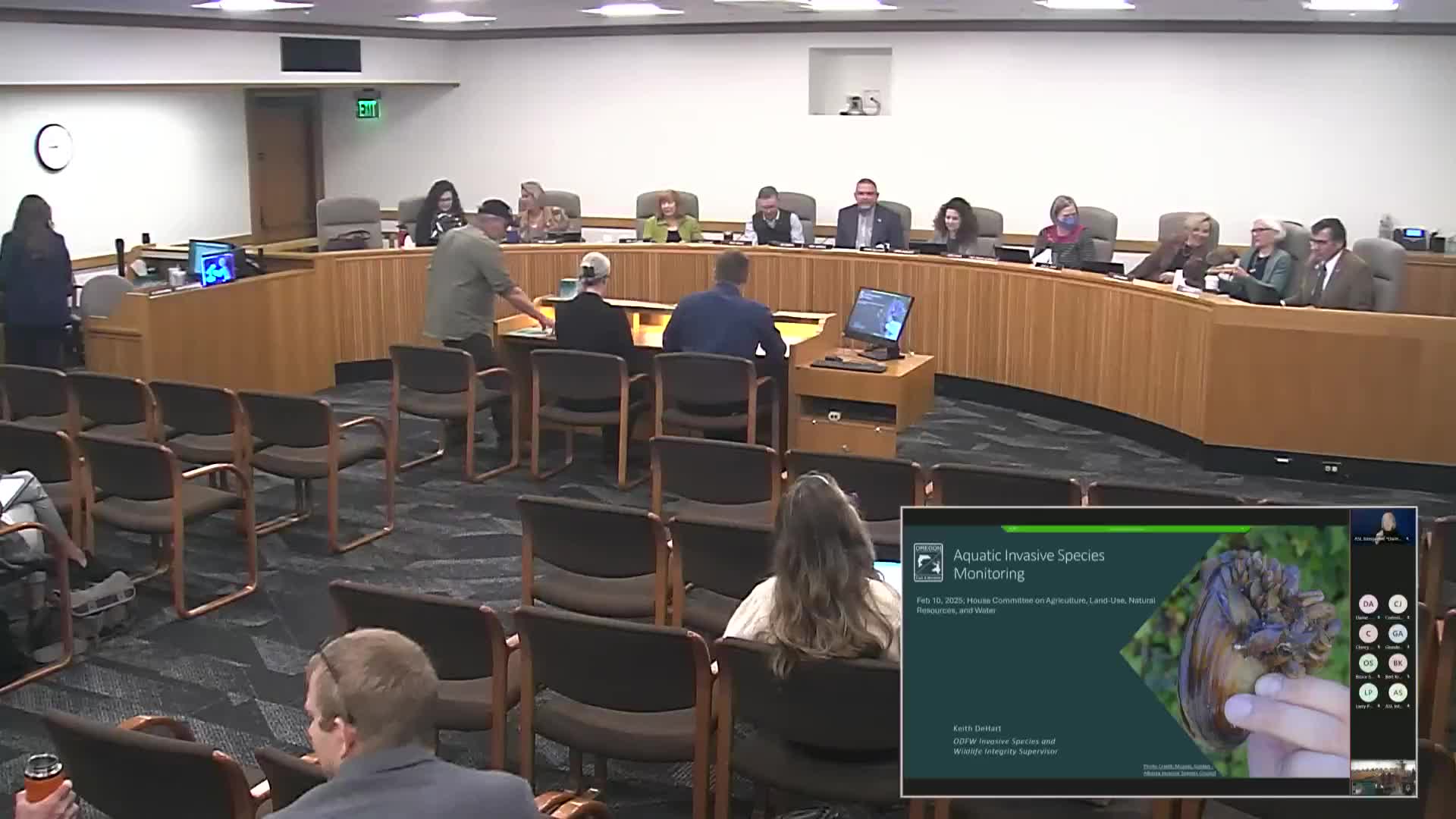
ODFW presented data on interception activity and inspection station coverage, noting two permanent check stations (I‑5 at Ashland and I‑84 at Ontario), seasonal stations and many unstaffed entry points. "Since the watercraft inspection stations were instituted in 2010, we have done a total of over a quarter million watercraft inspections," Keith DeHart, invasive species and wildlife integrity supervisor at ODFW, said. He reported 3,636 vessels stopped with aquatic invasive species (mostly plants) and 73 vessels found with quagga or zebra mussels.
Local irrigation district managers, county officials and recreation groups urged passage. Clancy Flynn of Oahe Irrigation District and Bruce Scanlon of Ochoco Irrigation District described large irrigation reservoirs with substantial economic value to local agriculture and recreation and warned that detections in neighboring states underscore risk. Malheur County Commissioner Ron Jacobs said the county has used grant funds for public outreach and supports additional stations near Lake Owyhee.
The Oregon State Marine Board said the current Aquatic Invasive Species Prevention Fund receives about $1.3 million per biennium from boat fees; roughly $1 million pays inspection stations, $150,000 funds detection sampling and about $20,000 goes to boater education. "Senate Bill 29A2, as proposed, will approximately double the funding to the Aquatic Invasive Species Prevention Fund," Alan Hansen, policy and environmental manager for the Marine Board, said, describing how raised fees and the removal of the 10‑foot exemption would change collections and boost both inspection capacity and early detection sampling. Director Warren of the Marine Board warned that containment responses in other states halted water‑based recreation quickly and that decontamination requirements can deter boating activity.
Supporters framed the bills as prevention‑focused and said fee increases are necessary to avoid the far larger costs of containment and infrastructure fouling. Opponents from American Whitewater urged the committee to avoid placing disproportionate burden on small paddlers who use unimproved access sites and recommended working with recreation groups on equitable funding solutions.
The committee took oral testimony and comments from sportfishing and paddling organizations. No final committee action on HB 21‑70 or HB 29‑82 was recorded in the hearing transcript.