Get Full Government Meeting Transcripts, Videos, & Alerts Forever!
Get email alerts on the Public Safety Mill Levy topic
No spam. Unsubscribe anytime.
Broadwater County sheriff urges voters to renew mill levy to preserve staffing and school resource officer
Summary
A Broadwater County Sheriff’s Office representative told residents the five-year public safety mill levy that expires this year funded new deputies, a school resource officer and other services and urged voters to renew it; commissioners and residents asked questions about costs, budget transparency and alternatives.
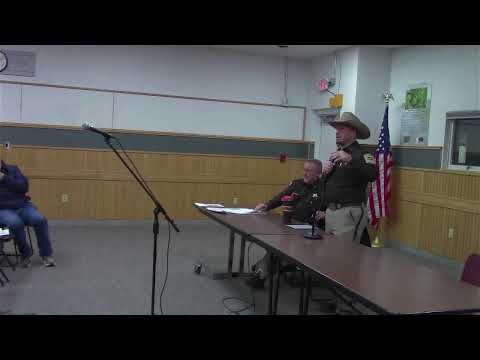
A representative of the Broadwater County Sheriff’s Office on Tuesday urged residents to approve a renewal of the county’s public safety mill levy, saying the five-year levy that expires this year paid for deputies, a school resource officer and other positions the office relies on.
The sheriff’s office representative told the audience the mill levy was adopted in 2020 after officials concluded inmate housing revenue was an unstable funding source. “It is not a secure source of revenue,” the speaker said, adding that the mill levy allowed the office to raise wages, restart a reserve-deputy program and hire a full-time school resource officer (SRO).
The levy now authorized “up to 39.93 mills,” the speaker said, and the office requested continuation rather than a new tax. The office offered sample tax impacts at the current full milling: $53.91 a year on a $100,000 house, $161.72 on a $300,000 house and $323.43 on a $600,000 house. The speaker said he would plan to mill 20% less in the next budget year if the renewal is approved, which he estimated would lower those amounts to $43.31, $129.40 and $258.80 respectively.
Why it matters: Broadwater County officials and the sheriff’s office say population growth and higher call volumes have increased demand for law enforcement services. The sheriff’s office reported case totals rising from 482 in 2022 to 609 in the most recent year cited; the office currently lists roughly 10 deputies (eight assigned to patrol shifts), one full-time detective, one SRO, six dispatchers and eight detention officers. The office’s operating budget was described as about $3.2 million, with roughly 77% going to wages.
What the levy has paid for: The speaker credited the mill levy with funding two deputy positions initially supported by a federal hiring grant (which becomes a local cost after the grant ends), the SRO position in the schools, a south-end deputy position, wage increases to improve retention, and startup of a reserve deputy program. He also described investments in vehicles, in-car laptops and other technology needed for patrol and dispatch operations.
Contracts and other revenue: The sheriff’s office representative said the department holds a contract with the city of Townsend to provide law enforcement services and receives revenue from the mill levy, state entitlement, PILT (Payments in Lieu of Taxes) and a percentage of the county’s floating mills (the commissioners currently provide 34.4% of the floating mills to the office). He said a prior contract with the Bureau of Reclamation was canceled after the agency disputed detailed time logs and the county declined to continue under terms it considered infeasible; the office still responds to emergencies on federal land.
Public safety examples and staffing pressure: To illustrate demand, the speaker recounted recent multi-day incidents in Townsend and nearby areas, including an alley shooting, a standoff that required Lewis and Clark County SWAT backup, and a suicide response. He emphasized operational constraints in a rural county — long travel distances, limited deputies on each shift, overtime and the time required to train new hires (roughly a 12-week academy plus a 16-week field-training program for inexperienced recruits).
Responses and questions from the public and commissioners: County Commissioner Daryl (full name not provided in the meeting transcript) and other attendees expressed support for maintaining staffing and equipment. Several residents pressed for budget transparency and asked why their public safety portion of the tax bills had risen, questioning where prior years’ increased tax revenue had been spent. The sheriff’s office representative described the county and state property-tax assessment process (citing the Department of Revenue), said the mill levy funds are part of a public budgeting process and offered to make the sheriff’s office budget and facility tours available to interested residents. He said the commissioners and the sheriff’s office have funded capital items in past years (for example, a body scanner and an evidence/impound facility expansion) and that those purchases were not taken from the sheriff’s operating budget.
Next steps: The sheriff’s office representative said a resolution to place the levy renewal before voters must be posted on the county agenda next Wednesday and that, if the levy were to fail, it could take roughly two years to place a new levy on the ballot and have it reflected on tax rolls. He asked for resident input on whether a permanent (or longer-term) mill authorization would be preferred or whether the office should again propose a five-year measure.
Ending: The sheriff’s office representative invited residents to scan a posted QR-code survey and to contact the office for budget information or tours. He said he would hold two more public meetings and try to reach a consensus before the resolution is finalized for placement on the commissioners’ agenda.