Get Full Government Meeting Transcripts, Videos, & Alerts Forever!
Get email alerts on the Water Infrastructure And Rights topic
No spam. Unsubscribe anytime.
Broadwater County reviews water-rights, storage and cost options for Wheatland and Rolling Glen
Summary
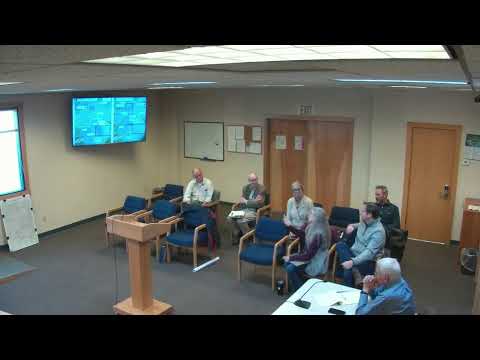
Broadwater County commissioners and outside consultants reviewed a preliminary engineering report on water supply alternatives and mitigation options for the Wheatland commercial core and the Rolling Glen planned unit development during a county meeting to discuss a Community Technical Assistance Program (CTEP) project.
Broadwater County commissioners and outside consultants reviewed a preliminary engineering report on water supply alternatives and mitigation options for the Wheatland commercial core and the Rolling Glen planned unit development during a county meeting to discuss a Community Technical Assistance Program (CTEP) project.
The engineering team said the study focused on a 20-year demand horizon drawn from the county's 2024 growth-policy land-use map and that securing water rights and mitigation will determine whether and when tanks, wells and distribution mains can be built. "Groundwater and surface water are considered to be connected," said Julie Merritt, water-rights specialist with WGM Group, describing why mitigation is required before the Department of Natural Resources and Conservation will grant a new water permit in the Upper Missouri basin.
The report, presented by John Gass of WGM Group, maps two primary demand centers: the Wheatland commercial core and the Rolling Glen residential area. The consultants examined three broad alternatives: separate systems for Wheatland and Rolling Glen; a single combined system with a strategically sited storage tank; and a phased hybrid that lets each area build modest initial storage and meet in the middle later. Gass said the engineering-level cost estimates for full buildouts ranged from roughly $8 million for a minimal Wheatland system to $13 million—17 million for larger combined options.
Why it matters: the Upper Missouri basin is effectively closed to new unmitigated consumptive uses. Consultants said mitigation can come from three general sources: water banking (buying or reserving a block of mitigation water for later use), releases from larger storage projects (for example, Canyon Ferry reservoir managed by the U.S. Bureau of Reclamation or the state's Willow Creek project), or retiring private irrigation rights and converting them to municipal mitigation. "Where the depletions show up in the surface water tells us where the mitigation needs to happen," Merritt said, noting a hydrogeologic study is needed to determine whether depletions from new wells would affect flows above or below Toston Dam.
The Bureau of Reclamation is doing a separate water-availability study for Canyon Ferry; WGM and Department of Commerce staff said Canyon Ferry or the Willow Creek project could be options depending on where the new-use depletions are modeled to fall. Department of Commerce representative Anne Schwend told commissioners Commerce can provide a CTEP work order to help the county pursue additional planning or project scoping.
The consultants also identified operational and governance choices. A private utility (such as the Headwaters Utility Association) can expand more organically and rely on private funding, while a county sewer-and-water district controlled by an elected board can access public funding but requires different governance and possibly boundary changes. Gass said public districts can be eligible for state and federal funding that a private system typically cannot.
Local developer and Headwaters Utility Association member David Sigler described a separate but related wastewater/reuse approach using a membrane bioreactor (MBR) system and on-site reclaimed water to lower net new water demand. "I take a wastewater stream, and I have an asset from it, which is reusable water and fertilizer," Sigler said, arguing that reclaimed water could supply irrigation, industrial uses and fire storage while conserving well withdrawals for potable needs.
Several practical thresholds emerged in the discussion. Merritt said DNRC considers a nearby well's drawdown of more than one foot during pumping an adverse effect that must be mitigated. Mitigation must match timing, location and amount of the new depletions. Consultants observed that retiring irrigated acres to generate mitigation in the immediate area would likely require thousands of acres and that available irrigation rights near the study area are limited, meaning the county might need to pursue mitigation farther afield or negotiate releases from larger storage projects.
Next steps identified by consultants and county staff include finishing the preliminary engineering report, performing a targeted hydrogeologic study and compiling mitigation options for DNRC permitting. WGM said it will finalize the report and deliver it to the county; county officials asked for the presentation slides and signaled interest in further conversations about a possible mitigation strategy and financing. Commerce staff also offered follow-up assistance through CTEP work orders to help scope required studies or funding applications.
The meeting included comments from landowners, Department of Commerce staff and representatives of the Headwaters Utility Association; commissioners present were asked to consider whether the county should take a lead role in assembling mitigation or support primarily developer-driven solutions. No formal motions or votes were taken during the discussion.