Get Full Government Meeting Transcripts, Videos, & Alerts Forever!
Get email alerts on the Public Safety Funding topic
No spam. Unsubscribe anytime.
Broadwater County sheriff urges voters to renew mill levy to preserve deputies and services
Summary
Sheriff Nick Rauser told residents at a Three Forks meeting that the county's five‑year voted mill levy, set to expire this spring and appearing on the May 6 ballot, funds deputies, a school resource officer and detention and dispatch operations; he recommended making it permanent to allow staffing to grow with population.
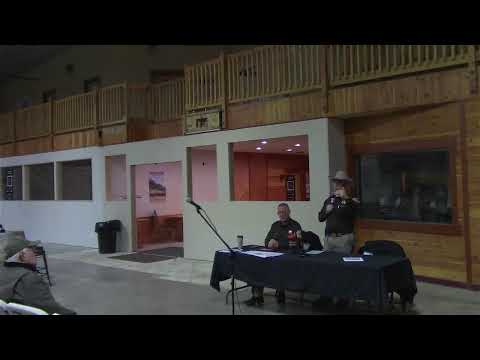
Sheriff Nick Rauser said at a Three Forks town meeting Thursday that Broadwater County’s five‑year voted mill levy, which expires this spring, is on the May 6 ballot and should be continued — ideally on a permanent basis — to sustain staffing and public‑safety services.
Rauser, who opened the meeting by reviewing why the levy was approved in 2020, said the sheriff’s office previously relied on inmate housing revenue from other counties and the state, an uncertain funding source that diminished in recent years. "This mill levy expires this spring," Rauser said, and the levy’s revenue has been used to hire deputies, start a reserve program and fund a school resource officer.
The levy approved in 2020 was set at 39.93 mills. Rauser said the county used that revenue to apply for a federal COPS grant that subsidized two deputy positions for four years; those positions are now fully funded by the department. He said equipment purchases and less‑lethal options — including Tasers, a bola wrap device and a 40‑millimeter less‑lethal round — have been paid for in part from the levy. "Those last five years, we...got our equipment up to par," he said.
Rauser outlined current staffing and workload: Broadwater County has about 10 deputies (eight on patrol at present), one full‑time detective, six dispatchers and eight detention officers. He said typical patrol staffing leaves only two deputies on duty for much of the week and that the office often lacks enough personnel to maintain continuous local coverage. He said the sheriff’s office budget last year was about $3.2 million to $3.3 million, and that roughly 70% of that budget goes to wages.
Rauser described recent increases in reported cases and regional traffic. He said the office opened about 482 cases in 2022 and about 609 in 2024, and cited highway traffic through the county — roughly 5,000 daily drivers on Highway 287 and about 18,000 on Interstate 90 — as a source of incidents such as wrong‑way drivers and multi‑vehicle crashes. He also said the county population has grown since 2000 and cited census figures he summarized for attendees.
Pointing to local results of the 2020 levy, Rauser said the office hired a school resource officer who has worked in the schools and helped patrol in summer months, and that the sheriff’s office has started a reserve program and added a full‑time deputy for the southern part of the county if the levy continues. He said the department made a conditional job offer to a resident who already owns a house in the south end; Rauser said that deputy could start around June 1 if funding remains.
On the question of a permanent levy, Rauser said the proposed language would allow the office to levy "up to 39.93 mills," which he described as permitting him to mill less in future years if property values rise. "If I need a deputy, I can go up to the 39.93 to get one," he said. He also told residents he would prefer not to raise the current rate and had discussed a possible 20% reduction in the mill rate in future years depending on revenues.
Rauser said the county commissioners have agreed to allocate 34.4% of the county’s floating mills to the sheriff’s office and that the city of Townsend has a contract with the county to support services. He asked residents to spread information about the levy, noted that the office will circulate a fact sheet, and said two additional town meetings are planned for the community.
No formal vote or decision was taken at the meeting; the session was informational and included public comment. Residents asked clarifying questions about outsiders causing problems in subdivisions, what "permanent" would mean in practice, and whether the levy would fund an emergency‑services building (Rauser said it would not). Rauser closed by asking supporters to contact neighbors and HOAs and by directing people to a QR code and a survey about the levy.
About the cost to homeowners, Rauser provided sample figures for the existing 39.93‑mill rate: $53.91 a year on a $100,000 house, $161.72 a year on a $300,000 house and $323.43 a year on a $600,000 house.
Rauser emphasized that the levy funds wages and staffing rather than capital projects. "This is just for the Broadwater County Sheriff’s Office to help with manpower through detention, dispatch and deputies," he said, adding that other proposals for an emergency‑services building are separate and remain under discussion.