Get Full Government Meeting Transcripts, Videos, & Alerts Forever!
Get email alerts on the Udc Update topic
No spam. Unsubscribe anytime.
Bozeman staff report wide public input for UDC supplemental engagement; phase 2 will hold workshops
Summary
City planners reported results of Phase 1 of a supplemental engagement process for the Unified Development Code update, saying roughly 230 online survey responses and hundreds of in-person comments identified four priority topic areas; staff plans four in-person and two online workshops in February–March to refine the draft code.
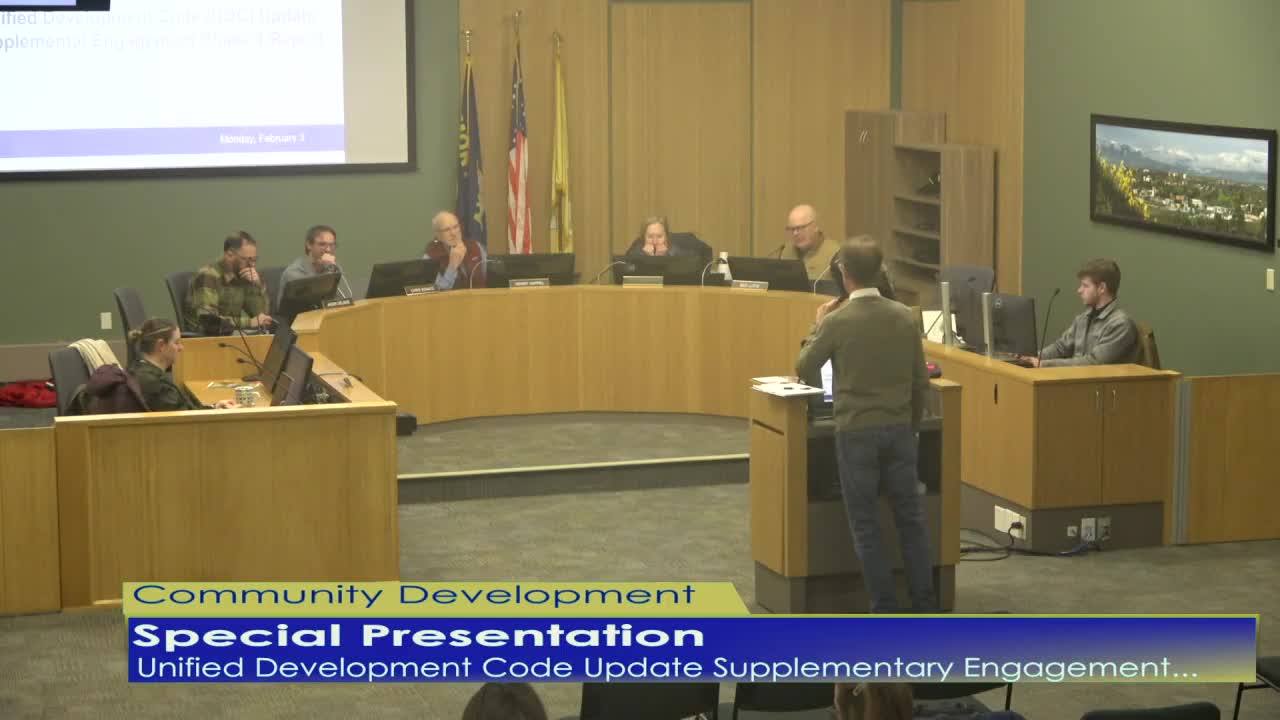
Tom Rogers, a Community Development staff member, briefed the Bozeman Community Development Board on Feb. 3 about Phase 1 of a supplemental engagement program tied to an update of the city’s Unified Development Code (UDC), Chapter 38.
Rogers said the Phase 1 outreach combined an online survey, a webinar and four in-person open houses, direct mail to city addresses, targeted neighborhood meetings and more than 500 sticky-note comments collected at events. “This is a special presentation. We’re not really asking for any direction or specific feedback. It’s just to report back, give you a quick update on where we are, what we’ve done, some of the findings that we have, and share that,” Rogers told the board.
The staff report and slides, which Rogers attached to the board packet and posted on the Engage Bozeman website, summarize survey responses (about 230 online respondents), an estimated 500-plus engagements overall, and roughly 550 individual sticky-note comments that staff coded and categorized. Using that input, planners identified four topic groupings they plan to use for Phase 2 outreach: neighborhood character/compatibility; housing availability/variety/affordability; transportation and environmental protection; and related infrastructure and utility concerns.
Rogers said the state legislature’s recent housing directives shaped parts of the conversation, noting that Montana law requires municipalities to consider a set of housing alternatives. Rogers referenced the list of 14 alternatives included in the materials and said some items on that list reflect practices Bozeman already allows in its code; others could be made more permissive to align with legislative intent.
Staff described Phase 2 as a focused public engagement window during which the city will host four in-person workshops and two online webinars to dive deeper into the four topic groupings, collect follow-up feedback, and then prepare a public draft of revised code language. Rogers told the board the outreach team has already printed mailers and will use the city’s existing channels—mail, utility inserts, social media and earned media—to publicize workshops.
Board members and city staff discussed the difficulty of grouping interrelated topics (for example, neighborhoods, housing and transportation) and whether separate or combined workshops would better surface trade-offs. Board member Jason Delmude and others urged staff to include modeling or trade-off visualizations where possible, so attendees can see how different regulatory choices affect housing, traffic and neighborhood character.
Public commenters at the meeting thanked staff for the outreach but urged care in how the next phase frames questions. Allison Sweeney, identified at the meeting as chair of the Better Bozeman Coalition and chair of the Jant Neighborhood, asked planners to avoid framing the issue as a binary between neighborhood character and affordable housing: “I want us to avoid that at all costs because it’s false and there are solutions,” she said. Other speakers asked staff to weigh survey demographics (homeowner vs. renter, age) when interpreting input and to consider regional commuting and housing-burden data when drafting code changes.
Rogers and other staff said more detailed data from the online survey and event tallies are available in the packet and on the Engage Bozeman site, and that the team will present the Phase 1 summary to the City Commission the following evening. Staff also described upcoming briefings to other advisory bodies, including the sustainability board, historic preservation advisory board, transportation board, parks and forestry, and economic vitality committees.
Rogers emphasized that Phase 2 will refine the public conversation and that a formal public draft of revised UDC language would follow the outreach and internal review. The board did not take formal action on the UDC update at the Feb. 3 meeting.