Get Full Government Meeting Transcripts, Videos, & Alerts Forever!
Get email alerts on the Unified Development Code topic
No spam. Unsubscribe anytime.
Bozeman commissioners approve plan for deeper public workshops on Unified Development Code update
Summary
City staff reported results of a supplemental public-engagement phase on the Unified Development Code, flagged water adequacy and sensitive lands as top concerns, and won direction from commissioners to shape Phase 2 workshops in February–March focused on growth/housing, transportation and environment with advisory-board input.
Bozeman City staff on Monday reported results from Phase 1 of supplemental public engagement on a proposed update to the city’s Unified Development Code, saying the work identified water adequacy and sensitive lands as top public concerns and setting the stage for deeper, topic-focused workshops this winter.
Aaron George, Community Development Director, told the City Commission that Phase 1 ran November 22 through Jan. 8 and produced 229 online survey responses, five in-person open houses and a well-attended webinar. He said the survey showed 66 percent of respondents identified as homeowners and 29 percent as renters, and that the largest single issues named were water adequacy and sensitive lands. “The Unified Development Code or UDC sets our development regulations,” George said, explaining the code controls land uses, building siting and dimensional standards.
Why it matters: The UDC update is intended to implement goals in the city’s 2020 community plan and more recent adopted policies, and must align with new state requirements from Senate Bill 382. George reminded commissioners the city has a statutory compliance deadline of May 17, 2026 for related changes.
What staff reported: Phase 1 outreach included five neighborhood open houses (one at Montana State University), a December webinar with about 76 attendees, a mailer to all households (staff estimated printing and mailing cost about $10,000), and roughly 500 public engagements overall. Staff said they collected roughly 550 written “Post‑it” comment notes at open houses and grouped them into topic clusters; neighborhood character, housing and density drew the most comment. The online survey’s top five issue rankings were (1) water adequacy, (2) sensitive lands, (3) affordable‑housing preservation, (4) affordable‑housing creation and (5) pedestrian infrastructure.
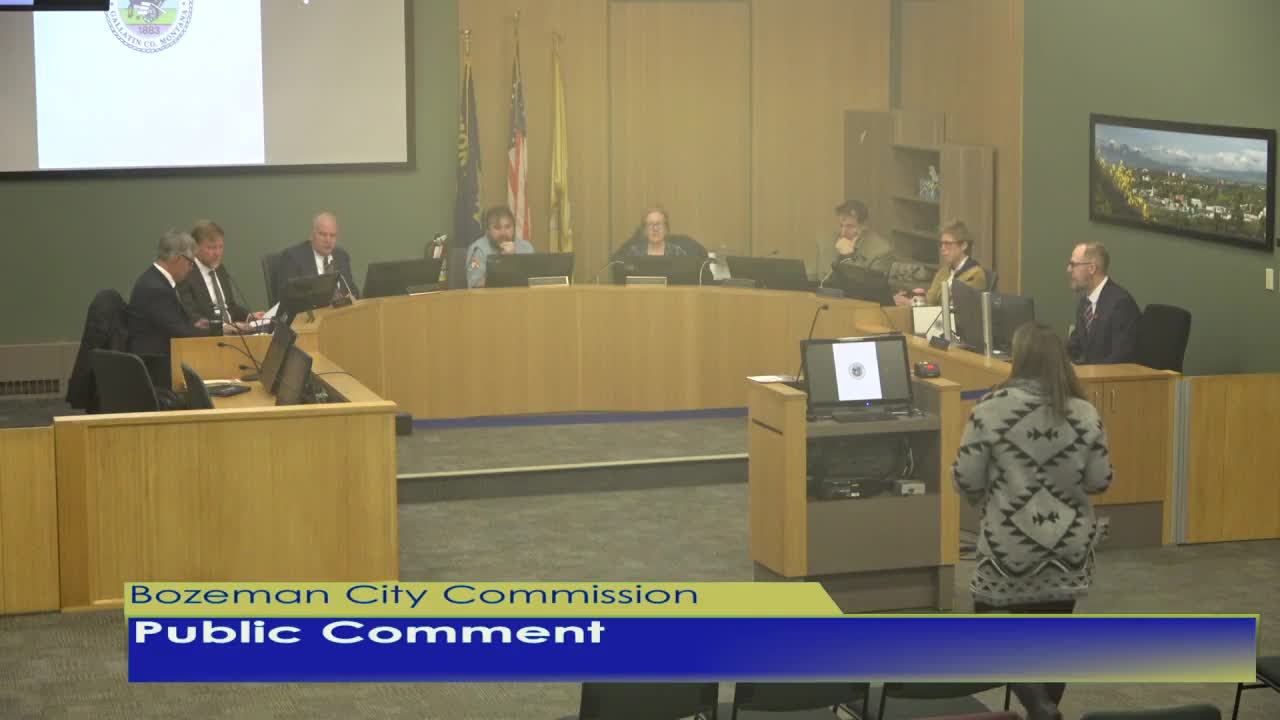
Public comment and stakeholder concerns: Speakers at the meeting urged more attention to water and ecosystem protections and caution when using zoning to address affordability. Allison Sweeney, chair of the Jant Neighborhood, asked that the city post full open‑response survey answers and notes from neighborhood engagements to EngageBozeman so the public can review the raw comments. Daniel Carty, a Bozeman resident, urged the commission to create or designate a water supply advisory board or delegate water topics to the Sustainability Board before the city proceeds with groundwater modeling and drilling. Catherine Berry of the Gallatin Watershed Council asked staff to treat wetlands, streams, riparian areas and irrigation ditches as a network and to align the UDC update with wetland and stormwater plans.
Commissioner discussion and direction: Commissioners debated how to structure Phase 2 so residents could both get a focused education and provide substantive feedback without needing to attend numerous meetings. After lengthy discussion, staff reported commissioners had given direction to shape Phase 2 as a set of deeper workshops running in late February and March, with an online option, and with explicit invitations to advisory boards. Commissioners asked staff to ensure water adequacy be clearly addressed in the environmental workshop and to include formats that ease public participation (virtual sessions, toolkits to host local conversations, and accessible note‑taking methods at in‑person workshops).
Next steps and timeline: Staff said Phase 2 will include four in‑person workshops and two webinars (February–March), a possible additional online survey and a “host your own UDC chat” toolkit that community groups can use. Staff also listed advisory‑board briefings set for mid‑February through early March (Sustainability Board Feb. 12; Historic Preservation Feb. 19; Transportation Feb. 26; Urban Parks & Forestry Feb. 27; Economic Vitality March 5). After Phase 2, staff will compile feedback and return to the commission with recommendations about potential amendments to the UDC draft.
Ending: City staff will post Phase 1 materials and the Phase 2 schedule on EngageBozeman and return to the commission after the workshops with a summary of public input and suggested next steps for aligning the UDC draft with state law and adopted city plans.