Get Full Government Meeting Transcripts, Videos, & Alerts Forever!
Get email alerts on the Housing Affordability topic
No spam. Unsubscribe anytime.
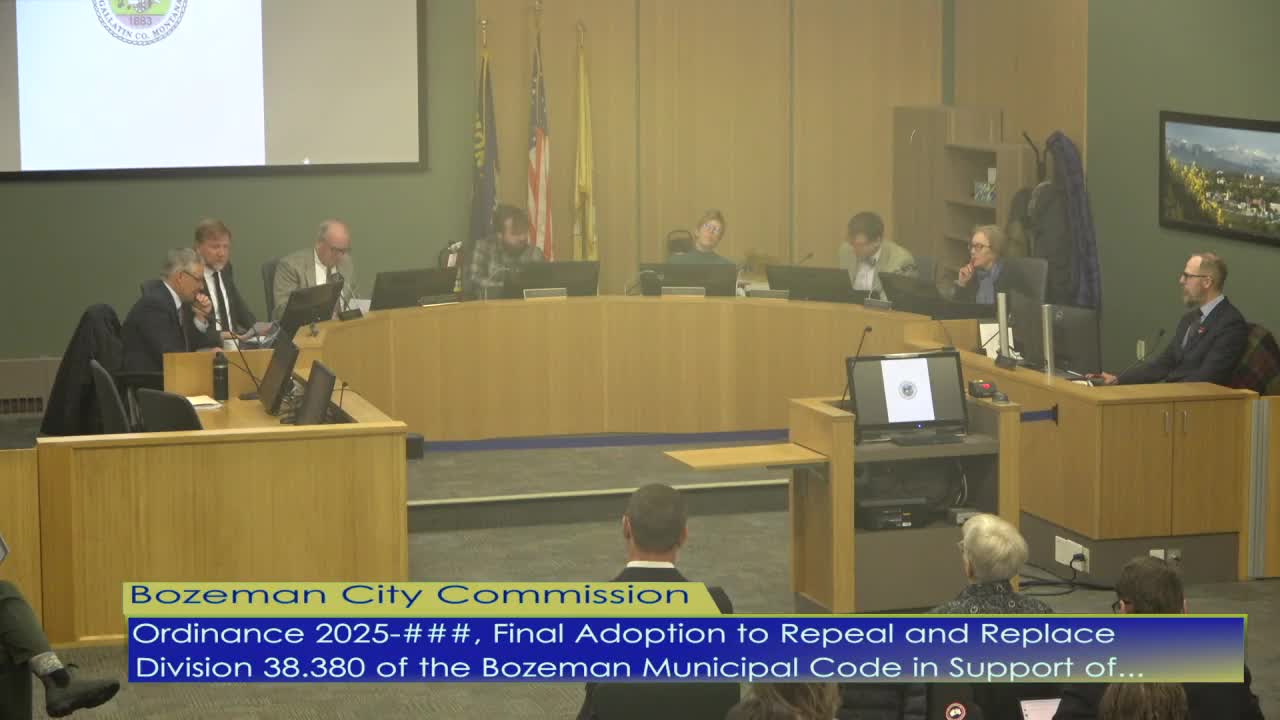
Bozeman commission adopts revised affordable housing ordinance after debate
Summary
After hours of public comment and edits, the Bozeman City Commission voted 3-2 to adopt a revised Affordable Housing Ordinance that narrows height bonuses, raises minimum parking for some incentives, and adds a pre‑application community‑meeting requirement for most incentive categories.
At its February commission meeting, the Bozeman City Commission voted 3-2 to adopt a revised Affordable Housing Ordinance intended to encourage deed‑restricted affordable rental housing while tightening some incentives after public concern.
The ordinance matters because commissioners and residents are wrestling with how to create more affordable units while limiting what some called “radical” change to established neighborhoods. Supporters said the package will help projects that rely on layered funding, while opponents said the current version still over‑incentivizes apartment-style development in certain areas.
City staff presented the ordinance amendments and the public offered extended comment. David Fine, the city’s affordable housing and urban renewal program manager, summarized final edits and how the ordinance would operate at adoption. Among the changes included in the adopted ordinance, staff and the commission described: 1) a pre‑application community meeting requirement for developments using A, B or C incentives with mailed notice to property owners within a 200‑foot radius and a 10‑day window for written public comment after the meeting; 2) documentation the developer must submit with their application showing comments received and whether or how they were incorporated; 3) a cap on height bonuses in lower‑density residential zones (no height bonuses in RS, R1, R2 and RMH); 4) more limited height bonuses in R3 and R4 (one additional story in some cases) and maximum two‑story bonuses for higher‑density and commercial mixed‑use zones (R5, RO, REMU, B1, B2, B2M, B3 and UMU); 5) an increase in the minimum parking requirement for Type C incentives to 0.75 spaces per dwelling; and 6) a requirement that all ADA parking spaces be located on the same site as the dwelling.
On the community‑meeting requirement, staff said the final language requires mailed notice at least 20 business days before the meeting (the commission adopted an amendment during the meeting changing the draft 15‑business‑day notice to 20 business days). Developers must accept written public comment for 10 days following the meeting and include the written comments and a developer response in the application package. The commission added the community‑meeting requirement to Type A incentives as well (the amendment expanding the meeting requirement to Type A, B and C passed 5‑0 before final adoption).
The vote on final adoption was 3‑2. The roll call as read during the meeting was Commissioner Fisher: No; Commissioner Magic: No; Deputy Mayor Morrison: Aye; Commissioner Boddy: Aye; Mayor Cunningham: Aye. Supporters argued the ordinance remains a necessary tool to stack incentives in projects that also use programs such as LIHTC (Low Income Housing Tax Credit) to close financing gaps. Opponents reiterated concerns about concentration of multifamily development and the ordinance’s impacts on neighborhood character.
Public comment during the hearing included a range of views. Supporters urged the commission to adopt the ordinance immediately to preserve projects in the pipeline; for example, one speaker said, “I urge the commission to pass the AHO in its entirety tonight.” Neighbors and neighborhood advocates pressed for stronger notice and recordkeeping for community meetings and for limits on building bulk and height in established residential areas. City staff and the city attorney repeatedly explained the limits of city authority under Montana law for binding pre‑application requirements and the legal point that the rules in place at the time an application receives adequacy govern review.
The ordinance, as adopted, will follow the standard ordinance effective timeline described in the staff presentation (typically becoming effective 30 days after final adoption) and will be implemented by planning and development staff. Staff said they will publish the final ordinance text, update application checklists to include the community‑meeting materials, and monitor use of the incentives to assess whether further adjustments are needed.
Votes at the final motion: motion to adopt findings and approve the proposed affordable housing ordinance (mover: Commissioner Fisher; second: not specified on the record). Outcome: approved (3‑2).