Get Full Government Meeting Transcripts, Videos, & Alerts Forever!
Get email alerts on the High School Modernization topic
No spam. Unsubscribe anytime.
Portland school board adopts cost‑reduction framework for three high‑school modernizations
Summary
The Portland School Board on Feb. 11 approved Resolution 7051 to direct the superintendent to pursue near‑ and mid‑term cost reductions on three high‑school modernization projects tied to a May general‑obligation bond; staff estimated $20 million to $40 million in potential savings per project.
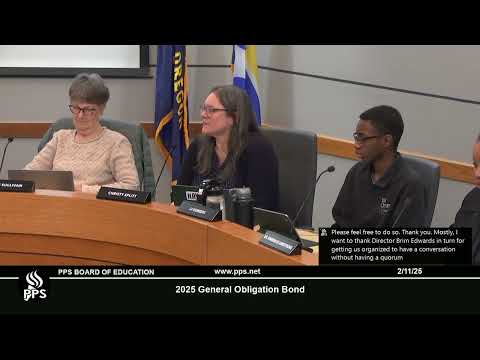
The Board of Education of Portland SD 1J on Feb. 11 adopted a resolution directing the superintendent to pursue cost reductions on three high‑school modernization projects tied to the district’s planned May general‑obligation bond, approving the measure by a 7‑0 vote.
Director Ben Edwards introduced the resolution and described it as “a framework for consideration which would direct the superintendent to pursue and deliver cost reductions in the 3 high schools targeted for rebuilding and modernization.” The board recorded the final vote as 7 to 0, with the student representative recorded as voting yes unofficially.
The board said it adopted the framework so potential savings in the high‑school projects could be reallocated to improvements and critical repairs at aging elementary and middle schools already included in the May bond. Edwards told the board the district contracted with Cornerstone Management Group to compare projected costs for the three high schools to previous PPS modernizations and to Beaverton High School, which is currently being built.
The framework directs the superintendent to deliver near‑term contractor cost‑reduction options and associated trade‑offs — covering items such as preconstruction services, general conditions and contractor fee — and, in the midterm, to provide recommendations “related to current and future contracting methods, method utilization, and efficiencies related to the Office of School Modernization project management,” language the board added during discussion.
Edwards said the framework also establishes modernization requirements that preserve the district’s comprehensive high‑school education specifications and a “foundational level” of athletic facilities and physical‑activity spaces. The buildings are required to be all‑electric and to conform to PPS equity and contracting provisions. The framework asks staff to propose reductions such as lower building square footage, lower‑cost systems and materials, the reduction or elimination of spaces beyond the education specifications, and limiting certifications other than LEED Gold. Child‑care centers and school‑based health clinics were listed as optional depending on demonstrated need or provider availability. Design advisory groups at each school are to reconvene if the board adopts the framework.
Danny, the district’s chief operating officer, said staff’s early, preliminary estimate was “20 to $40,000,000 of savings per project,” while cautioning the board that that was a high‑level range until work proceeds. Staff noted those potential savings could be added to the district’s planned investments in elementary and middle schools, which the board referenced as $190,000,000 for infrastructure in the bond package.
Several board members emphasized that the framework is intended to reduce costs without removing items within the education specifications. One director said, for the record, that the board was “not looking to take away their theater rooms” or other core arts spaces from the communities affected by the modernizations.
Board discussion also referenced differences between projects that make direct cost comparisons difficult. A board member cited differences with Beaverton’s project — student capacity, available land, and whether kitchen costs or certain facilities were included — and relayed a staff note that an escalation figure in the Cornerstone report used 5% where staff said market averages were 8%, a discrepancy the speaker described as producing a material error in the report as written.
The student representative said student groups supported sustainability efforts and performing arts in the bond but expressed concern that many students had not been sufficiently involved in developing the bond; board members acknowledged the need for additional student engagement in outreach and campaign efforts.
As amended on the floor to add the words “current and” to contracting recommendations, the board immediately voted to adopt Resolution 7051, “Resolution to adopt framework to build high quality high schools in a cost‑effective manner.” The motion was moved by Director Ben Edwards and seconded by Director Hollins. The resolution passed 7 to 0 (student representative recorded as an unofficial yes). After the vote, the board directed staff to reconvene design advisory groups, update engagement and communication plans, and produce the contractor‑side and modernization cost‑reduction options and associated trade‑offs for board review.
The meeting adjourned after the vote.