Get Full Government Meeting Transcripts, Videos, & Alerts Forever!
Get email alerts on the School Safety Worlds Fair topic
No spam. Unsubscribe anytime.
Stevenson speakers tell board harassment at World's Fair left students unsafe; district apologizes and promises review
Summary
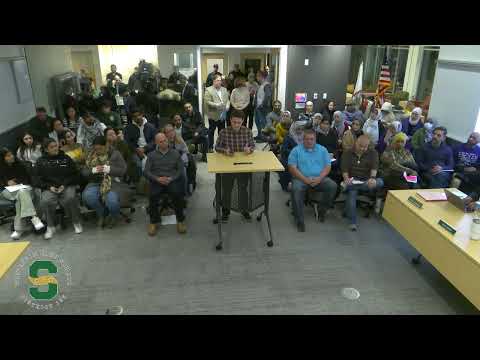
At a meeting of the Adlai E. Stevenson High School District 125 Board of Education, parents, students and civil‑rights groups urged the district to take stronger action after an incident at the district’s World's Fair that speakers said led to harassment, doxxing and threats against Palestinian and Muslim students.
At a meeting of the Adlai E. Stevenson High School District 125 Board of Education, parents, students and civil‑rights groups urged the district to take stronger action after an incident at the district’s World's Fair that speakers said led to harassment, doxxing and threats against Palestinian and Muslim students.
Speakers representing community groups and families described adults approaching and intimidating students at the fair, online campaigns that circulated photos and claims about students, and continued bullying afterward at school. "We just wanna say that we're appalled by the bullying and the gaslighting campaign that's been undertaken by hateful adults against Palestinian American students that attend Stevenson and Muslim students that attend Stevenson simply for daring to express their truth," said Maggie Slavin, school support coordinator for CARE, the Council on American‑Islamic Relations Chicago.
The public comment period included parents, students and representatives from Jewish and Muslim organizations who gave differing accounts of how the display should have been handled and what constituted harassment. Natan Ostrow, co‑founder of the Chicago Jewish Alliance, told the board that elements of the Palestinian booth went "beyond cultural expression and instead promoted messaging that erased Israel's existence," and asked the district to adopt written rules to keep school events politically neutral. Student speakers said they felt unsafe returning to class after the incident; student leader Aya said she was "done" being afraid to go to school and demanded equal treatment for students who display their heritage.
Speakers described a pattern that began with photos posted online, which they said led to coordinated online attacks and harassing phone calls. Several parents and students called for an independent investigation, clearer anti‑harassment policies and nonperformative cultural‑sensitivity training for staff. Deborah Adleman, who identified herself as a professor emerita of English and a member of Jewish Voice for Peace, urged the board to avoid equating criticism of Israel with antisemitism: "Criticism of Israel does not constitute antisemitism," she said, while also calling for protections for all students.
District staff members acknowledged failures in adult oversight at the event and apologized. A district administrator said, "We are truly sorry. We hear the hurt in the voices in the room, and that that hurts us as well," and said administrators would follow up with commenters who left contact information. The board's initial public statement included a pledge that "members of our administrative team will work with discrete individuals and departments to develop a clear and transparent prior review process for all World's Fair materials to prevent similar incidents from occurring in the future."
Speakers also pointed to a QR code on the booth linking to an outside relief organization and disputed claims about the meaning of cultural symbols such as the watermelon pattern; CARE characterized the pattern as "a creative cultural expression of resilience against erasure." Others called for accountability for adults who they said escalated the event. Several Jewish speakers described a broader pattern of antisemitic incidents at the school and urged the board to ensure that Jewish students are protected and supported.
Board members paused the meeting after public comment and offered a short break; administrators said they had taken detailed notes and would contact speakers who requested follow up. The board did not respond to public comment at length during the meeting and told speakers that staff would contact people who left names and phone numbers.
The public comment segment included dozens of speakers from parents, students and community groups and ran for the bulk of the meeting's public comment time. Speakers asked for concrete steps including an independent review, written limits on external links or QR codes at school events, mandatory staff training on cultural sensitivity and clear, timely communications to families when safety incidents occur.
The board did not take formal action on any of the requests during the meeting; administrators said they would return to the community with follow‑up information.