Get Full Government Meeting Transcripts, Videos, & Alerts Forever!
Get email alerts on the Human Relations Commission Anniversary topic
No spam. Unsubscribe anytime.
Metro Human Relations Commission marks 60 years and launches ‘Humans Over Hate’ outreach
Summary
The Metro Human Relations Commission celebrated its 60th anniversary with speeches from city leaders, the launch of the Humans Over Hate initiative and public warnings about recent federal moves targeting diversity programs.
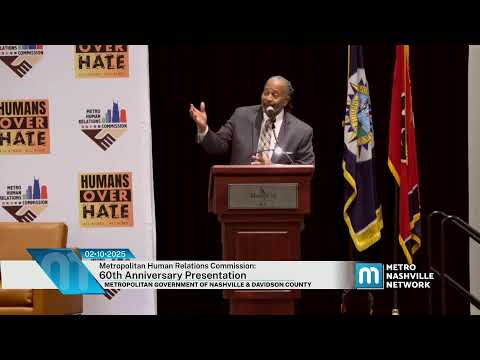
NASHVILLE — The Metro Human Relations Commission celebrated its 60th anniversary at a public event that combined history, a short documentary and the launch of a new public-awareness campaign called Humans Over Hate.
Director Ed Tucker, executive director of the Metro Human Relations Commission, opened the event by saying the commission’s purpose remains the same: “Our mission is to promote and advocate for the well-being of all Nashvillians.” The gathering included current and former commissioners, civic and religious leaders, and elected officials.
The commission framed the gathering around civil-rights history and present-day threats to diversity, equity and inclusion efforts. The event included a short documentary to be aired on Nashville Public Television, calls for Nashville residents to sign two anti-hate pledges distributed at the venue, and discussion of actions the commission has taken recently to mediate disputes and help distribute grant funds.
Mayor Freddie O’Connell credited the commission with helping to resolve a dispute over Metro Arts Commission grants, saying, “The MHRC got parties together that resulted in a reconciliation agreement that charted a path forward to paying artists.” The mayor also thanked staff who worked on the reconciliation and praised the commission’s role in brokering cooperative solutions.
Speakers used the anniversary to warn about recent federal directives targeting diversity programs. Sunu Shandy, senior adviser at Democracy Forward and a former civil-rights lawyer, described a wave of litigation and federal executive actions that she and her organization view as attempts to curtail DEI work. “Just because someone puts it on a piece of paper then says they think that’s what the law is, it’s not correct,” Shandy said, urging litigation and local resistance where appropriate.
Vice Mayor Angie Henderson, president of the Metro Council, called attention to local commitments to inclusion, saying, “Diversity is our strength,” and urged residents to enact the pledges offered by the commission rather than leave their commitments on the table.
Other speakers tied the commission’s founding to federal civil-rights developments of the 1960s. Program remarks noted that Metro established a local human-rights agency in 1965, inspired in part by federal civil-rights law, to address discrimination and promote mutual understanding. Rabbi Kenneth Kanter, a former commissioner, recalled clergy and civic leaders who helped found the current iteration of the commission and said the issues from decades past — race, faith, language access and hate groups — continue to resonate.
Event organizers asked attendees to sign one of two pledges distributed on tables: one to “reject racism, resist bigotry, and rise against all forms of hate,” and another to “embrace diversity and stand against discrimination in all of its forms.” Director Tucker also promoted a website and social-handle for the initiative: humansoverhate.org and IamOverHate (as stated at the event).
The program recognized MHRC staff members by name for their ongoing work and listed partners who helped produce the anniversary materials and documentary, including Nashville Public Television and a production group identified at the event as “353.” Organizers also asked former commissioners and civil-rights-era activists in the room to stand so their presence and service could be noted.
Speakers repeatedly urged local vigilance and collaboration. Sunu Shandy urged organizations and municipalities to use litigation and local policies to protect inclusion efforts; Councilwoman at-large Zofat Zora framed sustained, intercommunity solidarity as essential to resisting what she described as coordinated efforts to shrink civic inclusion. Rabbi Kanter closed his remarks with literary reflections, saying Nashville still can be “home” and emphasizing the commission’s continuing role.
No formal votes or official legislative actions were recorded at the event. The gathering was framed as a public commemoration and outreach effort rather than a policy meeting of the Metro Council or a decision-making session.
The commission asked attendees to join its mailing list and to sign the pledge cards before leaving. Organizers also announced that a longer documentary on the commission’s history will be broadcast on Nashville Public Television in coming weeks.