Get Full Government Meeting Transcripts, Videos, & Alerts Forever!
Get email alerts on the Priorities Process topic
No spam. Unsubscribe anytime.
Council retreat narrows priorities into "ones, twos and threes"; staff warns capacity limits will shape execution
Summary
Staff presented a three-tiered prioritization framework (ones/twos/threes) and urged council to pick a manageable set so city operations and budget can implement them; councilors flagged growth, revenue strategy and committee alignment for follow-up.
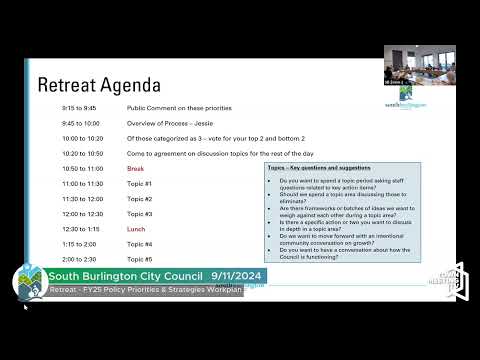
South Burlington city staff told councilors at a retreat they had recategorized 68 candidate actions into "ones, twos and threes" to help the council choose a realistic work plan for the coming year. Staff said "ones" include projects already funded or critical (CIP items, federal grant work); "twos" are high-priority staff-recommended actions; and "threes" are discretionary items the council could toggle on or off.
Staff and council members repeatedly raised a central constraint: staff capacity and the limits of council meeting agendas. City Manager Jesse Baker told councilors the city had been operating in a reactive mode, working week-to-week, and that a shared, stable work plan would reduce churn. "We're working one week at a time," a staff presenter said, and added that many ordinance changes will require months of legal and staff time.
Councilors asked for clearer level-of-effort estimates tied to each priority and for staff to return with staffing and budget implications. Staff said it had added a funding column to the priority spreadsheet indicating where one-time money vs. new ongoing operating costs would be required, and that some "ones and twos" could be accomplished in FY25 without new tax revenue.
Growth and revenue strategy were recurring themes. Councilors asked staff to prepare a data-driven study of recent growth, fiscal impacts, infrastructure constraints and options for encouraging development in specific areas (for example, concentrating commercial growth in Tech Park/airport-adjacent zones). Staff said a multi-year growth study would be useful and recommended assembling a short steering group and using the planned data manager to run the analysis.
The retreat also exposed process frustrations. Several council liaisons asked for clearer rules on the liaison role and better coordination so committees do not spend volunteer time on projects the council does not intend to pursue. Staff said they will produce a recommended committee-charge and liaison protocol for council review. The retreat did not adopt a final, binding priorities list; staff will compile council feedback and circulating a draft work plan for formal adoption.