Get Full Government Meeting Transcripts, Videos, & Alerts Forever!
Get email alerts on the False Reports Study topic
No spam. Unsubscribe anytime.
Committee approves study of false‑report laws; adds defense attorneys to advisory list and gives bill due‑pass recommendation
Summary
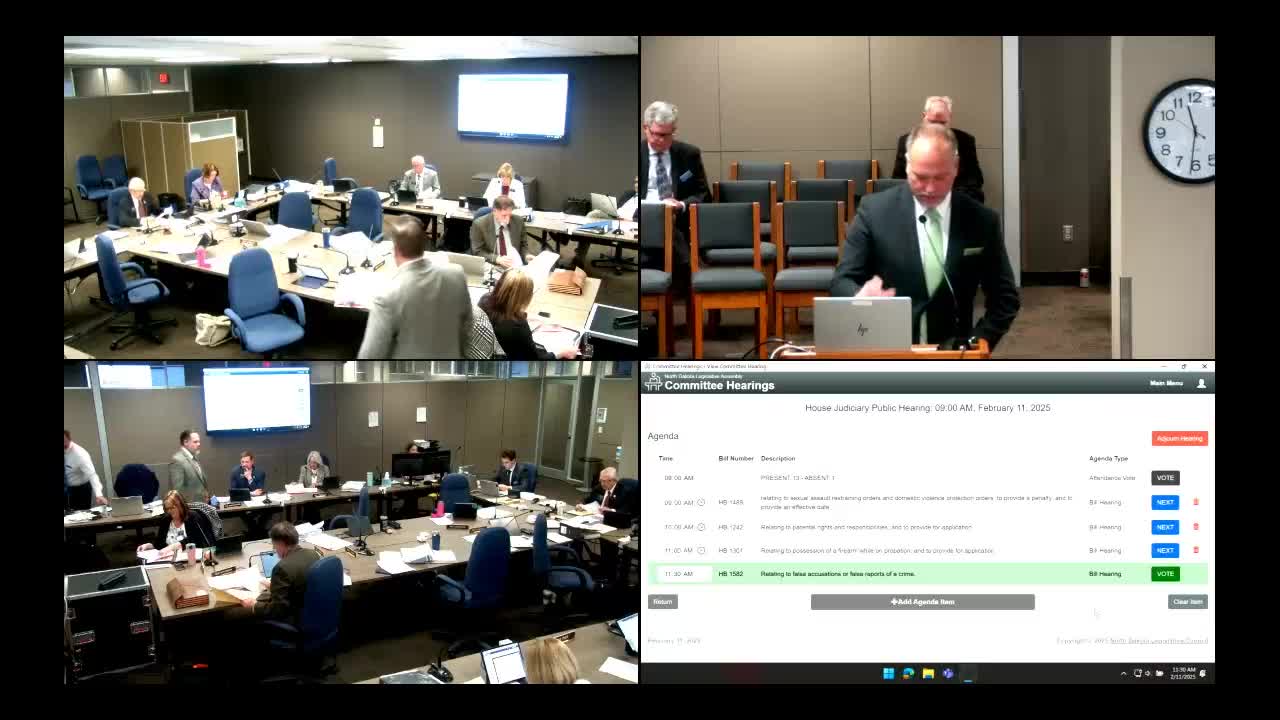
Representative Steve Vetter asked the House Judiciary Committee to approve House Bill 1582, a Legislative Management study into laws and practices related to false accusations or false reports of crime, and proposed adding defense attorneys to the study’s stakeholder list.
Representative Steve Vetter introduced House Bill 1582, a proposal to direct the Legislative Management to study whether state laws related to false accusations or false reports of a crime warrant review and potential change. Vetter said he had received anecdotal reports that false reporting has increased and asked the committee to authorize a study that would collect data on existing charges and outcomes and consider possible statutory responses.
Vetter told the committee he would amend the bill to add defense attorneys to the list of stakeholders the interim study must seek input from; he said the amendment was suggested after consulting with legal counsel. Travis Fink of the North Dakota Commission on Legal Counsel for Indigent Defense (testifying for the Commission on Legal Counsel for Innocence) said his organization supported the study and asked that defense perspectives be included so defense counsel could identify patterns of repeated or unsubstantiated complaints that should be disclosed to prosecutors and defense counsel in future cases.
Representative Joe Twight moved the committee amendment to add defense attorneys; Representative Cloud seconded. The committee approved the amendment on a roll call, 13‑0 with one member absent (recorded as 13‑0 with 1 absent not voting). Representative Hoberson moved (moved as recorded in the transcript) that the committee give the bill a due‑pass recommendation as amended; on the final roll call the committee recorded 12 yes, 1 no and 1 absent not voting and the motion carried.
Supporters said the study could identify whether reporting processes or documentation practices should change so prosecutors, defense counsel and courts have better information about prior unsubstantiated allegations. Opponents did not appear at the hearing. The committee placed the study on the floor consent calendar if the bill receives unanimous support in the full House.
Ending: The committee voted the bill as amended out with a due‑pass recommendation and specific roll‑call tallies: the amendment adding defense attorneys passed 13‑0 (1 absent) and the bill as amended passed the committee 12‑1 (1 absent). The study will include input from state’s attorneys and defense attorneys and will report back through the Legislative Management process.