Get Full Government Meeting Transcripts, Videos, & Alerts Forever!
Get email alerts on the Civil Protection Orders topic
No spam. Unsubscribe anytime.
House Judiciary hearing examines bill to consolidate civil protection orders into single chapter
Summary
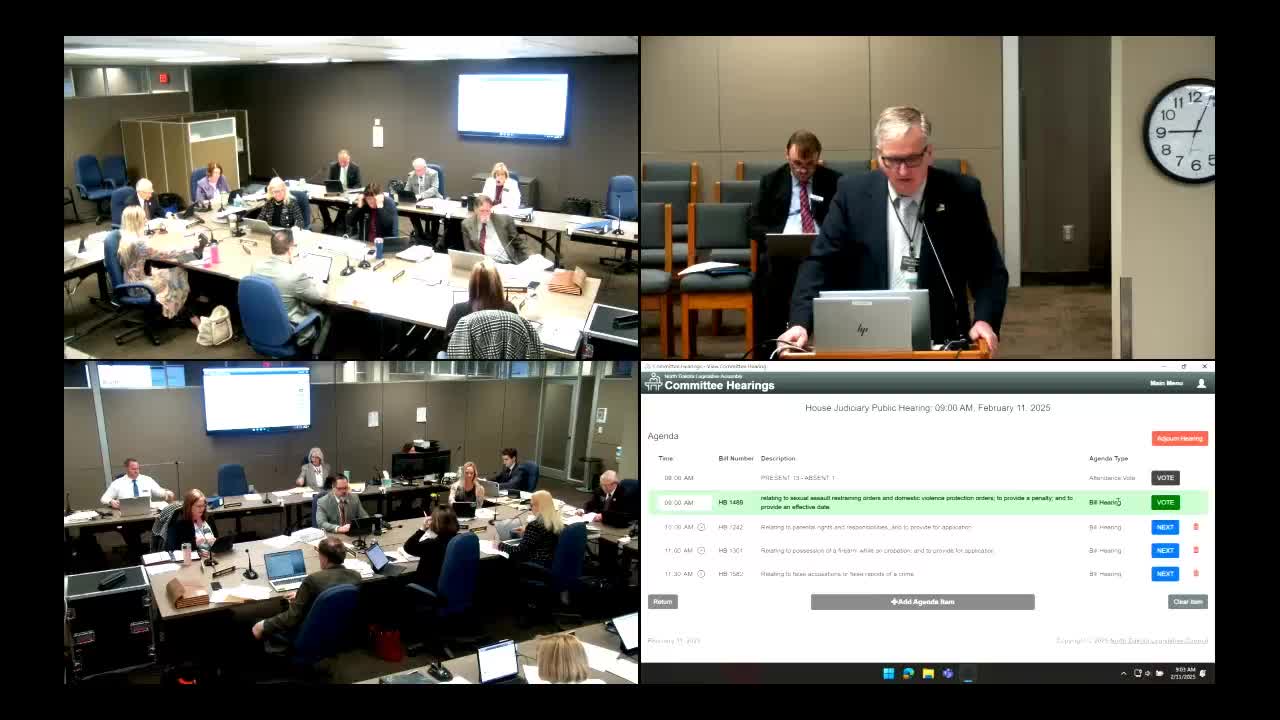
Representative Bernie Satrim, sponsor of House Bill 1489, told the House Judiciary Committee the measure was submitted at the request of the Supreme Court and “has a very simple purpose, which is to streamline our laws and have this subject in 1 spot rather than multiple places.”
Representative Bernie Satrim, sponsor of House Bill 1489, told the House Judiciary Committee the measure was submitted at the request of the Supreme Court and “has a very simple purpose, which is to streamline our laws and have this subject in 1 spot rather than multiple places.”
The bill would create a new chapter in the North Dakota Century Code consolidating three existing civil remedies — disorderly conduct restraining orders (DCROs), domestic violence protection orders (DVPOs) and sexual‑assault restraining orders (SAROs) — under a single umbrella term “civil protection order” and move related provisions into chapter 14‑07.7. The sponsor and court staff told the committee that the change is intended to make forms, service, and court procedure more consistent and to avoid confusion about filing and service fees.
Sarah Behrens, a staff attorney with the State Court Administrator’s Office, outlined specific changes in the bill, including a uniform definition section, a requirement that courts transmit entered orders to the Bureau of Criminal Investigation for inclusion in the National Crime Information Center, and a conspicuous notice requirement telling respondents what conduct would violate an order and that law enforcement may arrest without a warrant for probable‑cause violations. Behrens also said the bill sets a delayed effective date of Jan. 1, 2026, to allow Judicial Branch IT and the Supreme Court self‑help center time to update forms and systems.
Advocates and practitioners who testified generally supported consolidation but proposed targeted amendments. Seth O’Neil of the North Dakota Domestic and Sexual Violence Coalition urged restoring language that would enhance penalties for repeat violations only after a prior conviction, saying the bill as filed could be read to reduce repeat‑offense penalties. He provided an amendment to clarify that the second or subsequent violation becomes a class C felony only after a prior conviction. Behrens said the court supports adding conviction language to address that concern.
Aaron Burst of the North Dakota Association of Counties supported the bill’s principles but flagged a fiscal concern: language in the draft that would bar sheriffs from charging service fees for any civil protection order. Burst said several county sheriffs perform many services and that outright elimination of service fees would be a revenue hit for some counties; he asked the committee or a follow‑up subcommittee to quantify any fiscal impact.
Jonathan Byers of the North Dakota State’s Attorneys Association opposed a provision that would allow state’s attorneys to advise petitioners on preparation of civil documents, arguing that office ethics, potential conflicts and liability concerns counsel against state’s attorneys providing civil advice to private parties.
Chairman Clamine (committee chair) said the committee would appoint a subcommittee to reconcile the Supreme Court’s proposed amendments, O’Neil’s suggested clarifications, and the county concerns about fees. Representative Bernie Satrim was named chair of the subcommittee; Representatives Schneider and Holson were also appointed. The chair asked the subcommittee to report back by the following Tuesday and said the subcommittee meetings would be public with the clerk in attendance.
The committee took no final vote on the bill after the hearing. The sponsor and court staff asked for a “do pass” recommendation and agreed to work with the subcommittee on technical fixes and the penalty language. The chair closed the hearing and set a subcommittee review as the next step.
Ending: The committee will reconvene on the bill after the subcommittee completes its review and reports back to the full committee; any fiscal information about service‑fee impacts and language addressing state’s attorneys’ role will be part of that work.