Get Full Government Meeting Transcripts, Videos, & Alerts Forever!
Get email alerts on the Childcare Policy topic
No spam. Unsubscribe anytime.
Planning Commission staff backs ordinance changes to align county childcare rules with state licensure
Summary
Staff recommended removing county zoning rules that duplicate or contradict Tennessee Department of Human Services (DHS) childcare licensure requirements and making many childcare uses permitted by right in commercial zones to streamline permitting and reduce conflicts.
Planning staff recommended that Knox County amend local zoning rules to defer to Tennessee Department of Human Services licensure standards for child care and to simplify permitting for child care providers.
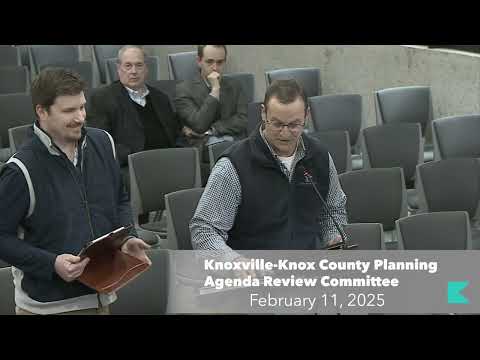
Jesse, planning staff, told the Planning Commission during the Feb. 11 agenda review that the proposal updates terminology, removes most supplementary local regulations in Article 4.91 that repeat or conflict with DHS rules, and shifts child care facilities from a use-on-review to a use-by-right in many commercial and business zones. “The amendment focuses on review processes for child care facilities and its purpose is to align zoning regulations with the Department of Human Services licensure rules for childcare agencies and to streamline the provision of those services,” Jesse said.
Staff said the local standards sometimes required more or different space than state licensure—the example cited was outdoor play space, where DHS requires 50 square feet of usable outdoor play space per child while the zoning ordinance required 2,500 square feet for the first 20 children and 100 square feet for each additional child. Staff recommended removing the local standard so providers need only meet state rules for licensing.
The proposal also renames and clarifies four terms used in the code (child care agency, child care center, group child care home and family child care home) to match DHS language. Under the draft, child care homes continue to be permitted in residential zones; in commercial and employer-focused zones, child care agencies would be a use by right and child care centers would be removed as a use on review.
Staff framed the change as consistent with several Knox County comprehensive plan implementation policies (including Policy 3.4 on simpler permitting and Policy 3.1 on removing regulatory barriers) and with national planning guidance. Jesse said the change is intended to reduce duplicative review and confusion for providers while preserving state public-safety licensing.
Commissioners asked whether the county would still record a facility’s maximum number of children as part of any review; Jesse confirmed that any use-on-review approval would continue to state a maximum and that DHS sets licensing limits. Commissioners also asked which standard was larger for outdoor play; Jesse said the county standard became larger after 20 children and that the amendment intends to defer to DHS.
No formal vote or ordinance text adoption occurred at the agenda review; staff presented the recommended amendments for the commission’s consideration and questions.
Ending: Staff asked the commission for questions and said a formal ordinance would follow through the normal public hearing and adoption process.