Get Full Government Meeting Transcripts, Videos, & Alerts Forever!
Get email alerts on the Juvenile Competency Remediation topic
No spam. Unsubscribe anytime.
Senate panel delays vote on $4.58M juvenile remediation plan, asks staff to draft smaller appropriation
Summary
Lawmakers pressed Human Services on implementation, certification and regional staffing for a proposed program to restore juveniles’ competency to stand trial and asked staff to draft an amendment reducing the appropriation and removing federal spending authority before further action.
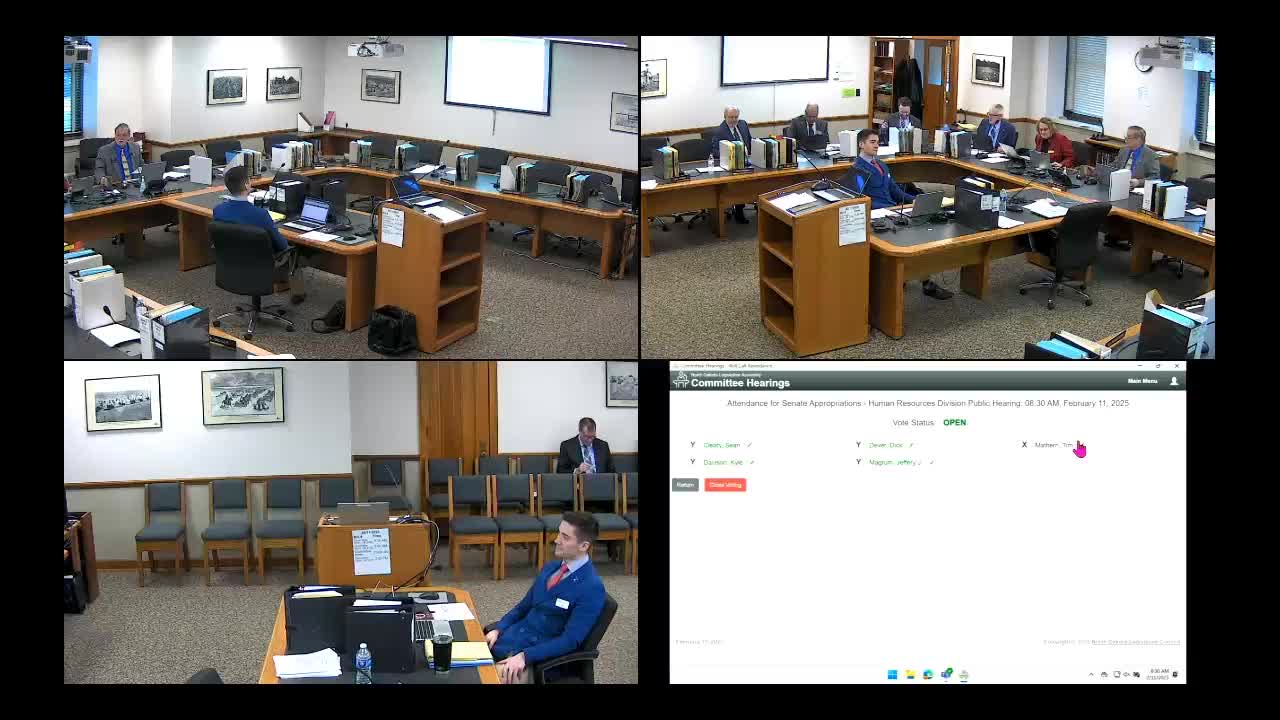
The Senate Appropriations Committee (Human Resources Division) continued work on Senate Bill 2036, a bill to fund community-based remediation services to restore juveniles’ competency to stand trial, but did not vote on the measure and directed staff to draft amendments reducing the appropriation and removing the federal spending line.
Antonia Burningsili, director of operational development at the Department of Health and Human Services, told the committee the bill "sets up programming to assist an individual ... that is found lack competency, which means they don't understand or appreciate the court proceedings and helps them regain" the understanding necessary to participate in their defense. She said the draft appropriation reflected an earlier $4.58 million general-fund total plus $1 million in federal funds, and that an amendment during an earlier policy session had moved the bill’s effective date to Jan. 1, 2027.
Committee members pressed the department for implementation details, asking how personnel and certification would be handled and whether private contractors could provide parts of the service. Pam Sagnis, Executive Director of Health and Human Services, said the department prepared a budget at the Juvenile Justice Commission’s request after the department’s executive budget was already submitted, and that the proposed FTEs and funding were not included in House Bill 1012, the department’s base budget.
Committee members raised several recurring concerns: (1) no national certification currently exists for the proposed remediation providers and the state would need to create and maintain a certification process; (2) the department proposed staffing that would place one remediation specialist and one child-in-need-of-protection-services worker in each of the state’s eight regions (the bill’s request translated to roughly 21–22 FTEs in testimony), while current referrals are about 12–20 assessments per year; and (3) the department’s plan assumed community-based regional services rather than centralized inpatient care.
Jonathan Hall, an attorney with the Department of Health and Human Services, explained the bill’s relationship to other proposals: "They're two separate laws. ... 2,037 is dealing with 12.104.1, which is dealing with lack of criminal responsibility. ... 2,036 ... is dealing with the 12.104, which is dealing with the fitness to proceed and the remediation services." Committee members pressed whether the same forensic assessment team would serve both processes; legal staff said the same forensic team generally performs assessments for the separate statutory processes but at different times.
Several senators urged a smaller, staged approach. One member suggested funding planning and rule development first (an example figure discussed was $250,000 to develop certification and an implementation plan), rather than funding a full regional rollout immediately. Senator Davidson (member of the committee) proposed reducing the general-fund appropriation to $1.5 million and removing the $1 million federal funds line; the chair asked legislative counsel to draft the technical amendment language.
The committee closed discussion on SB 2036 and asked staff and counsel to prepare an amendment that would lower the general-fund appropriation and remove the federal spending authority; the bill will return to committee when the amendment is ready. No formal committee vote on SB 2036 occurred during the session.
Background: Testimony described three possible case paths after assessment — (1) a juvenile found fit to proceed, (2) unfit but restorable (the target group for remediation services), and (3) unfit and unrestorable (potential CHIPS/civil processes). Department witnesses said current assessments (about 12–20 annually) are occurring now without a remediation service available and that referrals would likely rise if a formal service expectation were established.
The committee’s next step was to await the drafted amendment and return the bill for further action.