Get Full Government Meeting Transcripts, Videos, & Alerts Forever!
Get email alerts on the Assistive Technology topic
No spam. Unsubscribe anytime.
Committee hears bill to codify Maryland Assistive Technology Program and let it charge fees for new services
Summary
House Bill 214 would codify the Maryland Assistive Technology Program (MDTAP/TAP) in state law, allow new fee-for-service assistive-technology assessments, and create a special fund to retain modest revenue for program sustainability.
House Bill 214 would add the Maryland Assistive Technology Program (TAP) to state statute, authorize TAP to perform additional assistive-technology (AT) services beyond its current federal grant, and allow the program to charge reasonable fees for some of those new services.
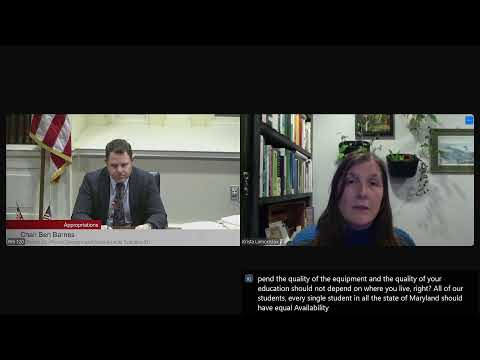
Carol Beatty, secretary of the Maryland Department of Disabilities, told the House Appropriations Committee that TAP exists today under federal funding only and cannot undertake non‑federal activities or retain revenue. "TAP is not in state law," Beatty said. The bill would codify TAP into the statute that established the Department of Disabilities and authorize a special fund to receive modest fee revenue; the department estimated initial revenue at roughly $25,000 annually.
Laurie Barong, executive director of MDTAP, described the program's current federally funded services — consultations, demonstrations, training and device libraries — and asked the committee to let the program begin providing AT assessments. Barong said a comprehensive AT assessment typically requires about four hours of clinician contact and produces clinical documentation similar to a medical prescription. She told the committee TAP declined more than 450 requests for full AT assessments between 2023 and 2024 because the federal grant does not pay for assessments.
Under HB 214 those free AT services currently covered by the federal grant would remain free, witnesses said, while fee‑for‑service assessments and similar activities would be authorized and their fees placed into a TAP special fund to sustain program operations without relying on state general‑fund appropriations. The bill would not initially require state general fund support, according to testimony.
Committee members asked about fees, service access and the potential for the new authority to affect federal funding. Witnesses said the aim is modest revenue to expand services, and emphasized that TAP would preserve current free services and prioritize access for people the federal grant already serves.
Ending: The bill would codify MDTAP in state law and authorize limited fee‑for‑service operations, with TAP-specific revenue placed in a special fund to support expanded AT assessments and related services.