Get Full Government Meeting Transcripts, Videos, & Alerts Forever!
Get email alerts on the Higher Education Funding Formula topic
No spam. Unsubscribe anytime.
Appropriations panel advances working version of higher-education funding formula, flags pharmacy credit change
Summary
Chairman Sarvaugh opened a session of the Appropriations - Education and Environment Division to review a new higher-education funding worksheet that would recalculate base rates, incorporate targeted equity and retirement pools into the base, and model a 4% increase to base rates — decisions the panel said are intended to create a working budget baseline for further negotiation.
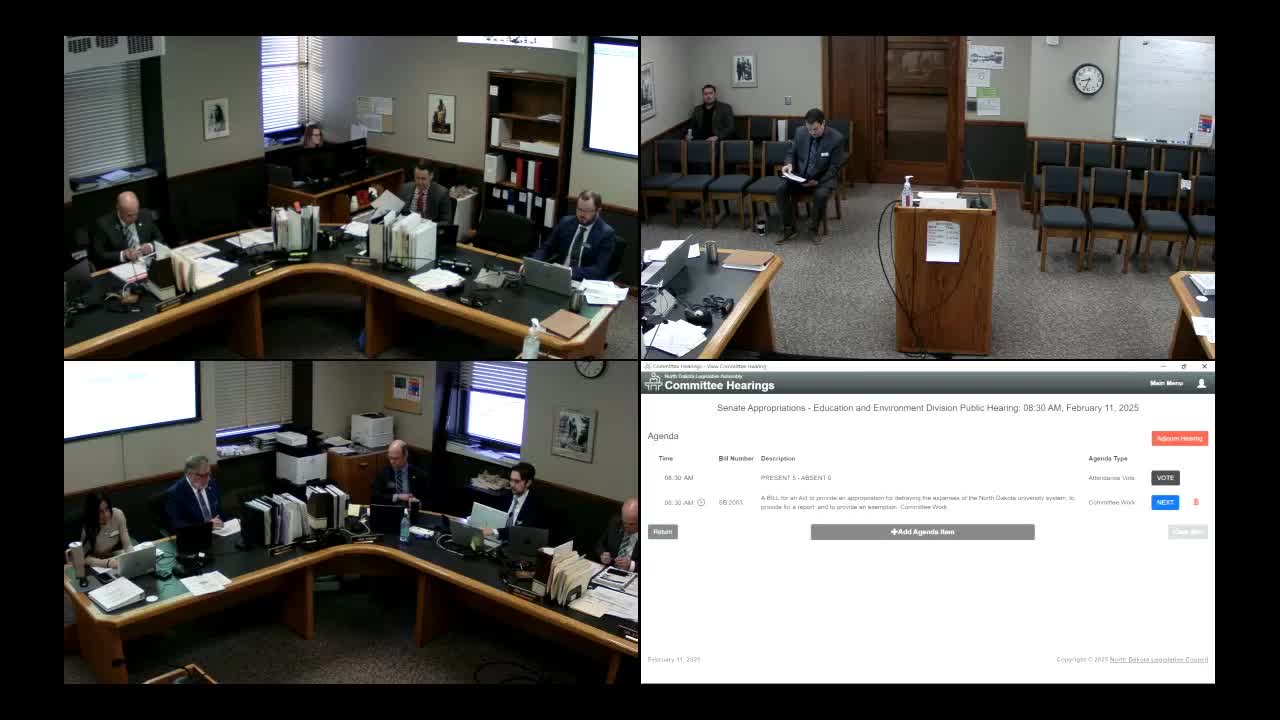
Chairman Sarvaugh opened a multi-hour Appropriations - Education and Environment Division session by asking staff to walk members through a new higher-education funding worksheet intended to produce a working budget baseline.
The worksheet, explained by Alex Braun of the North Dakota University System (NDUS), showed columns for institutions’ current base funding, previously appropriated targeted equity and retirement pools, credit adjustments, and proposed changes from Senate Bill 2034. Braun said increasing base rates by 4% under the worksheet would cost “a little under $27,000,000 from the general fund.”
The committee’s purpose, Sarvaugh said, was to produce a working long sheet within about 10 days; numbers in the packet were provisional placeholders, not final amounts. Braun told members the spreadsheet combined the base funding formula, targeted equity and retirement appropriations, and adjustments to credit-completion factors carried forward from the prior biennium.
Why it matters: the worksheet redefines the “base” from which future percent increases would be calculated. Braun and other staff said including targeted equity and retirement in the base is intended to make funding consistent across agencies but will raise the apparent base budget compared with governors’ recommendations that left those pools outside the formula.
Key technical points discussed
- Targeted equity and retirement: Braun said those appropriations were previously allocated by the Office of Management and Budget and then distributed to campuses; the worksheet treats them as part of the base for formula calculations to maintain consistency with other agencies.
- Equalization adjustments and hold-harmless: Senators pressed for clarity about a recent practice called “averaging” that adjusted base rates after inserting new costs (salary increases, tuition freezes). The worksheet restores amounts for institutions that lost funding due to averaging; committee members and staff described that restoration as meant to “make up for those that lost because of averaging.”
- Senate Bill 2034 and credit-factor changes: Braun described portions of SB 2034 that would raise completion factors for certain career-technical programs (wind-energy technology and law-enforcement credits at select campuses) and the pharmacy professional-credit factor. Those program-level factor changes drove some large campus adjustments in column E of the worksheet, most notably increases shown for Lake Region State College and Dickinson State College.
- Pharmacy credits: Braun noted pharmacy was historically treated as a lower factor (discussed in the packet as roughly 9) compared with law and medicine. He said committee staff asked institutions (NDSU and others) to justify a proposed move toward a much higher “factor” for pharmacy instruction (Braun’s packet modeled a factor of 25 to drive the discussion). The committee did not adopt a final pharmacy factor; members requested additional justification from institutions before deciding.
Committee direction
Members agreed to move the worksheet into a long sheet so staff could produce a working budget document for further adjustments. Sarvaugh emphasized the numbers were not final, calling the long sheet a “working” baseline for negotiations. The committee also agreed that the averaging practice would not be used going forward absent direction.
What’s next
Staff will convert the worksheet to long sheets for the committee to review. Members requested more detailed written justifications from campuses about large program-factor changes (particularly pharmacy) and scheduled further discussion in subsequent meetings before any final appropriations language is adopted.