Get Full Government Meeting Transcripts, Videos, & Alerts Forever!
Get email alerts on the Prison Nursery Program topic
No spam. Unsubscribe anytime.
DOCR urges approval of nursery program at Heart River Correctional Center; advocates cite lower recidivism, civil‑justice groups warn on immunity
Summary
Senate Bill 23‑52 would authorize children to live with incarcerated mothers at the Heart River Correctional Center in a staffed nursery unit inside the secure perimeter; the department says federal funds and the facility plan support the program, while a legal‑advocacy group opposes broad immunity language.
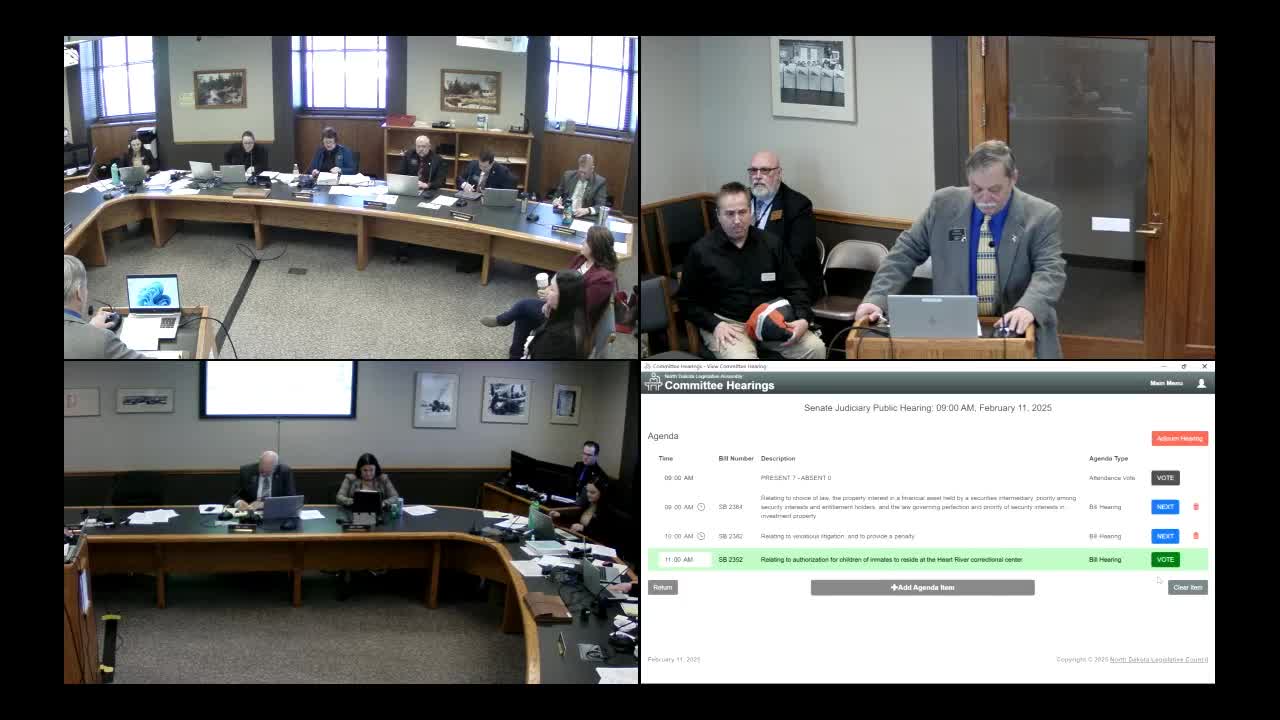
Senator **** Deaver reintroduced Senate Bill 23‑52 to allow children of incarcerated women to reside at the Heart River Correctional Center (HRCC) in a nursery program inside the new women’s facility. The Department of Corrections and Rehabilitation (DOCR) and child‑welfare advocates testified in support; the North Dakota Association for Justice testified in opposition, chiefly over a proposed liability immunity provision.
Sponsor and agency presentation - Senator Ron Deaver (sponsor) told the committee that federal Title IV‑E (often cited as “IV‑E”) funds and other program support make the proposal financially feasible and said the Legislature should give the DOCR direction now so the agency can plan while the new women's facility is built. He urged either passage with a delayed effective date or a later session reintroduction if the committee preferred more work. - Cheryl Thomas, women’s services manager for the Department of Corrections and Rehabilitation, outlined DOCR’s proposed policy and operations. “The DOCR will make the well‑being of an infant within our facility priority,” Thomas told the committee. She described a staffed, secure apartment unit inside the secure perimeter of the HRCC, a 24/7 staffed nursery model that the department’s draft policy would make available from birth to 18 months in the initial plan. Eligibility criteria in the draft policy include that the mother gives birth while in custody, intends to be primary caregiver upon release, has a parole or good‑time release date within 18 months of birth, and clears medical and mental‑health screening.
Supporters’ arguments and evidence - DOCR and supporting witnesses emphasized research from other states: Illinois reported 3 of 78 participants returning to prison in a cited sample; Ohio 7 of 74 over five years; Delaware and California programs were also cited with low return‑to‑prison rates. DOCR stated existing training for staff and residents (CPR, first aid, mandated reporting) and said some facility costs are included in the new construction budget. - Chelsea Florian, a county human services zone director, testified that the program would create day‑to‑day parenting opportunities — mealtime, medical visits and routine care — that short visitor sessions cannot replicate, and she called the program a tool for reunification and stabilization.
Costs, staffing and logistics - DOCR provided a fiscal estimate of $100,000 for initial operational purchases (cribs, mattresses, chairs) for the 2027‑29 biennium and estimated roughly $70,000 for the 2029‑31 biennium to support eight infants in the program; DOCR told the committee the nursery will not open until the new facility is scheduled to open in fall 2027. - The department said the apartment unit is inside the secure perimeter, would be staffed 24/7, and that caregivers for day‑to‑day infant care would initially be incarcerated residents assigned institutional jobs and trained for the work; those caregivers would be paid institutional wages and would not be external FTEs paid from the general fund. The DOCR said clinical and treatment staffing is included in the facility’s staffing plan submitted as part of the construction project.
Opposition and legal concerns - Jackie Hall, executive director of the North Dakota Association for Justice, testified in opposition to the bill as written. The association’s principal concern was a proposed immunity clause in the draft statute (language that would bar civil actions for certain harms occurring while a child resided at the facility). Hall urged the committee to remove the word “affirmatively” from the draft immunity provision because “affirmatively” is not defined and would create uncertainty about the standard of negligence. - Hall also noted that the statutory draft used the word “children” (which in law commonly extends to age 18) and urged the committee to narrow the age range in statute or clarify policy so the Legislature is not effectively delegating a broader program expansion without return.
Questions from senators - Senators asked whether the $100,000 fiscal note represented state general funds or other funds; DOCR said the $100,000 in the note is general fund for initial equipment purchases and estimated some operating costs would be covered by federal funding such as Title IV‑E and Medicaid for eligible services. - Senators sought detail about apartment capacity and security. DOCR staff explained that the women’s unit is divided into four secure apartment clusters; during the hearing there was back‑and‑forth over room counts and how many mothers the design could house, but DOCR clarified the apartment layout allows flexibility for up to the design capacity of the unit and that operational rules will determine the day‑to‑day census.
Outcome and next steps - The Judiciary Committee closed the hearing and received written testimony; no committee vote on SB 23‑52 was recorded during this session. DOCR asked the Legislature to adopt the statutory authorization now or to use a delayed effective date so the agency can finalize policies while construction continues.
Clarifying details - DOCR’s operating‑cost estimate and stated staffing plan are tied to the new women’s facility under construction and to plans already submitted with the build; the department said key training items and many operational features are already budgeted in the facility planning. - Foster care cost comparison: DOCR cited a foster‑care payment of $870 per month (about $10,440 per year) for an infant as a comparator and said in testimony that the state’s cost to support a mother and baby in the nursery would be lower than that foster‑care annual figure once the nursery is established.
Notes: The committee heard multiple student and child‑welfare advocates in favor and a formal legal‑interest organization opposing the immunity language. Members asked the department to refine policy and cost details; the Legislature could advance with a delayed effective date to allow DOCR to finalize administrative policy before opening the program.