Get Full Government Meeting Transcripts, Videos, & Alerts Forever!
Get email alerts on the Childrens Health Insurance Program topic
No spam. Unsubscribe anytime.
Committee upholds CHIP eligibility limit under federal rules; no fiscal impact reported
Summary
The Senate Human Services Committee voted unanimously to approve House Bill 1070, which aligns state Children's Health Insurance Program eligibility with a federal regulatory limit and noted there is no immediate fiscal impact under current projections.
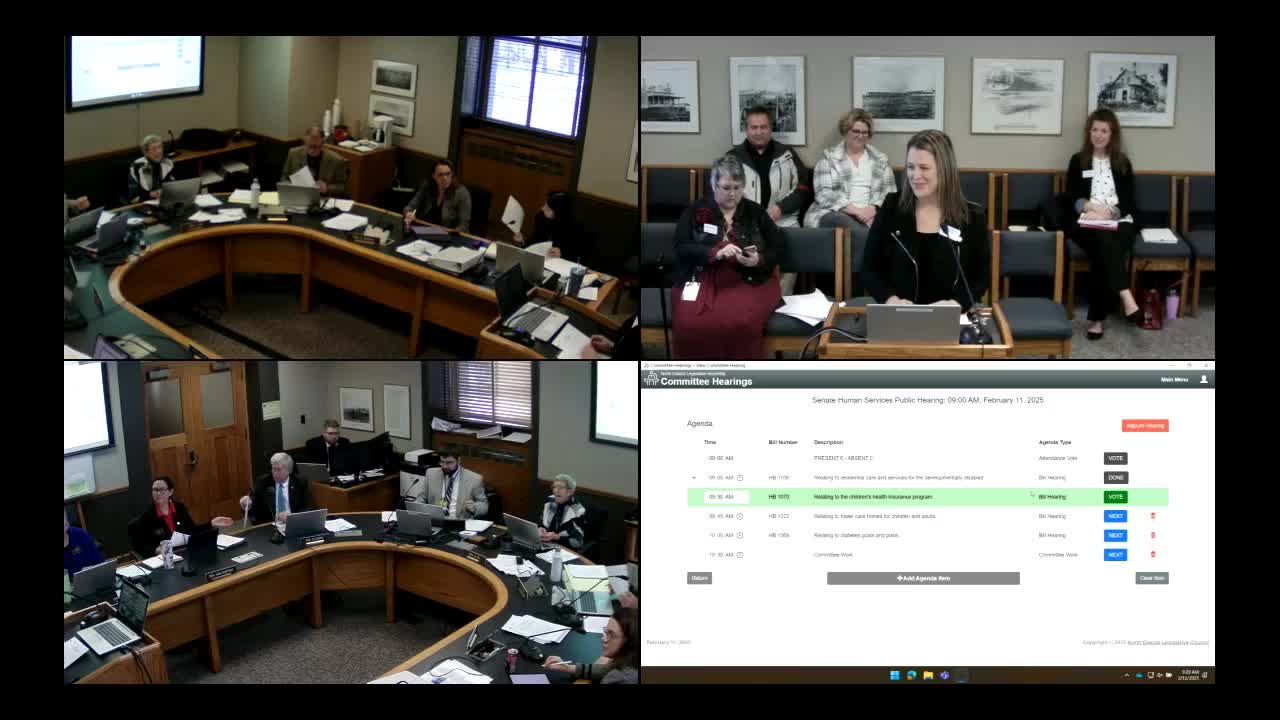
The Senate Human Services Committee voted 6-0 to give House Bill 1070 a due-pass recommendation after hearing department testimony explaining a federal limit on income eligibility for the Children's Health Insurance Program (CHIP).
Krista Fremming, assistant director of medical services at the Department of Health and Human Services, said the department initially sought to raise CHIP income eligibility to 210 percent of the federal poverty level during the 2023 session. Following further guidance from the Centers for Medicare and Medicaid Services, the department learned federal regulation 42 CFR 435.4 effectively caps the state’s upper limit at 200 percent of the federal poverty level with a standard five-percentage-point income disregard applied, yielding 205 percent as the practical upper bound for the state. Fremming explained, “The reason that this is the maximum is because of federal regulations at 42 CFR 435.4.”
Why it matters: CHIP provides coverage for children in families whose incomes exceed regular Medicaid thresholds. The department told the committee that, because of the federal regulatory cap, the state cannot lawfully set CHIP eligibility at 210 percent federal poverty level and instead must use the maximum allowable federal threshold.
Testimony and local perspective: Lynn Fleeth, director for an RSR human service zone, told the committee her zone and other local human-service directors strongly support continuing the program, even at the 205 percent level. Fleeth said zone staff see CHIP as critical to families living paycheck to paycheck for whom employer or private coverage is unaffordable or unavailable. The department agreed to provide members with a chart showing federal poverty level thresholds and eligibility pathways used by state programs.
Vote and procedural details: Senator Roars moved the due-pass motion, seconded by Senator Weston; the motion passed by roll call 6-0. Committee members asked the department for enrollment numbers and the department agreed to follow up with specific current enrollment figures.