Get Full Government Meeting Transcripts, Videos, & Alerts Forever!
Get email alerts on the Developmental Disabilities topic
No spam. Unsubscribe anytime.
Senate Human Services committee approves technical updates and a pilot 'host home' program for people with developmental disabilities
Summary
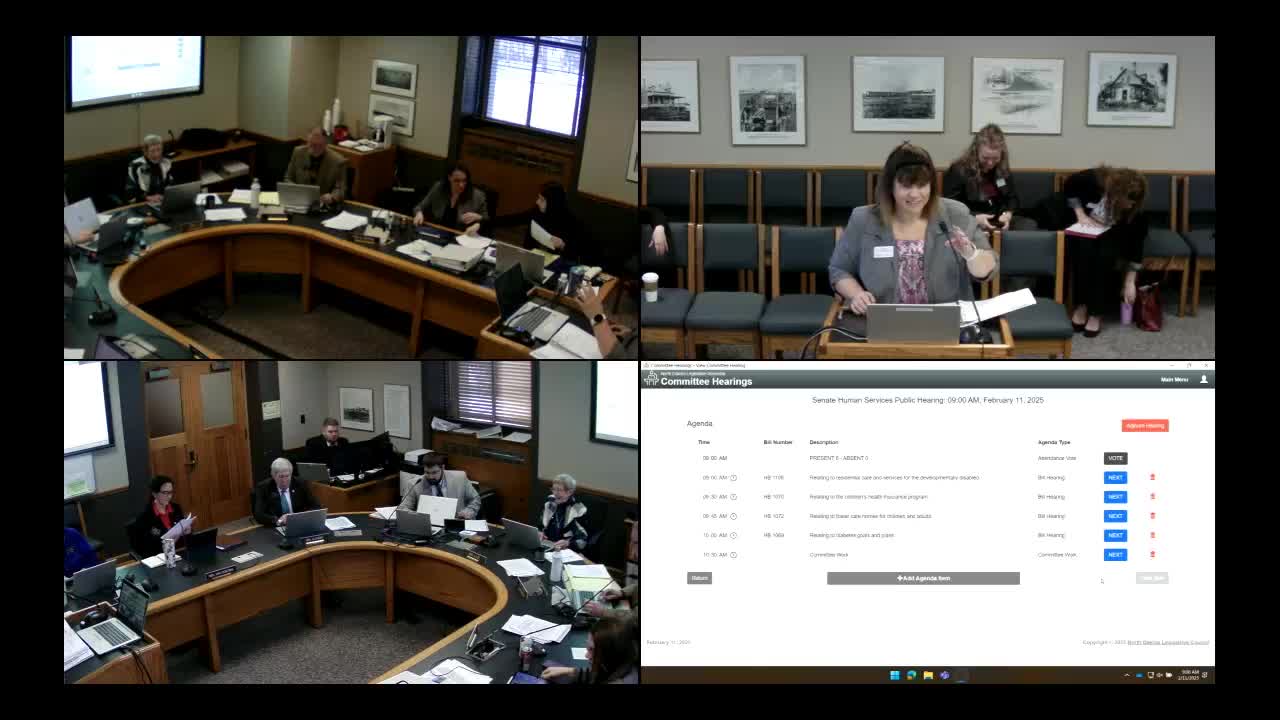
The Senate Human Services Committee voted unanimously to amend and pass House Bill 1109, which updates terminology in state law and authorizes a pilot host-home program limited to small, family-like placements for Medicaid-eligible individuals with developmental disabilities.
Chairman Lee and members of the Senate Human Services Committee voted 6-0 to pass House Bill 1109 as amended, approving a suite of technical changes to North Dakota law and language authorizing a pilot host-home program for some people with developmental disabilities.
The bill, presented by Tina Bay, director of the Developmental Disabilities Section at the Department of Health and Human Services, replaces outdated phrases such as “treatment or care center” with “provider agency” and “resident or patient” with “individual or eligible individual” across multiple sections of the Century Code. Bay told the committee the department requested the bill “to remove outdated terminology, and align with the language with more person centered principles.”
Committee members also approved a department-proposed amendment that adds a definition for a host home and moves several related statutory provisions into clearer locations in the chapter. Under the amendment, the department may establish “a host home program to provide out of home placement habilitation and support services for Medicaid eligible individuals with developmental disabilities.” The draft amendment specifies that a host home would be a community-based family home providing services to “no more than 2 individuals with developmental disability.”
Why it matters: Committee members framed the change as both a housekeeping update and a policy step to expand small, family-like placements for people who need intensive supports. Supporters said the host-home option could provide respite, wraparound services and, whenever appropriate, help with reunification to the person’s biological family.
Details of discussion and implementation: Bay said several administrative-code and statutory adjustments are included: moving definitions (for example, group home and individual with a developmental disability) into a single definitions section, revising record-access provisions used for department oversight, and creating a new corrective-actions section giving the department options if a provider agency is not in compliance. Bay also told the committee the department wants to add the host-home definition to enable “continued development of services that can better address the range of unique needs of people served.”
On program design, committee members pressed for operational detail. Senator Hogan asked whether a host home could be a single-occupancy home; Bay answered, “That would be the intent.” Bay said the department currently operates a related waiver service called Family Care Option that has been underused (she estimated about three people currently use it), and the department plans a pilot with a private vendor experienced in foster care models funded initially with American Rescue Plan Act funds before seeking to move the service into the Medicaid waiver. Bay also said funding for the host-home projects was included in the governor’s budget.
Committee members debated the numerical limit used in the draft language (the amendment uses “no more than 2”). Bay explained that administrative rules treat settings with more than three or more residents differently (noting the threshold language in administrative code), and that keeping host homes at two or fewer residents is intended to preserve a “family-like environment” for children who may need intensive supports. Committee members asked the department to consider whether “three or fewer” might be a better pilot threshold; Bay said the department is open to discussion as the pilot develops.
Formal actions and votes: The committee moved and passed the department-proposed amendment, and subsequently moved and passed the bill as amended. The amendment was moved by Senator Rohrer and seconded by Senator Weston; the roll call vote on the amendment was 6-0 (aye). The committee then moved a due-pass motion on House Bill 1109 as amended (moved by Senator Holden; seconded by Senator Van Oosting), and the motion passed by roll call 6-0.
Closing and next steps: Senator Hogan volunteered to carry the bill. Bay told the committee the department is still finalizing pilot details and would return with proposed operational rules and a pilot timeline as those specifics are developed. Committee members asked the department to continue outreach to developmental-disability providers and to report back with lessons learned from the ARPA-funded pilot.