Get Full Government Meeting Transcripts, Videos, & Alerts Forever!
Get email alerts on the Uniform Commercial Code Article 8 topic
No spam. Unsubscribe anytime.
North Dakota hearing on UCC Article 8 draws farmers, citizen experts and banking lobby
Summary
Supporters urged the Legislature to amend Uniform Commercial Code Article 8 to protect small investors’ claims to securities in insolvency; banking groups, the Uniform Law Commission and state regulators warned changes could disrupt clearinghouses and investor services.
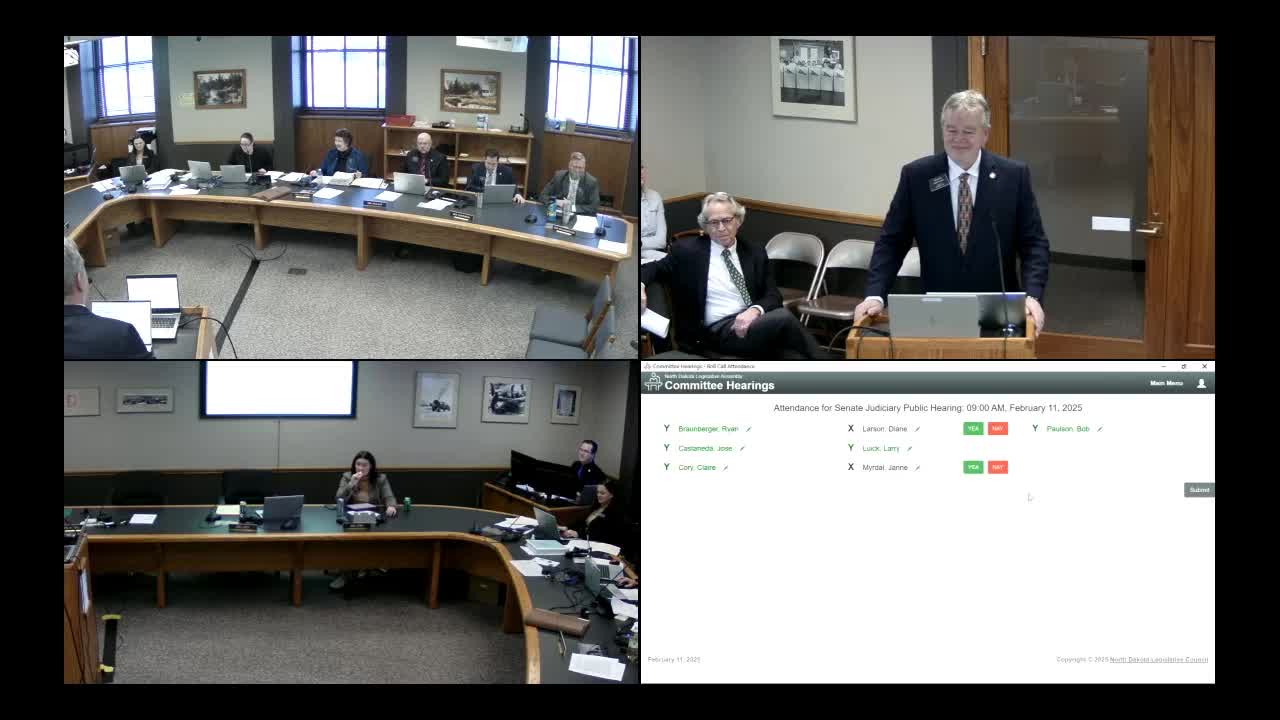
Chair Larson convened a Senate Judiciary Committee hearing on Senate Bill 23‑64, a proposal to change the choice‑of‑law and priority rules in Uniform Commercial Code (UCC) Article 8 that supporters say would protect North Dakotans’ property interests in securities. Proponents told the committee that the current indirect holding system leaves individual investors as “entitlement holders” with weaker rights in institutional insolvency.
The bill’s sponsor and early proponent, Senator Mark Inge, introduced the topic and said the hearing would focus on Article 8’s treatment of security entitlements. “I am here to express legitimate and alarming concerns over the content and dangers of Article 8,” Inge said. Private citizen Kyle Warner and attorney Don Grandy, who represents True North Public Policy, both urged the committee to adopt the draft changes; David Webb, author of The Great Taking, gave similar written testimony and spoke remotely.
Why it matters: proponents said the current rules can leave ordinary investors behind secured creditors if an intermediary or clearing corporation becomes insolvent. Warner summarized the proposal’s aim: give entitlement holders higher priority and allow North Dakota law to govern disputes over property interests so the state’s residents and public entities could litigate locally instead of in out‑of‑state venues.
Proponents’ claims and evidence - Kyle Warner, testifying as a citizen, told the committee that section changes on pages 3–4 of the bill would reverse what he called a priority that currently favors secured creditors in the event a clearing corporation “does not have sufficient financial assets to satisfy its obligations.” - Don Grandy, an attorney, told the committee that the bill’s changes are “conservative, surgical” strikes to exceptions he said permit customer property to be treated as collateral without adequate protection. Grandy argued margin accounts are governed by contract and not affected by the proposed deletions. - David Webb told the committee he had a submission from the New York Fed’s response to the Legal Certainty Group that, in his reading, supports the view that entitlement holders are vulnerable in insolvency and receive only a pro rata share of any remaining pool after secured creditors are paid.
Bankers, the Uniform Law Commission and regulators push back - Ben Orzewski, chief counsel for the Uniform Law Commission, said the UCC and Article 8 were developed to enable large‑scale trading and that intangible holdings have long been treated as property. “Intangible property is not new,” Orzewski told the committee, noting electronic holding systems were introduced to address a historical settlements crisis and to enable modern markets. - Orzewski cited UCC section 8‑504(b), which he said prevents intermediaries from using customer holdings as collateral without consent, and he said the exceptions targeted by the bill — including provisions the bill would delete — play recognized safety roles for clearinghouses. - Rick Kleberg, president and CEO of the North Dakota Bankers Association, and Lisa Cruz, commissioner of the Department of Financial Institutions, both testified in opposition. Kleberg argued the bill would make North Dakota “an island” from uniform practice and could raise costs or reduce services such as margin accounts and short selling for North Dakota investors. - Cruz told the committee that the bill could limit consumer choice and make it harder for crypto custody and staking services to operate in North Dakota; she said the department’s experience was that existing law did not expose investors’ assets as proponents described.
Quantitative context and clarifying details - Witnesses used a case study of NVIDIA stock to illustrate volume: proponents cited about 215,000,000 shares traded per day for the company and a market capitalization cited as roughly $3.45 trillion in testimony. - Proponents also cited the notional size of the derivatives market as between $2 and $4 quadrillion (they emphasized the lower bound, $2 quadrillion) to underscore systemic risk arguments. - Ben Orzewski told the committee that North Dakota adopted the current version of Article 8 in 1997 and that the Uniform Law Commission last substantially addressed the topic in 1994; the UCC has been updated in other places as recently as 2022, he said.
What the bill would change - Proponents described the draft changes as striking two exceptions that currently allow secured creditors of clearing corporations or secured creditors that extend liquidity to clearing houses to have priority in insolvency scenarios; the bill would leave the general rule that entitlement holders have priority.
Ending and next steps - The committee allocated time for proponents and opponents and received written testimony; no committee vote on SB 23‑64 was recorded during the session. The Judiciary Committee closed the hearing and signaled it would consider the bill in a later agenda slot.
Notes: The hearing included extended technical discussion of UCC section numbering and exceptions; senators asked for clarifications about the number of states considering similar changes and the scope of any effect on small community banks.