Get Full Government Meeting Transcripts, Videos, & Alerts Forever!
Get email alerts on the Education—Taxonomy topic
No spam. Unsubscribe anytime.
Lawmakers consider requiring mailed notice, property‑owner petition rights for school‑district annexations
Summary
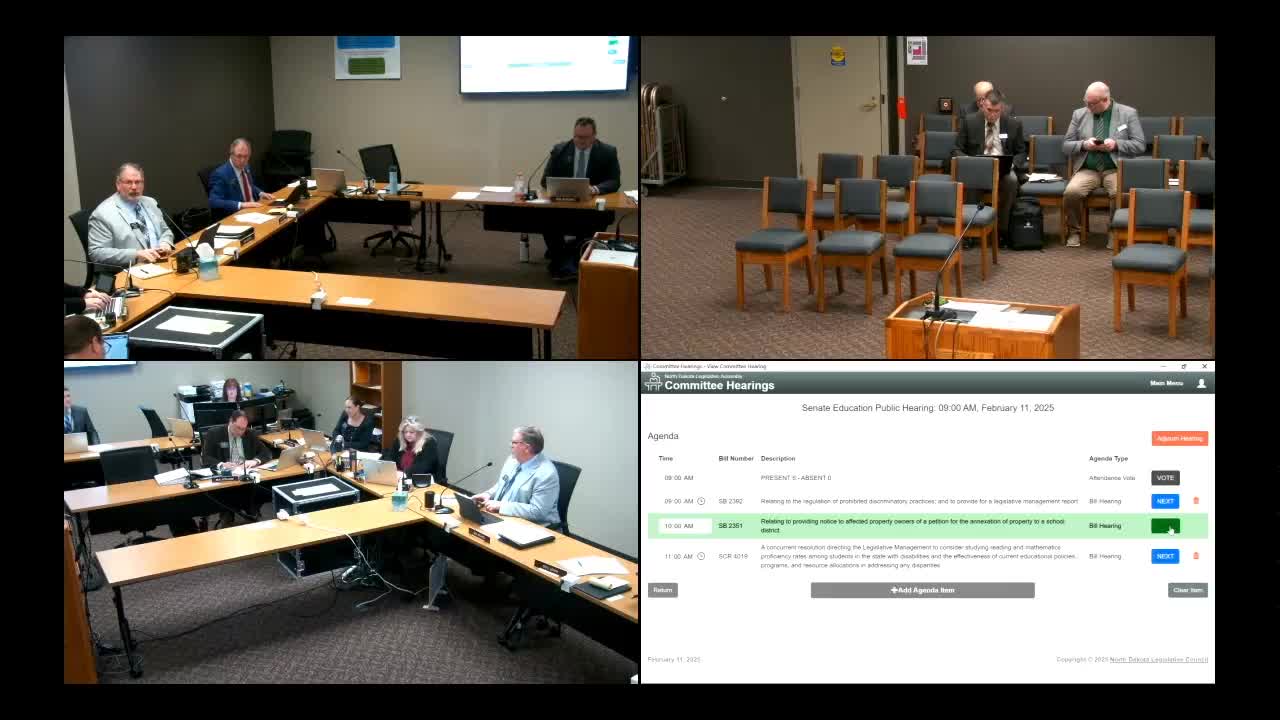
Senate Bill 2,351 would require mailed notice to property owners of proposed school‑district annexation hearings and sponsors urged allowing property owners (not just resident electors) to sign annexation petitions; county and school officials raised practical and legal questions at the hearing.
Senate Bill 2,351, introduced by Senator Todd Beard, would amend state law governing school‑district annexation petitions to require mailed notice to real‑property owners whose land is described in an annexation petition and to clarify who may initiate petitions.
Senator Todd Beard, sponsor (District 23), told the Senate Education Committee the change is designed to ensure property owners learn about annexation petitions that can change school‑district assignment, tax mills and other property implications. “If you annex from one school district to another, it affects your mills, your taxes, everything,” Beard said, and he said a citizen brought the concern to his attention.
Supporters asked the committee to go further and allow all owners of real property affected by a proposed annexation to sign or decline the petition, not only resident qualified electors. Travis Zablotny of Minot, who testified in support, described a personal case where he and his wife were not given formal notice in a legal ad; he said county superintendent courtesy notice was the only reason they learned the property was under petition. Zablotny proposed changing the notice requirement to regular mail (rather than certified mail) and setting a 21‑day notice window to account for mail delivery.
Proponents argued allowing property owners to sign would protect owners who do not reside on a parcel (for example, farmland owners or out‑of‑state owners) from having their land annexed without their knowledge and could prevent unintended loss of property value or school access. The written testimony and witnesses cited property‑rights principles and analogized annexation petitions to special assessment processes that already use owner petitions.
County and school officials urged caution. Brandt (last name redacted in the public transcript), Burleigh County superintendent of schools, asked why the change was needed and warned the bill’s current drafting used the term “affected” broadly; he said many owners in a district could be considered affected and that could create unintended notice obligations. He also emphasized the existing process: hearings are public, county superintendents routinely seek to notify adjacent property owners, and parents or residents with school‑age children can already start annexation petitions under current law.
Committee members queried practical implementation questions: who is the official contact for a property owned by a corporation, trust or multiple owners; how will signatures be counted when multiple owners hold title; whether renters should be allowed to initiate petitions; and which agency would bear the cost of mailing notices. Witnesses said county superintendents typically handle notice logistics and that the secretary of state’s office and the attorney general maintain guidance, but acknowledged the statutory phrasing needs precision to avoid expanding the pool of persons entitled to notice.
The hearing closed with no committee vote. Sponsors signaled willingness to refine language — including whether to limit petitions to one signature per parcel or one signature per ownership entity, and whether to require mail (first class) rather than certified mail — and to consult the secretary of state and attorney general’s offices on implementation and counting rules.