Get Full Government Meeting Transcripts, Videos, & Alerts Forever!
Get email alerts on the Education—Taxonomy topic
No spam. Unsubscribe anytime.
Senate committee hears hours of testimony on bill to bar taxpayer-funded programs it labels "prohibited discriminatory practices"
Summary
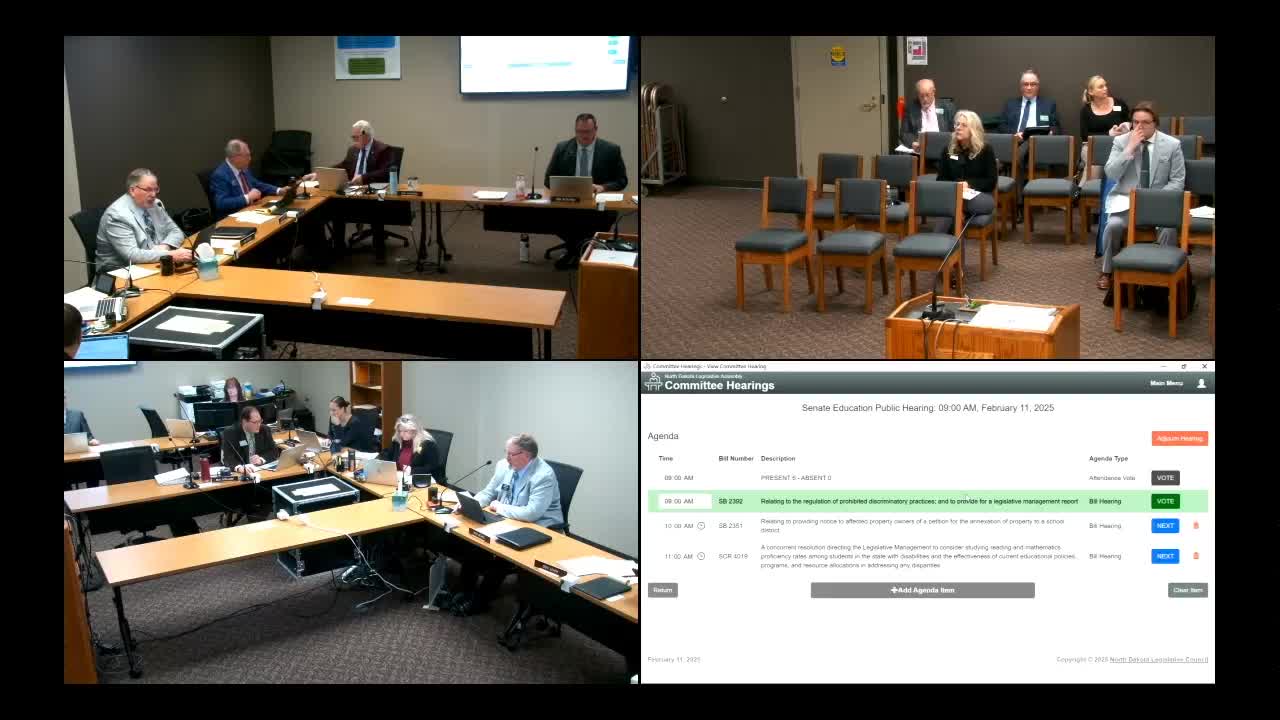
Senate Bill 2,392, which would bar use of North Dakota taxpayer funds for certain programs and trainings the text describes as "prohibited discriminatory practices," drew hours of testimony before the Senate Education Committee.
Senate Bill 2,392, which would bar use of North Dakota taxpayer funds for certain programs and trainings the text describes as "prohibited discriminatory practices," drew hours of testimony before the Senate Education Committee.
Sponsor Senator Mike Wawba, sponsor for District 24, told the committee the bill aims to “remove from taxpayer funding those programs and processes which advocate for discriminatory practices,” and said the measure is intended to curb mandatory identity-based requirements while not preventing study or discussion of history or social issues. “The goal … is to remove mandatory requirements,” Wawba said during his opening remarks.
The bill would apply in three broad areas listed in the text: higher education, K–12 schools and state governmental offices. Opponents — led by administrators and student leaders from the North Dakota University System and public universities — said the language as written could reach routine campus offices, scholarship programs and course materials, and that it lacks specificity about scope and exemptions.
Lisa Johnson, vice chancellor for academic and student affairs for the North Dakota University System, testified in opposition and told the committee the bill “would impinge on the ability to discuss these complex and at times controversial topics” and lacks any express protection for academic freedom or student free-speech rights. Johnson cited existing state provisions, including “North Dakota Century Code 15-10.4” and “century code chapter 15-10.7,” and State Board of Higher Education policy 401.1, arguing the institutions already operate under free-speech and academic‑freedom rules.
Student groups described concrete impacts they expect if the bill passes. Carter Gill, vice president of governmental affairs for the North Dakota Student Association, said the association opposes the bill because its definitions and reporting requirements would amount to “unprecedented legislative overreach” into curriculum and governance that the association believes should remain with the State Board of Higher Education. Christopher Scott, the association’s policy director, said roughly 700 students in the system currently receive diversity waivers and warned the bill could end those waivers and force closure of campus centers that provide student supports.
Multiple student and campus speakers described the role of diversity and student‑support centers in recruitment, retention and student mental-health support. Connor Ferguson, student body president at the University of North Dakota, said a campus Pride center “has become one of the most important aspects of my life here in Grand Forks” and warned that closing offices or removing waivers would harm students and could make institutions less competitive.
Labor and K–12 advocates warned the bill’s phrasing could create constitutional risk. Mike Guierman of North Dakota United said provisions mirroring laws enacted in other states have faced federal court challenges and argued the bill, as drafted, could be read as content‑based restrictions on speech and curriculum. He asked the sponsor to add clarifying language expressly exempting curricular instruction and classroom discussion.
Committee members questioned the sponsor about whether the bill intentionally omits carve-outs that other state models include for athletics, research, academic coursework, private scholarships and grant programs. Senator Wawba said he had used other states’ models (including legislation modeled on a recently enacted Utah bill) but that he was unaware of some of the exclusions and would research possible amendments.
Several witnesses raised implementation and cost questions. Johnson described a compliance burden if institutions were required to post searchable copies of mandatory course syllabi, noting NDUS runs roughly 15,000 courses a term and estimated that publishing and making thousands of syllabi fully searchable would be “an enormous burden.” She also said some third‑party training vendors treat content as proprietary and would not permit public posting.
The committee heard both procedural and definitional concerns: how the bill defines “personal identity characteristics,” whether veterans or persons with disabilities are captured, and whether “prohibited discriminatory practices” language could unintentionally sweep in standard public‑health or safety trainings. Several witnesses urged the committee to clarify whether mandatory trainings (versus voluntary discussion) are the chief target and asked the committee to add academic‑freedom protections.
The committee took no vote at the hearing; the chair closed the public record after testimony and recessed to continue work later. Committee members indicated they expect committee drafting and amendments to clarify curriculum exemptions, training definitions, reporting requirements and implementation costs before any final recommendation.
Votes at this hearing: none (bill in committee, no vote recorded).