Get Full Government Meeting Transcripts, Videos, & Alerts Forever!
Get email alerts on the Education topic
No spam. Unsubscribe anytime.
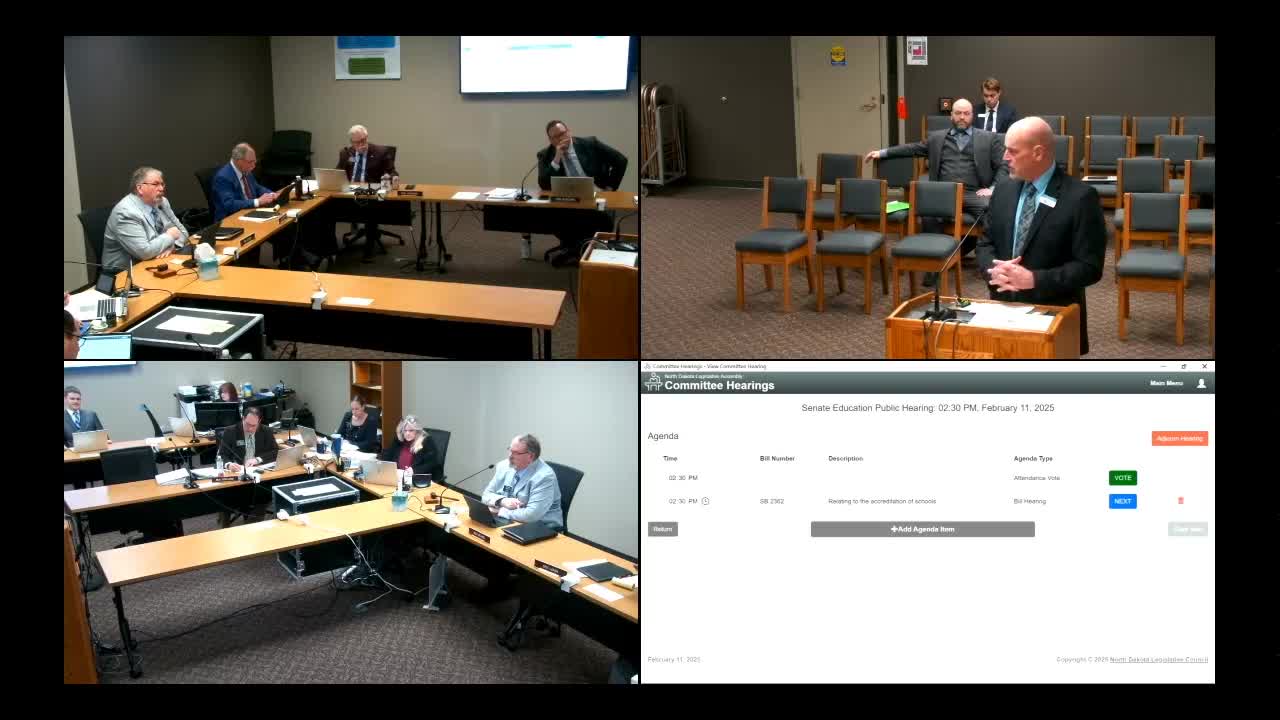
Senate Education Committee hears support and concerns for bill to expand school accreditation options
Summary
At a Senate Education Committee hearing, members heard testimony on Senate Bill 2362, a proposal to expand the list of state‑approved accreditation options available to North Dakota public schools and to allow districts to pursue nationally recognized school‑improvement frameworks such as High Reliability Schools (HRS) as alternatives to the current Cognia accreditation pathway.
At a Senate Education Committee hearing, members heard testimony on Senate Bill 2362, a proposal to expand the list of state‑approved accreditation options available to North Dakota public schools and to allow districts to pursue nationally recognized school‑improvement frameworks such as High Reliability Schools (HRS) as alternatives to the current Cognia accreditation pathway.
The bill’s sponsor told the committee the measure would give districts flexibility to choose accreditation aligned with local instructional and community goals and reduce duplicative reporting. Senator Shibley introduced the bill and said it "ensures our schools have the flexibility to pursue accreditation models that align with their unique instructional goals, operational needs, and community needs and desires."
Why it matters: supporters said alternative accreditation options can embed continuous improvement into daily practice rather than leaving evaluation to intermittent external visits. Kevin Hoertz, representing the North Dakota Council of Educational Leaders, called the change a way to "remove duplicate work" and to allow the state superintendent to approve different improvement models so districts are not required to replicate the same documentation twice.
Proponents’ case: several district leaders and superintendents testified in support. Dr. Ben Johnson, assistant superintendent for secondary schools at Bismarck Public Schools, said HRS "operationalizes school improvement efforts by providing a clear roadmap for continuous improvement that is actionable at the building level." Dr. Corey Steiner, superintendent of Northern Cass School District, said Northern Cass was certified at HRS level 5 and that HRS helped align the district’s strategic plan and led to a district‑level recognition under the Cognia review. John Dreiberg, superintendent at Hillsborough Public School, described HRS as a "constant and consistent improvement" process and said his district spent less on duplicative work by using HRS materials for Cognia documentation.
Details offered in testimony: witnesses described HRS as a research‑based framework organized around five levels of reliability, with the first three levels focused on core conditions (safe/supportive culture, effective teaching, guaranteed and viable curriculum) and levels four and five representing optional extensions such as standards‑referenced grading or competency‑based approaches. Dr. Steiner told the committee that Northern Cass pays roughly $3,000 to $3,500 in a certification year to certify elementary, middle and high schools and achieve district certification under the HRS process.
State superintendent’s amendment and conditions: Kirsten Basler, North Dakota superintendent of public instruction, testified she supports the bill only if specific amendments are adopted. Basler asked the committee to change prescriptive language requiring inclusion of particular association representatives from "shall" and "must" to permissive "may" language, arguing the change preserves the authority of the elected state superintendent under North Dakota Century Code. Basler also proposed a provision that the department secure a statewide contract so a state‑provided accreditation option would be available to all districts at no cost, and that districts choosing other approved options would assume any additional costs.
Concerns about data comparability and equity: Pamela Mack, program director at the North Dakota Protection and Advocacy Project, testified in opposition, saying multiple accreditation pathways could undermine the state’s ability to collect consistent data, compare school performance across districts, and track student progress when students move between districts. Mack urged the committee to consider adopting a single, uniform accreditation process or ensure any alternative maintains comparability for accountability and oversight.
Process and next steps: the committee took testimony from multiple district leaders, the state superintendent, and advocacy groups and closed the hearing on Senate Bill 2362. No committee vote on the bill was recorded in the hearing transcript.
Ending: support and opposition highlighted a tradeoff the committee will have to weigh — local control and alignment with district improvement work versus the need for statewide comparability and uniform, reliable metrics. The committee did not take a formal vote on the bill during the hearing recorded in the transcript.