Get Full Government Meeting Transcripts, Videos, & Alerts Forever!
Get email alerts on the Environment Petroleum topic
No spam. Unsubscribe anytime.
House approves rulemaking authority for above‑ground petroleum storage tanks; bill draws questions on inspections and coverage
Summary
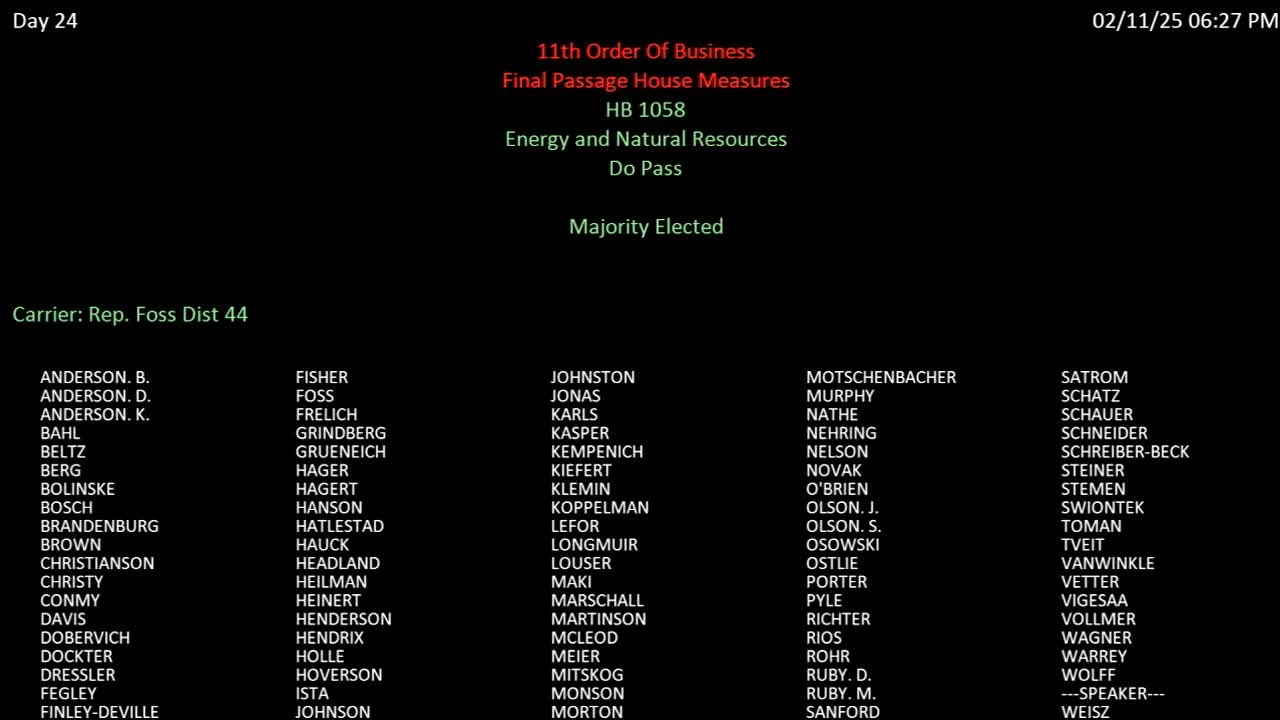
House passed House Bill 10-58 to extend Department of Environmental Quality authority to regulate above‑ground storage tanks registered with the petroleum tank release compensation fund; final vote 67-22.
Bismarck — The House of Representatives on Tuesday approved House Bill 10-58, extending authority to the Department of Environmental Quality (DEQ) to adopt rules covering above‑ground storage tanks that are registered with the petroleum tank release compensation fund. The bill passed on a 67-22 vote.
Representative Foss, presenting the measure for the Energy and Natural Resources Committee, said the legislation responds to several large fuel spills that exposed gaps in oversight of above‑ground tank systems. Foss said the Petroleum Tank Release Compensation Fund currently provides coverage for both above‑ground and underground tanks but that DEQ lacked explicit rulemaking authority for above‑ground tanks; the bill grants that authority and clarifies that large industrial and oil‑and‑gas sites remain outside the fund because they are regulated separately.
During floor debate Representative D. Ruby asked for clarification about whether DEQ already regulated above‑ground tanks and whether those paying fees had received coverage; Foss replied that voluntary participants were covered but that the bill would create a framework for required leak detection, equipment standards and inspection to protect the fund’s solvency. Representative Henderson raised concerns about the bill’s inspection and right-of-entry language; Representative Brandenburg also expressed concern about enforcement on farms. Committee chair Representative Porter responded that the statutory changes are aimed at commercial operations and that residential non‑commercial tanks are not the target of the bill.
Proponents said the lack of explicit rules left the fund exposed to multi‑million dollar claims; Foss cited instances where large spills cost the fund about $1,000,000 each. The committee recommended a do‑pass by a unanimous vote (12-0). Following debate, the House approved the bill 67-22.
The bill now proceeds for further legislative steps; supporters said it will preserve insurance fund solvency and introduce consistent leak‑prevention and inspection standards for commercial above‑ground tanks.