Get Full Government Meeting Transcripts, Videos, & Alerts Forever!
Get email alerts on the CSCU Pcard Audit topic
No spam. Unsubscribe anytime.
Comptroller and auditors find widespread p‑card documentation gaps at CSCU; chancellor vows reforms
Summary
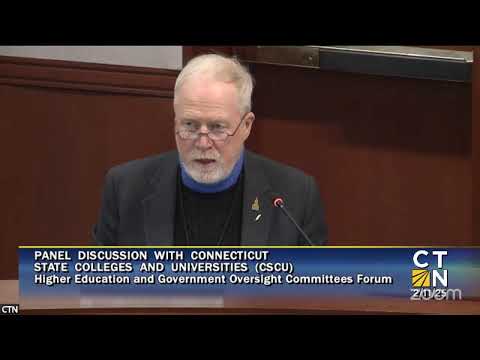
Comptroller Sean Scanlon told lawmakers at a joint forum of the General Assembly’s Higher Education and Employment Advancement Committee and the Government Oversight Committee that a special examination of procurement‑card spending at the Connecticut State Colleges and Universities (CSCU) found numerous policy gaps and missing documentation.
Comptroller Sean Scanlon told lawmakers at a joint forum of the General Assembly’s Higher Education and Employment Advancement Committee and the Government Oversight Committee that a special examination of procurement‑card spending at the Connecticut State Colleges and Universities (CSCU) found numerous policy gaps and missing documentation.
The comptroller’s office reviewed roughly 1,000 sampled p‑card transactions spanning July 2021 through October 2024 and compared university records with vendor transaction data. “While none of the behavior that we found warranted in our minds a criminal referral, they certainly were things that were clear that there was not the right policies and procedures in place,” Scanlon said.
The comptroller and auditors outlined several recurring problems: missing or incomplete receipts, transactions that lacked attendee lists or stated business purpose, senior‑leadership carve‑outs from ordinary spending limits, and use of p‑cards for purchases that typically require formal procurement processes. The comptroller said 70% of the chancellor’s reviewed purchases were for dining and that 43% of those dining transactions lacked itemized or fully itemized receipts. State auditors separately reported duplicate payments and untimely reconciliations.
Why it matters: lawmakers said the findings undercut public confidence while the system seeks more state funding and faces budget pressure. “These dollars are precious,” said Senator Alexis Slapp, adding the committee will evaluate whether the system has “the right fiscal controls in place.”
What the reviews found - Sample and scope: The comptroller’s office sampled just over 1,000 transactions across 76 billing cycles from the system’s roughly 1,070 issued p‑cards; auditors of public accounts conducted a related review focused on executive leadership cards and the chancellor’s employment agreements. - Documentation gaps: Comptroller staff and APA auditors repeatedly flagged missing receipts, incomplete attendee lists for meals, and purchases lacking a stated business purpose. - Examples called out in testimony: an interim university president charged about $47,000 over 16 months; Charter Oak College leadership and marketing staff charged nearly $500,000 on a p‑card for online advertising; auditors identified 22 duplicate payments to the chancellor (each listed as $957.85 in the report) and transportation charges and other items that lacked adequate support. - Policy carve‑outs: Current p‑card rules include a $50 per‑person food limit for most staff, but testimony confirmed senior leadership has discretion to exceed that threshold without routine secondary sign‑off.
Recommendations and proposed legislation Comptroller Scanlon said his office issued 10 recommendations and that “almost all of them made it into a bill that the higher education committee has raised this session.” The legislation cited in the forum, HB 6887, titled an act concerning higher education management and fiscal accountability, would codify many of the comptroller’s recommendations.
Key recommendations discussed at the forum included: - Require a second reviewer or sign‑off for exceptions to meal or other spending limits to reduce unilateral discretion. - Reinstate and require a system‑level internal audit function after the CSCU internal audit unit was disbanded in 2017. - Require improved reconciliation and post‑audit transparency by integrating or bridging CSCU’s Banner financial system with the state’s Core‑CT reporting environment so expenditures can be visible on the state’s Open Connecticut portal.
Cost and technical notes: Scanlon cautioned that migrating fully to Core‑CT would be costly; his office estimated a full Core‑CT implementation for the system could cost about $25,000,000. He proposed an interim “bridge” that would export and map Banner data to give auditors and the public better line‑of‑sight without a full systems migration.
CSCU response and internal actions Chancellor Chang acknowledged the audits and apologized to legislators, students and staff. “This has caused frustration and has diverted attention from what matters the most, the success of our students and our institutions. And for this, I take personal responsibility, and I am extremely, extremely sorry,” Chang said in opening remarks.
CSCU leaders told lawmakers they have taken steps to tighten controls: a centralized p‑card policy was slated for Board of Regents consideration with a planned effective date in April 2025; the system created a policy committee chaired by a newly hired chief compliance officer and pledged more training, clearer guidance, and stricter monitoring. Lloyd Blanchard, CSCU vice president for finance and administration, said CSCU posts annual financial statements online and has begun providing more frequent accountability reports to the board.
Unresolved items and follow‑ups - Missing documentation: auditors and the comptroller both said some supporting records requested during their reviews were not provided to the auditors in the initial stage; CSCU testified it supplied additional documentation afterward and identified certain expenditures (for example, student project shirts) that auditors had flagged but which CSCU said supported student activities. - Payroll and housing: auditors reported duplicate housing stipend payments and said the chancellor is repaying the overpayments; the precise repayment timetable was described as in process and subject to payroll adjustments. - FERPA and data sharing: CSCU counsel and finance staff said mapping and sharing every transaction with the comptroller must consider student‑privacy protections under federal law (FERPA). They told the committee that many expenditures are not student‑specific and could be redacted for public reporting, but technical and legal mapping is required.
What happens next Lawmakers said HB 6887 will be the vehicle to codify many of the recommendations; the committee scheduled a public hearing on legislation following the forum. Comptroller Scanlon and the auditors invited further written comments and follow‑up. CSCU said it will continue to work with the comptroller’s office, auditors and the board to adopt uniform policies, reinstate internal audit capacity and implement reporting improvements.
Ending: Committee members signaled they expect both statutory changes and continued oversight. Several lawmakers asked for periodic progress updates and said they will monitor implementation to ensure changes move beyond policy language to operational practice.