Get Full Government Meeting Transcripts, Videos, & Alerts Forever!
Get email alerts on the Public Safety topic
No spam. Unsubscribe anytime.
St. Pete Beach officials push to demolish aging Station 22 and build hurricane‑resistant replacement
Summary
City staff recommended demolishing Fire Station 22 after post‑storm inspections found damage exceeding FEMAthresholds and retrofit costs that would trigger full code compliance. Staff presented options for funding a replacement, including loans, bonds and pending grants; commissioners pressed for timeline and financing details.
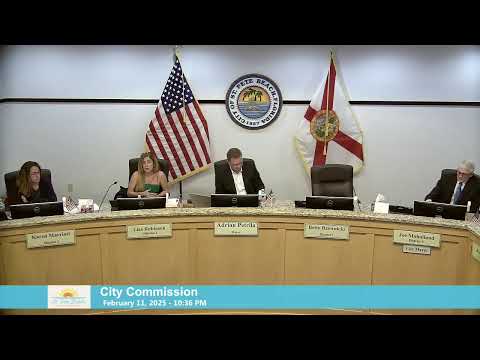
City Manager and fire officials told the St. Pete Beach City Commission on Feb. 11 that Fire Station 22, the city's south‑end firehouse, is beyond cost‑effective repair and should be demolished and replaced with a hurricane‑resistant facility.
Fire Chief (title in transcript: Fire Chief) summarized decades of structural problems at Station 22, at 1950 Pass‑a‑Grille Way, saying the building "has unfortunately reached the end of its useful life" and that repairs after the recent storms push estimated work above FEMA's 50 percent rule. "The staff recommendation is to proceed with demolition. The current station is beyond cost effective repair," the chief said. He said the existing structure fails to meet a range of modern codes and standards including NFPA, OSHA and ADA and that bringing it into compliance would be pricier than rebuilding.
The chief said a 2011 structural analysis recommended replacing the station with a facility able to withstand major hurricane forces; prior short‑term repairs had included removing a leaning host tower and cosmetic work. He said older elements include seven overhead doors that do not meet current wind‑load requirements, masonry deterioration, an electrical panel with storm damage and moisture infiltration at the north brick wall. The station failed catastrophically during Hurricane Irma in 2017 when its generator failed and crews relocated to Station 23, causing "significant increases in response times," the chief said.
Finance Director Angel Laflin presented preliminary financing scenarios for a replacement estimated at $10–12 million, noting the city already secured a $2 million state earmark obtained with Representative Linda Chaney's assistance. Laflin explained options including bank notes (shorter terms, higher rates) and a 30‑year public bond (lower annual debt service but longer term). "It really comes down to the amount of principal we need to borrow," Laflin said, showing sample debt service schedules for 15‑, 20‑ and 30‑year structures.
Commissioners asked for details on timing, insurance and temporary housing. The chief said the department is using a FEMA‑provided temporary structure at the Don Vista location now; FEMA is reimbursing those monthly costs in full through Feb. 28, after which the reimbursement will shift to a 75/25 split. The chief said a different modular trailer option would cost about $47,000 to set up with roughly $7,500 monthly recurring costs.
On funding, staff said further grant requests are in progress (a $3 million appropriation request being pursued by lobbyists) and that loans or bonds remain possibilities. The city attorney told the commission that a general obligation (GO) bond could trigger a required referendum, which would lengthen the schedule; a utility‑style pledge or other non‑GO structure could avoid a referendum but would require legal review and a pledge of permitted revenues. Laflin said the city's current long‑term debt roughly totals about $32 million and that replacing Station 22 with a 30‑year bond would add annual debt service in the low‑hundreds of thousands depending on final principal amount and market rates.
Staff said permitting and construction would take about 16 months once design and funding are secured; Sweet Sparkman was the architect on the preliminary design and the project has prior historic‑preservation board approvals, staff said. The chief said demolition, finalized engineering, permitting and a targeted transition plan should be next steps; staff also flagged potential FEMA compliance rules that can require permitting completed before an award is made.
Commissioners did not take a binding vote on financing at the meeting but pressed staff for timelines, confirmation of the $2 million state grant timing, and whether insurance proceeds (the station is insured for about $1.25 million, staff said) could be applied. The chief and finance director agreed to return with details on grant timing, borrowing structure options, and a more precise construction schedule.
Why it matters: The station serves the city's south neighborhoods and houses firefighting apparatus and personnel necessary for response times on the barrier island. Staff presented evidence that continued reliance on temporary trailers and piecemeal repairs could threaten operational continuity during future storms.
What's next: Staff will pursue grant requests and return with financing options and a more detailed schedule and cost estimate for the demolition and replacement plan.