Get Full Government Meeting Transcripts, Videos, & Alerts Forever!
Get email alerts on the Shaw Walker Redevelopment topic
No spam. Unsubscribe anytime.
City approves Shaw Walker transformational brownfield plan, affordable-housing and community-benefit agreements
Summary
The Muskegon City Commission voted unanimously Tuesday to approve a transformational brownfield plan for the Shaw Walker mixed‑use redevelopment and to authorize related affordable‑housing and community‑benefit agreements with Parkland Properties of Michigan.
The Muskegon City Commission voted unanimously Tuesday to approve a transformational brownfield plan for the Shaw Walker mixed‑use redevelopment and to authorize related affordable‑housing and community‑benefit agreements with Parkland Properties of Michigan.
The plan covers a roughly 15‑acre former Shaw Walker Furniture complex at 965 West Western Ave., 920–930 Washington Ave. and 1330 Division Ave. that Parkland acquired in December 2022. Contessa Alexander, development analyst for the City of Muskegon, told the commission the developer proposes to rehabilitate four existing buildings and add 538 new housing units — 69 condominiums, 37 townhomes and 432 apartments — bringing the project to a total of 591 units when combined with 53 existing units. Alexander said, “The total capital investment for this project is expected to exceed $212,900,000,” and that the redevelopment is expected to create about 200 permanent full‑time jobs and about 600 temporary construction jobs.
Why it matters: The commission and economic development partners described the project as one of the largest and most consequential in recent local history, promising hundreds of housing units and new commercial space in downtown Muskegon and the adjacent NIMS neighborhood. Greg King, director of economic development for Greater Muskegon Economic Development (GMED), said the development’s housing will help meet demand from recent and planned job growth in the county and called the proposal “one of the City of Muskegon’s, if not Muskegon County’s, most important and significant development projects to date.”
What the approvals do: A transformational brownfield plan allows a municipality to capture a broader set of incremental tax revenues than a traditional brownfield plan. Alexander walked commissioners through eligible activities and estimated eligible costs: $168,502,280 in eligible activities and $159,598,389 in total reimbursable/eligible costs, with certain environmental, demolition, rehabilitation and new construction costs listed as eligible under EGLE and Michigan Strategic Fund programs. She said property‑tax capture would not exceed 30 years, the overall brownfield capture could extend up to 35 years, and the plan includes potential state income tax capture provisions available under Michigan Public Act 381. Alexander also explained the project will use a Neighborhood Enterprise Zone incentive; because that reduced assessment affects tax capture timing, staff and counsel recommended delaying the city’s capture start from 2028 to Feb. 2030 to recover more revenue after the reduced rate expires.
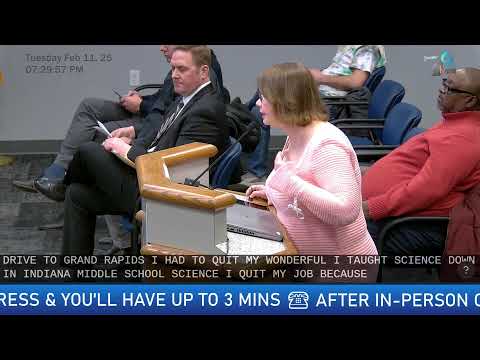
Council and public input: The Brownfield Redevelopment Authority heard the development team and approved the plan locally earlier the same day. At the commission public hearing, several residents and local business representatives spoke in favor: Greg King (GMED) urged approval as housing relief for the current local shortage; Sarah Sass, owner of the Coffee Factory and a tenant at the Watermark, said Parkland’s earlier site work and hiring had already benefited downtown businesses; and multiple callers from neighborhoods and the Brownfield board said they supported the plan. Developer John Rooks of Parkland Properties told commissioners the firm sees the project as a ‘‘legacy’’ redevelopment and said Parkland negotiated the accompanying agreements in good faith.
Linked agreements approved: Following the brownfield vote the commission approved two companion agreements. • Affordable‑housing agreement: Jake Eckholm, director of development services, explained that under Public Act 381 the developer must enter an affordable‑housing agreement to qualify for full state income tax capture. The city’s agreement requires a rolling annual average of 20 units to be maintained at or below the agreed affordability threshold (staff noted the unit mix likely results in more than 20 units in practice), provides remedies for breaches (including collection of overage charges), and preserves city options to place recovered funds into a local housing fund. • Community benefits agreement: The commission also approved a community benefits agreement negotiated with Parkland. Eckholm said the agreement is voluntary (not required by statute) and is intended to secure concrete, local outcomes. Key provisions include a neighborhood amenity fund for the NIMS Neighborhood Association, financial support for at least one capital item on the Hartshorn Park and Marina master plan (examples cited included an ADA fishing pier or pavilion), and a not‑less‑than‑five‑year workforce and apprenticeship partnership with Muskegon Public Schools or Muskegon Community Education focused on hospitality and related career training. The developer agreed to cost‑share relocation of certain utility infrastructure (25% of relocation costs up to $200,000; Parkland to pick up costs above that limit) to improve firefighting access and streetscape safety near Western Avenue.
Votes and next steps: The commission approved the transformational brownfield plan and then approved the affordable‑housing and community benefits agreements by roll‑call votes (all affirmative). Staff said the brownfield authority’s local approval, the city commission approvals and the submitted application will be used to pursue competitive state transformational brownfield funding (the state limits transformational awards to five projects annually). Eckholm said project implementation will proceed through site design, permitting and construction; the development team and city staff will coordinate on infrastructure relocation and the community‑benefit commitments.
What remains uncertain: Staff and the developer indicated some details remain to be finalized in engineering and utility coordination (for example, the final approach to rerouting or abandoning an existing pressurized water main under the building and precise relocation work for overhead power lines). Alexander and Eckholm indicated the city retains remedies in the agreements if commitments are not met.
Public‑record note: The Brownfield Redevelopment Authority reviewed and approved the plan before the commission hearing; the commission’s votes tonight authorized the city mayor and clerk to sign the formal resolution and agreements. The development team will now pursue the state transformational brownfield award and begin phased site work and rehabilitation.