Get Full Government Meeting Transcripts, Videos, & Alerts Forever!
Get email alerts on the Judicial Budget topic
No spam. Unsubscribe anytime.
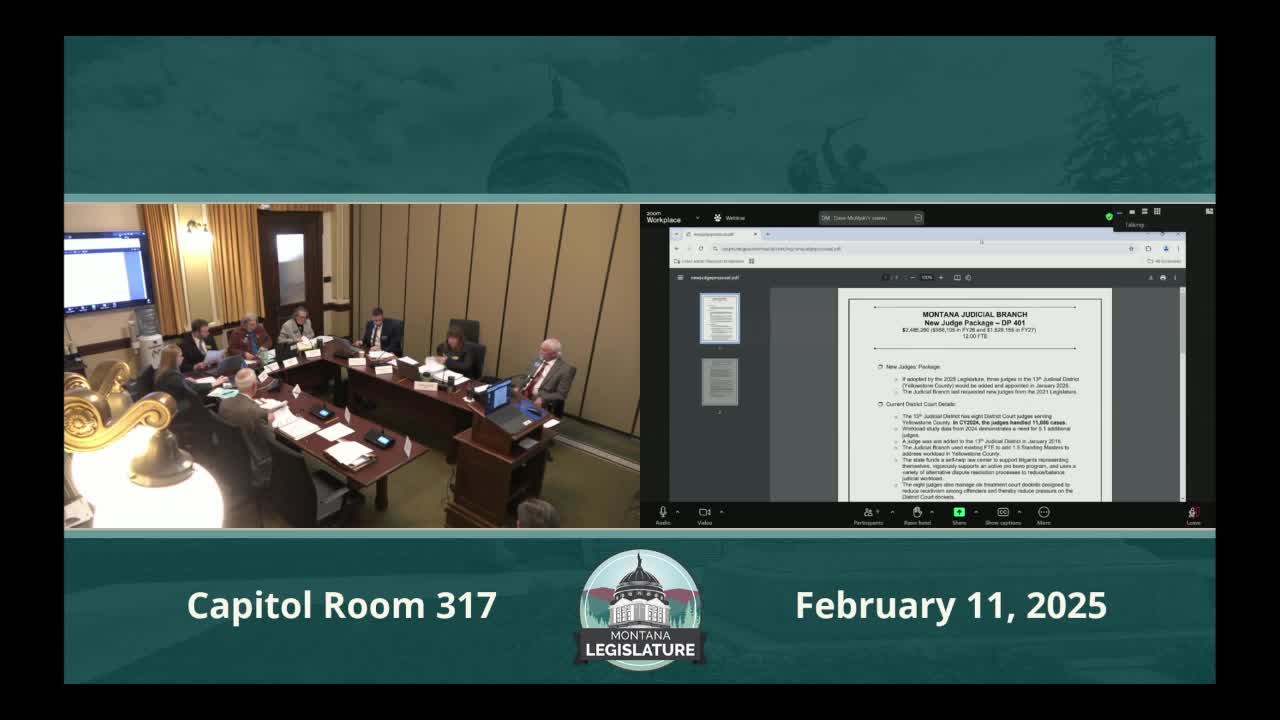
Judicial branch asks Section D for three judges in Billings amid rising caseloads
Summary
Judicial branch officials told the Section D subcommittee the district courts are requesting funding for three new judges and supporting staff for the Thirteenth Judicial District (Billings), citing sharply increased filings and uneven workload across districts.
The judicial branch told the Section D subcommittee it is asking the Legislature to fund three new district judge positions and accompanying staff for the Thirteenth Judicial District in Billings, citing a sustained rise in filings and concentrated workload in a few large districts.
The request appears in the district court operations budget, which the branch presented to the committee. "The district court operations division has a base budget of 36,400,000.0 and they are requesting an increase of roughly 4,000,000 and they're also increasing their PB's by 13," Ms. Wagner said during the presentation. The package includes three new judge positions and related staff; timing of hires produces a 6 personal‑service budget (PB) impact in fiscal 2026 and 12 PBs in fiscal 2027, the branch explained.
Committee members were shown workload data that the branch said underpins the request. "There are 51 district court judges. They cover all 56 counties," Dave McAlpin, court administrator for the judicial branch, told the panel. McAlpin and other staff pointed to a workload study and a time‑weighted case index that the branch uses to estimate judicial need; the branch said caseloads rose about 20% between 2010 and 2024 and that 69% of last year’s 57,082 district court filings were concentrated in the six largest districts.
The Thirteenth Judicial District in Billings was highlighted as the district with the greatest need. McAlpin said district‑level calculations weight judges’ time by case type and that "Billings rises to the top in this and virtually every other metric we have." Committee members asked for detail on how the index is compiled and whether case weights can be broken down by individual judge; McAlpin pointed to the branch’s public dashboard for granular, quarterly figures.
Judge Rod Souza, a district court judge from the Thirteenth Judicial District, described how the workload appears in practice and how the branch has tried to mitigate pressure. "We have 2 standing masters that are based in Yellowstone County. Our FTE dedication to Yellowstone County is 1.5," Souza said. He described standing masters’ role in family law and related matters and cautioned that they are limited: "A standing master cannot handle criminal matters," he said, while noting the district uses a standing order to appoint standing masters as special masters to handle arraignments only.
Souza told the committee that criminal law calendars have lengthened considerably. "When I started as a deputy county prosecutor in 1999 ... a law and motion calendar would be 2 to 3 pages. Now ... sometimes 10 to 12 pages," he said, adding that lengthy law and motion calendars are driving the need for additional judicial capacity so routine arraignments and motions do not consume trial and sentencing dockets.
Committee members probed whether judges specialize now and how additional judges would change operations. Souza said the district currently uses a shared calendar and pod system for prosecutors and defenders and that specialization would be contemplated if the court grows. "If we add 2 judges, we would need to specialize," Souza said; he and other witnesses said full specialization would likely follow only if the Legislature approves multiple new positions.
Budget detail provided by the branch included roughly $1.3 million in statewide present‑law adjustments and a mix of general fund and state special revenue sources; the branch also noted it expended 92.3% of its 2024 appropriation, with most unspent authority in personal services due to vacancies. The presentation referenced a pending legislative vehicle for maintenance funding (House Bill 2) for court IT contracts and clarified that that request concerns maintenance rather than full system replacement.
The subcommittee asked operational questions about the branch’s public dashboard and data inputs; Mr. McAlpin said the dashboard draws from the branch’s full court enterprise system and that clerks input case data. Judge Souza said the dashboard’s three categories include filings, case processing time and active caseloads, and recommended filings data as the most reliable. He cited his three‑year window as an example: "In front of me, there were 4,103 cases filed over 3 years, and then I closed 4,160," and said a high proportion of those were criminal and child‑welfare filings in Yellowstone County.
The committee did not take a final vote on funding at the hearing. Staff said they will distribute additional documentation to members and that the subcommittee plans a work session with the judicial branch and anticipated executive action later in the week and the following week.
The branch’s request now moves to the Legislature’s budget process, where final action will determine whether the Thirteenth Judicial District receives the additional judges and related staff.