Get Full Government Meeting Transcripts, Videos, & Alerts Forever!
Montana panel reviews BISFIG budget projections and informal fiscal notes for behavioral health proposals
Summary
Department of Public Health and Human Services staff told a legislative subcommittee their informal fiscal analyses show the governor's 10 long-term BISFIG recommendations could be largely funded from the state BISFIG account through FY2031 but will require further decisions on timing, procurement and ongoing general-fund commitments.
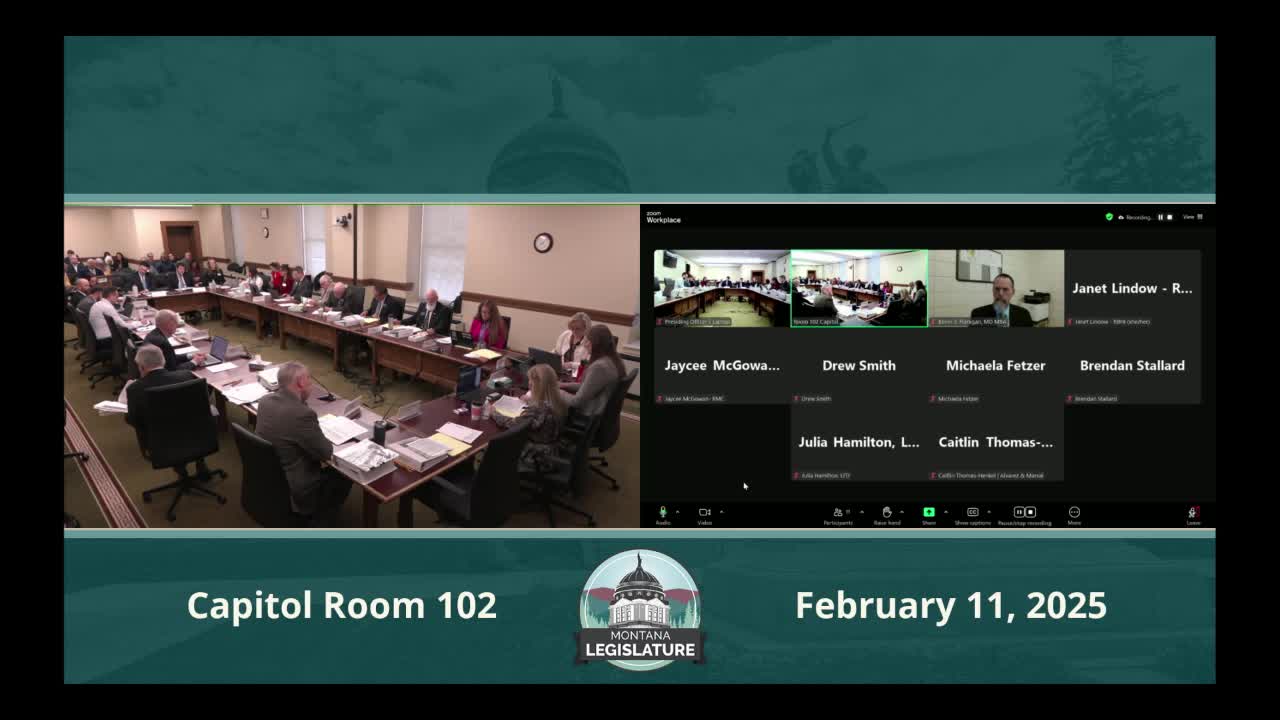
Madison — The House Bill 872 commission’s BISFIG subcommittee reviewed informal fiscal notes and spreadsheets for 10 long-term behavioral health recommendations included in the governor’s budget, with department staff outlining cost assumptions, implementation timelines and funding risks.
The department’s Medicaid finance manager, Jean Hermanson, told the subcommittee “you’ll see the $300,000,000 that the legislature set aside,” and walked members through a color-coded spreadsheet that projects state special revenue (BISFIG) balances, estimated state share spending by fiscal year, and the projected mix of state special revenue and federal Medicaid match through state fiscal year 2031.
Why it matters: committee members pressed staff for clarity on which costs are one-time versus ongoing and how proposals would enter the state’s base budget. Members said they need clearer baselines and timelines to decide whether to fund start-up costs, ongoing program expenses, or to delay implementation pending further analysis.
Major fiscal highlights and assumptions
- Overall BISFIG account: Department materials start from a $300 million legislative set‑aside and show projected spending for the 10 governor-recommended items that would reduce BISFIG balances over time; staff reported updated projections that reduced the biennial 2026–27 request from roughly $99 million to about $85.6 million after timing adjustments.
- Near-term vs. out-year mix: Department staff said IT and vendor costs are heavier in the 2026–27 biennium (for example, roughly $4.0 million/year for IT in 2026–27 and $3.0 million vendor support in those years), while benefit and service expenditures dominate later years; by 2028 the department expects the majority of spending on the package to be direct benefits to clients.
Selected recommendation summaries and dollar figures from the informal notes
- DD waiver: acuity-based rates and assessments — The department assumes contracting for a rate methodology vendor ($500,000) and a project-management vendor ($325,000), purchase of an acuity assessment tool, and an initial Medicaid benefit increase of about $3.5…
Already have an account? Log in
Subscribe to keep reading
Unlock the rest of this article — and every article on Citizen Portal.
- Unlimited articles
- AI-powered breakdowns of topics, speakers, decisions, and budgets
- Instant alerts when your location has a new meeting
- Follow topics and more locations
- 1,000 AI Insights / month, plus AI Chat