Get Full Government Meeting Transcripts, Videos, & Alerts Forever!
Get email alerts on the Nil Athlete Payments topic
No spam. Unsubscribe anytime.
Update to Montana NIL law would let universities oversee athlete payments under recent settlement
Summary
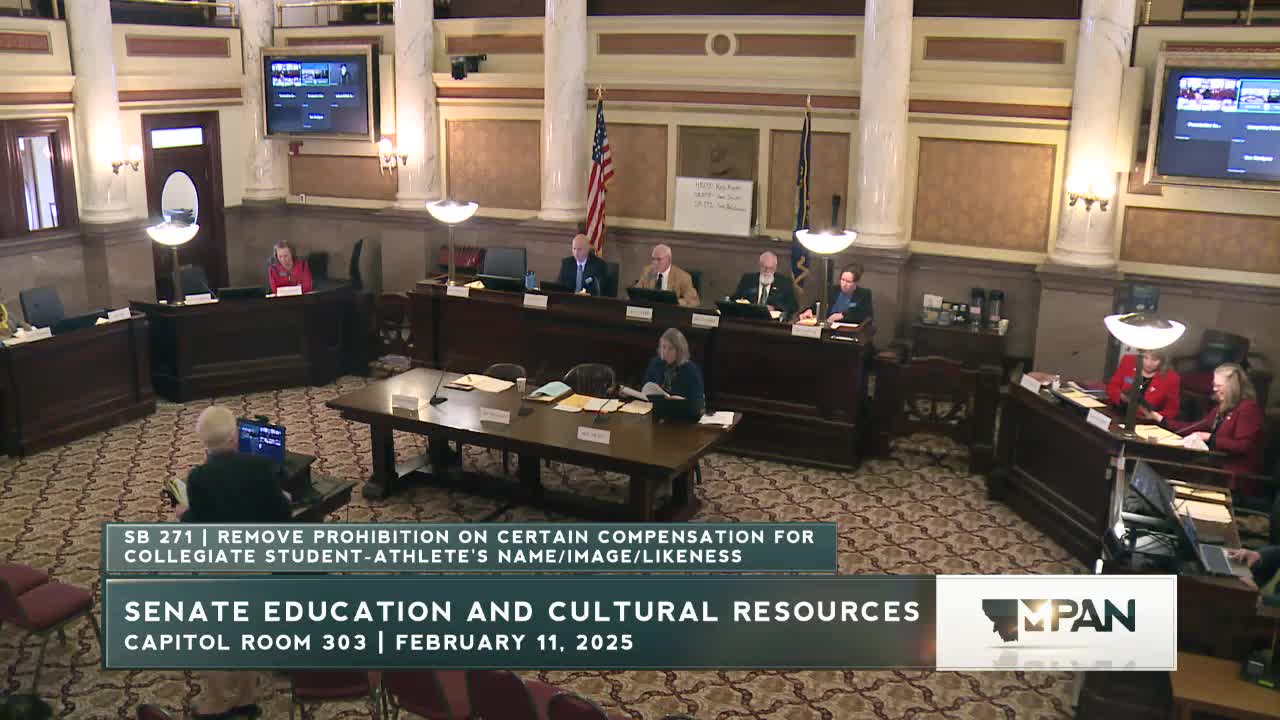
Senate Bill 271 would let Montana universities oversee and administer name-image-likeness (NIL) compensation for student athletes and align state law with the House v. NCAA settlement.
Senate Bill 271 would update Montana’s name-image-and-likeness (NIL) law to align state law with a recent national settlement and provide universities a mechanism to oversee and administer NIL arrangements on behalf of student athletes.
Senator Ellie Boldman, the sponsor from Missoula, told the committee the bill updates the state’s 2021 NIL law to reflect the House v. NCAA settlement and to allow universities to manage payments and oversight. “We just brought this update so that our Montana student athletes can continue to have the benefits and opportunities to make them competitive with all our neighboring states,” Boldman said in closing remarks.
Representatives of Montana State University and the University of Montana testified in support. Tracy Lehi, vice president of communications for Montana State University, said the change will provide additional administrative support for students navigating complex NIL contracts. Dave Kuntz, director of strategic communication at the University of Montana, said the universities have staff in place to manage payments and serve as administrators for these arrangements and supported the update to remain competitive with peer institutions.
Several student and tribal representatives also testified in favor. Patrick Yawake represented tribal communities and cited the 2024 settlement in House v. NCAA that “instructs schools to start to share broadcast revenues with players,” and urged support to correct longstanding issues that prevented athletes from receiving compensation tied to substantial broadcast and sponsorship revenues.
Committee members asked detailed questions about practical effects, such as whether student journalists and campus publications would be restricted from photographing or featuring athletes. Tracy Eleg of Montana State said press access to games and the use of photographs by credentialed journalists are not affected by NIL contracts; NIL deals are commercial arrangements and do not prohibit typical journalism or alumni publications from using student images for non-commercial reporting or features.
University witnesses described services they can provide to student athletes, such as contract review, valuation support and guidance on tax and financial matters; witnesses said current collectives (fan-funded “Grizzly Collective,” “Bobcat Collective”) existed because of prior regulatory constraints but could continue to operate in partnership with the universities under the proposed framework.
Deputy Commissioner Galen Hollenbaugh of the Office of the Commissioner of Higher Education provided background on the landscape that led to this change, saying the House court decision recognized economic value generated by student athletes and that universities are updating policies to remain in parity with NCAA and legal developments.
No committee vote was recorded in the hearing transcript. Proponents across universities, student governments and tribal representatives urged passage to align Montana with other states and to provide administrative protections and supports for athletes negotiating NIL agreements.
Ending: The hearing closed without a recorded committee vote. Sponsor and proponents said the change would help student athletes capture lawful commercial opportunities while allowing universities to administer contracts and provide oversight and support services.