Get Full Government Meeting Transcripts, Videos, & Alerts Forever!
Get email alerts on the Private Fish Ponds topic
No spam. Unsubscribe anytime.
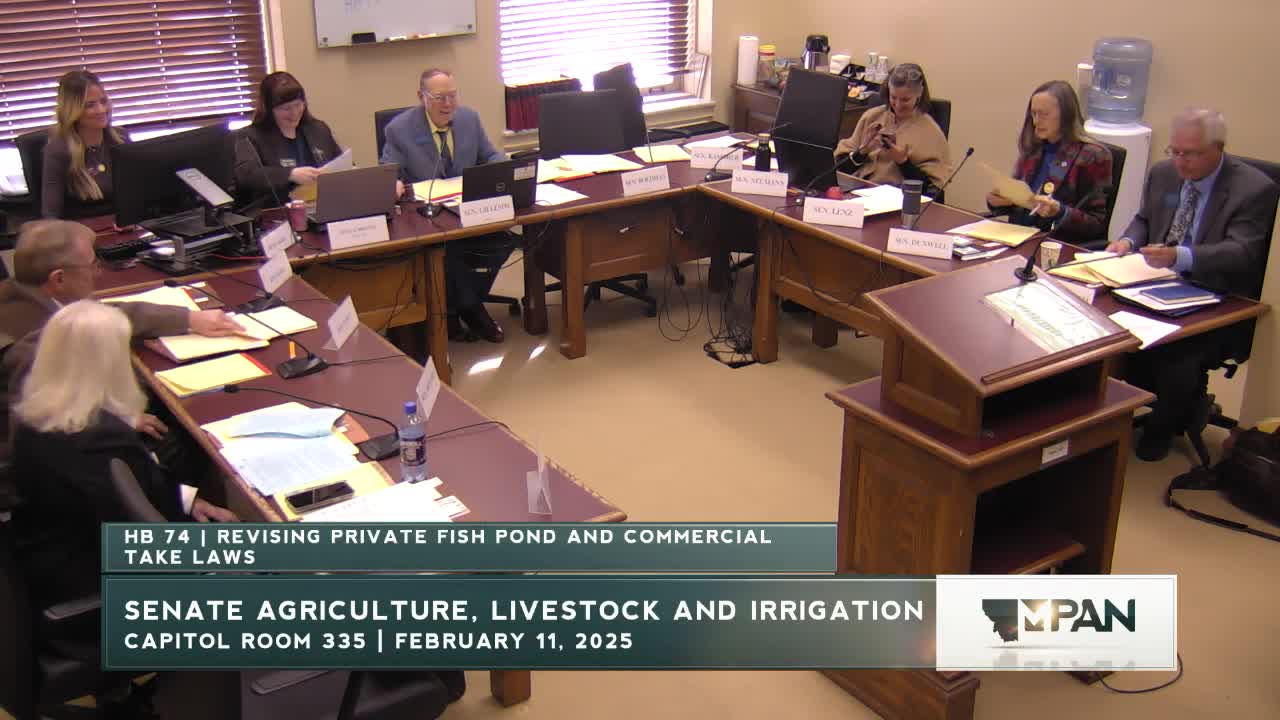
Senate committee hears bill to raise private fish‑pond permit fees to cover program costs and reduce invasive‑species risk
Summary
House Bill 74 would raise the private fish‑pond permit fee from $10 to $600 for a 10‑year permit, with a $250 renewal, to cover Fish, Wildlife & Parks’ estimated $70,000 annual cost to administer pond permits and to reduce subsidy of the program by general license dollars.
Representative Walsh presented House Bill 74, a bipartisan bill stemming from the water policy interim committee, saying the bill updates statute governing private fish ponds and asks private pond owners to share more of the cost of administering permits to cover Fish, Wildlife & Parks’ work on inspections, site visits and pathogen and aquatic invasive species prevention.
Under the bill as presented, the current $10 permit (set about 20 years ago) would be replaced by a $600 application fee for a 10‑year permit, with a $250 renewal fee at the end of the term. Supporters said the change is intended to address a roughly $70,000 annual cost to administer the program and to reduce the extent to which general hunting and fishing license dollars subsidize permitting for private, privately enjoyed ponds.
Clayton Elliott of Trout Unlimited told the committee the department estimated "the approximate cost" to administer the private pond permitting program at "approximately $70,000" a year and that current revenue from the $10 permit totals about $2,419 annually. Elliott said the committee and stakeholders considered alternate fee and term proposals and settled on the $600 / $250 structure with a 10‑year term in the House committee.
Adam Strainer, fisheries division administrator for Montana Fish, Wildlife & Parks, described the agency’s role: staff evaluate pond siting, connectivity to public waters, pathogen and escapement risks, and, when necessary, conduct field inspections and mitigation. Strainer said the department evaluates private ponds ‘‘to identify those potential impacts’’ and that permits are intended to prevent escapes, illegal stocking and spread of pathogens.
Supporters included Trout Unlimited, the Fishing Outfitters Association of Montana, the Montana chapter of the American Fishery Society, the Montana Travel Association and the Montana Lodging and Hospitality Association. They told senators that illegal fish introductions and aquatic invasive species have imposed significant mitigation costs on the state and license holders.
Senators asked whether the permit requirement would apply when water rights are lacking and whether permit frequency and renewal terms were appropriate. Department and DNRC staff said the bill codifies an existing practice of requiring proof of a water right for the pond and that the statutory language can be clarified to specify meeting cadence and departmental consultation.
Opponents raised concerns about the cost for landowners with multiple ponds or those who use ponds primarily for livestock, and urged care in setting fees and renewal intervals. Committee members noted the $600 fee applies to the initial application for a 10‑year permit and that subsequent renewals would be $250, not $600 per year.
Ending: The sponsor asked for a do pass and acknowledged continued conversation about fee levels; no committee vote was recorded at the hearing.