Get Full Government Meeting Transcripts, Videos, & Alerts Forever!
Get email alerts on the Law Enforcement Jurisdiction topic
No spam. Unsubscribe anytime.
Committee Advances Bill Letting DOJ Assist Local Law Enforcement on Trafficking, Drugs and Child‑Exploitation Cases
Summary
House Bill 104 would clarify and expand Department of Justice authority to assist local law enforcement on human trafficking, patronizing a prostitute, drug enforcement, and Internet crimes against children. DOJ and DCI witnesses said the change would align statute with current practice and provide needed technical support to rural agencies.
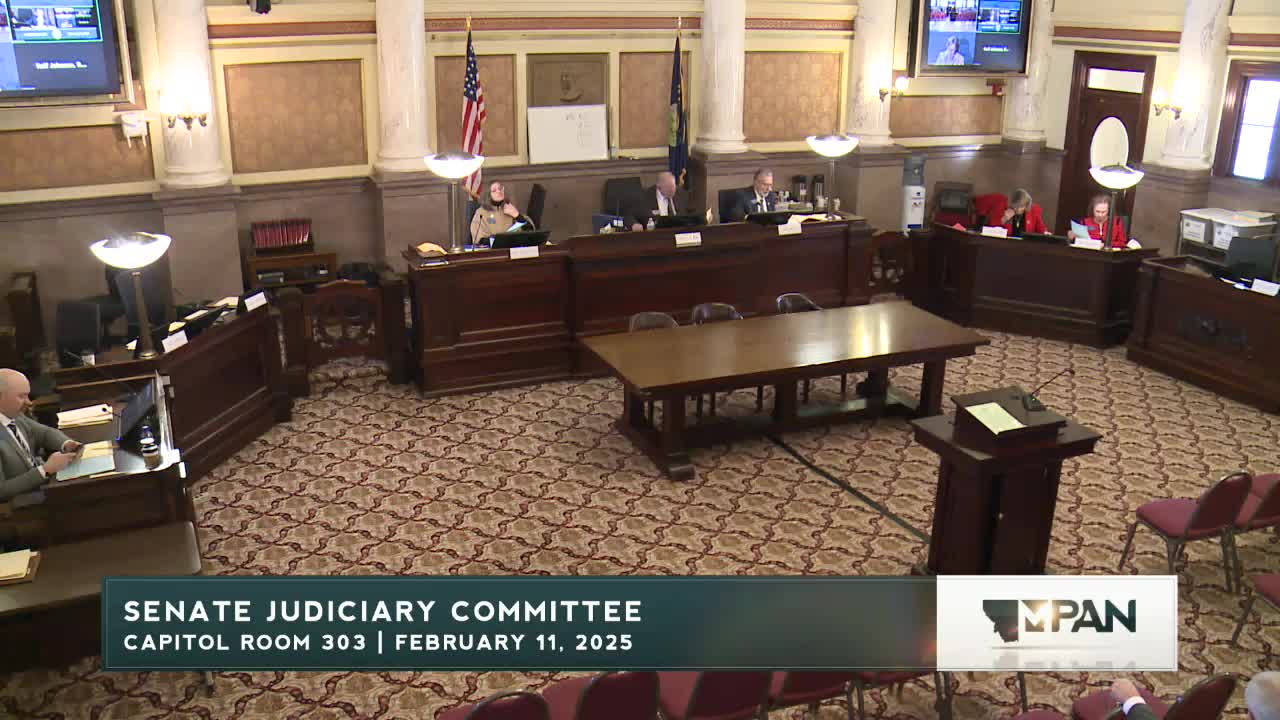
Senate Judiciary Committee members heard House Bill 104, a Department of Justice request measure that would clarify and expand DOJ authority to assist local law enforcement and to exercise concurrent jurisdiction in investigations of human trafficking, related prostitution offenses, drug crimes, and Internet crimes against children.
Representative Eric Albus, sponsor, said the bill would allow DOJ investigators to "help local sheriff's departments" by providing personnel and equipment and would bring statutory language in line with actual investigative practice. Alan Doane of the Department of Justice and Stephen Crawford, bureau chief of the Division of Criminal Investigation’s narcotics bureau, both testified in support. Crawford said the update would allow DCI to exercise concurrent jurisdiction and better deconflict investigations that unfold in real time.
Brian Cassidy, the ICAC commander, and Dan Smith of the Montana Police Protective Association also supported the bill, saying it would help smaller and rural agencies access specialized training, equipment, and investigative resources. Witnesses described current practice of information sharing and operational coordination between DOJ/DCI and local agencies and said the bill would put that practice into clearer statutory form.
Committee members asked clarifying questions about wording changes from "shall" to "must" and back to "shall" in one subsection; the sponsor said the change reflected local sheriffs’ preference to retain discretion to accept or decline DOJ assistance. There were no opponents. The committee subsequently moved and passed a concurrence vote in committee business, and senators volunteered to carry the bill to the Senate floor.
The committee record shows supporters emphasizing rural capacity and technical needs; DOJ witnesses described existing deconfliction practices and specialized units (narcotics bureau, human‑trafficking investigators, and a victim services specialist) that would operate under the clarified authority.