Get Full Government Meeting Transcripts, Videos, & Alerts Forever!
Get email alerts on the Economic Development topic
No spam. Unsubscribe anytime.
Invest Atlanta reports $1.5 billion in capital investment in 2024, highlights small‑business grants and housing pipeline
Summary
Invest Atlanta told the City Council committee it helped generate more than $1.5 billion in capital investment last year, directed most of that toward disinvested neighborhoods, and closed out a water‑grant program that funded 472 small businesses.
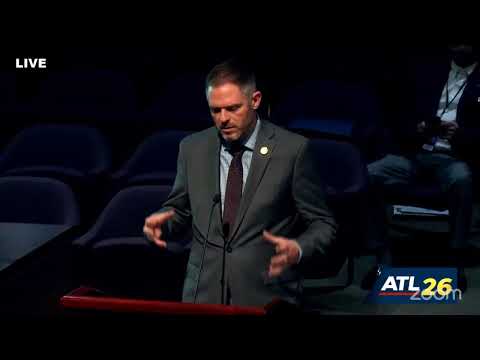
Eloisa Clemente, president and CEO of Invest Atlanta, told the Community Development & Human Services Committee on Feb. 5 that the agency’s investments produced “more than $1,500,000,000 in 2024,” representing a 22% increase over 2023. She said total economic impact — the agency’s measure of direct, indirect and induced activity — was about $1.9 billion.
Clemente said Invest Atlanta directed more than 62% of total investment to disinvested neighborhoods, more than double the share in 2023. She said the agency provided $14,800,000 in direct investment to small businesses across programs last year, delivered 590 grants or loans, and supported 1,844 small businesses through financing, technical assistance and consultations. The city’s recovery fund closed with 472 small businesses funded, $4,400,000 in awards and an average award of $9,446 per business, she said.
The Invest Atlanta leader described workforce and business outcomes: the agency supported 4,433 jobs in 2024, of which 1,675 met the city’s definition of “good jobs” (annual pay between $40,000 and $80,000). Invest Atlanta closed 50 business development projects and said its priority industries include technology, clean energy, retail/food and manufacturing.
On neighborhood redevelopment, Clemente updated council members on Proctor Creek, naming Kelsey Maynor as a staff lead for that area. She said Invest Atlanta has attracted $517,000,000 in capital investment to Proctor Creek to date, with 742 affordable housing units and 848 jobs created or retained. The agency said it is pursuing a phased development strategy, stakeholder mapping and a feasibility study for the corridor.
Clemente reviewed tax‑incentive and finance tools. She said the city currently has nine active state opportunity zones; those zones produced an estimated $1,900,000 in company tax savings in 2024 through a $3,500 state credit per employee for qualifying hires. She also said Invest Atlanta launched a commercial property assessed clean energy (CPACE) program that has produced more than $13,000,000 in financing, and said the city is the only municipality in Georgia with an active CPACE program.
On housing, Clemente said Invest Atlanta financed 2,475 affordable housing units in 2024, about 75% more than in 2023, with total project costs exceeding $1 billion. She reported 409 homeowners were supported through homeowner programs, including 232 down‑payment assistance loans totaling about $4,600,000 in principal and roughly $59,800,000 in total mortgage value associated with those loans; 62% of those assisted were female homeowners and 88% were Black homeowners, she said.
Clemente said Invest Atlanta is “over‑committed” on the 2021 housing opportunity bond due to demand and expects to close nine projects in 2025 from that bond. For the 2023 issuance she said the agency is about 97% committed and expects to close roughly 11 projects in 2025, with a combined pipeline for 2025–26 totaling about 1,639 units (83% expected to be affordable). When combined, she said the 2021 and 2023 bonds are expected to produce nearly 2,300 units in 2025–26, of which 2,007 are expected to be affordable.
Council members pressed Invest Atlanta on how opportunity zones are chosen and whether Invest Atlanta could help connect small businesses to Showcase Atlanta and other event‑driven promotional programs. Clemente described a state application process for zones — she said the city proposes candidate areas, then submits analytic data and a state review determines approval — and said Invest Atlanta is developing a platform to help surface small businesses for event organizers.
Clemente also said Invest Atlanta is monitoring the possible loss of tax‑exempt bond finance tools under a prospective federal reconciliation bill and that staff and partners, including Dawn Arnold, are engaging federal advocacy networks such as NALHFA on the issue.
Questions from council members ranged across Proctor Creek coordination, Mechanicsville commercial gaps, food‑access projects (Invest Atlanta expects grocery openings in Q2 and Q3), workforce housing compliance and the agency’s verification process for affordability targets.
Ending: Clemente thanked staff and council for the support and offered to follow up with council offices on pipeline and compliance details.