Get Full Government Meeting Transcripts, Videos, & Alerts Forever!
Get email alerts on the Rezoning topic
No spam. Unsubscribe anytime.
Council approves rezoning at 150 East 30 Second Street to allow subdivided townhomes
Summary
The City Council adopted Ordinance 2025‑6 to rezone a vacant commercial parcel at 150 East 30 Second Street from C‑2 to R‑4 with a conditional overlay limiting development to townhomes subdivided for individual ownership; the ordinance passed 5–1.
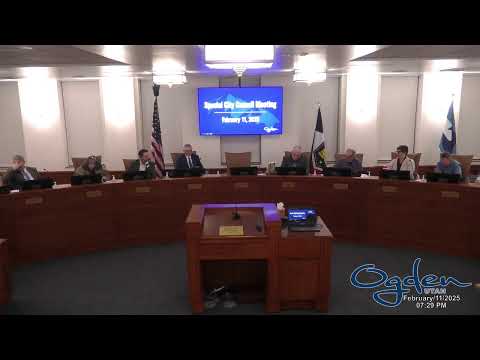
The Ogden City Council voted Feb. 11 to adopt Ordinance 2025‑6, rezoning 150 East 30 Second Street from C‑2 (commercial) to R‑4 with a conditional overlay that would allow single‑family row houses (townhomes) subdivided for individual ownership.
Planning staff presented the rezoning as a proposal consistent with the Jefferson Community Plan and with a positive recommendation from the Planning Commission. Planning staff (Mr. Brierley, Planning staff) told the council the property “is not a real prime commercial spot” and noted the future street plan could alter traffic patterns when the 30‑Second Street couplet is implemented.
The petitioner, David Anderson, who identified himself as the property owner, said he had owned the parcel for five years (having purchased it from his grandfather) and had been unable to attract commercial tenants. Anderson told the council the site “obviously…isn't much of a viable site for commercial use” and said townhomes would add sidewalks and other neighborhood improvements.
The conditional overlay would limit development to row houses (townhomes) divided for individual ownership; the development agreement attached to the zoning will require subdividing the units so they can be individually conveyed, although the city noted the agreement does not force owner‑occupancy and enforcement of owner‑occupancy requirements is legally and practically challenging. Council discussion considered buffering and impacts from adjacent commercial uses, including a tire shop with compressors and loading docks nearby; staff said landscaping, walls or other screening could be included in project design to mitigate noise or visual impacts.
Public comment included neighborhood voices supporting lower‑scale housing and concerns about historic preservation and compatibility with adjacent uses. Council Member Graff opposed the rezoning, saying the lot is surrounded by commercial operations (junk cars, loading docks, power substation) and questioned residential livability on that block. Other council members said they were persuaded by the petitioner’s ownership history, planning analysis and the potential for homeownership opportunities.
Council Member Ritchie moved to adopt Ordinance 2025‑6; Council Member Myers seconded. Roll call was recorded as: Council Member Blair — Aye; Council Member Chibirka — Aye; Council Member Graff — No; Council Member Myers — Aye; Council Member Ritchie — Aye; Vice chair Haire — Aye. The ordinance passed by a 5–1 vote. The council did not attach an owner‑occupancy enforcement mechanism to the conditional overlay during this vote; staff said homeowners association provisions or design‑level mitigation could be added at the development review stage.
The ordinance directs staff to continue processing the development agreement and conditional overlay standards; the petitioner indicated he will determine whether to develop, partner or sell the finished parcels to a homebuilder.