Get Full Government Meeting Transcripts, Videos, & Alerts Forever!
Get email alerts on the Student Transportation topic
No spam. Unsubscribe anytime.
Staff and districts back SB 5009 to let districts include non‑bus vehicles in STARS allocation
Summary
A staff report and district witnesses told the committee that Substitute Senate Bill 5009 would allow districts to include district‑owned cars and smaller vehicles in the STARS allocation, address driver shortages and change reimbursement and training rules; the fiscal note estimates a modest state cost.
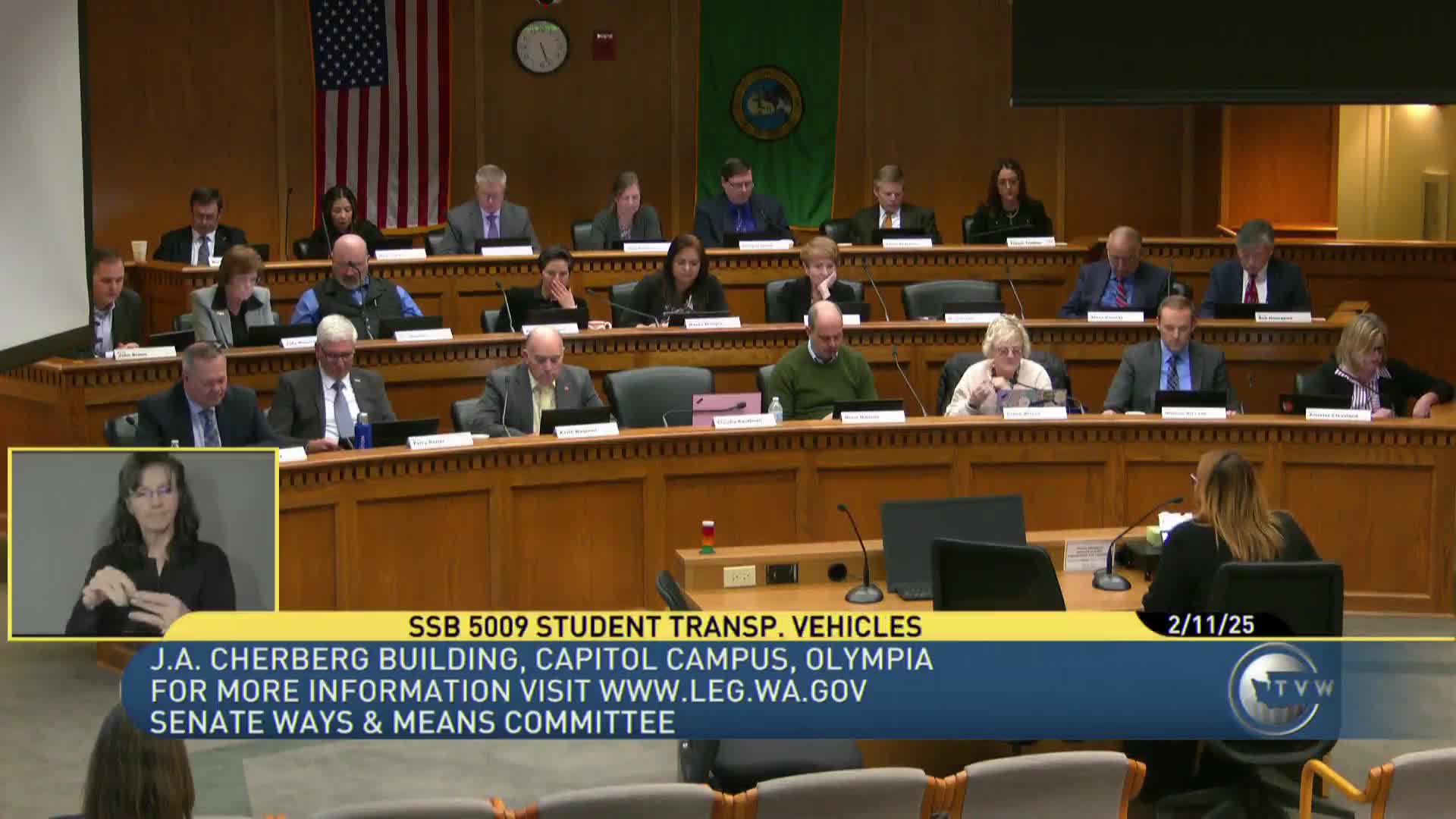
Committee staff briefed the Washington State Senate Committee on Early Learning & K-12 Education on Substitute Senate Bill 5009, which would permit school districts to include district-owned passenger vehicles used to transport students in the STARS transportation allocation and would change reimbursement and training rules for drivers.
Kayla Hammer, staff to the committee, said the bill “requires district owned cars to be included in the overall transportation allocation rather than being subject to the private reimbursement rate,” and that it would expand the bus-purchase and reimbursement process to include other vehicles used in lieu of school buses. Hammer said the bill applies training and qualification requirements that now apply to school-bus drivers to drivers of other district-owned vehicles and also modifies the definition of school bus while excluding certain non‑school-bus drivers from commercial driver's-license requirements. She also summarized the fiscal note: a state impact of $236,000 in the 2025–27 biennium and $260,000 over the four‑year outlook, with additional indeterminate costs if the STARS allocation expands.
District officials told the committee the bill would provide operational flexibility and help address the bus-driver shortage. Robert (Bob) Maxwell, superintendent of Pullman Public Schools and president of LHSAS (as identified in testimony), said the measure “provides critical flexibility for school districts by allowing the use of smaller, safe, and cost effective vehicles inspected by Washington State Patrol to transport students.” Maxwell and Justin Polstead, director of operations for Pullman Public Schools, described routes where smaller vans or passenger vehicles reduced travel time for preschool and special‑needs students — Polstead said a trip that had taken “well over an hour” was reduced to “about 40 minutes” after the district added a transit van to the route.
Jim Kolkowski, director of the Bridal Lehi Center, called the bill “a common sense bill,” and said it would allow trained district employees to drive smaller vehicles when a CDL driver is not available. Brian Freeman, superintendent for the Enjilum School District on the Caldwell Reservation, told the committee his district purchased a vehicle last year to meet transportation needs and that “placing these ... vehicles in [a] depreciation model will create a sustainable model for meeting the transportation needs of districts.” Freeman also noted that requirements in the bill are consistent with current practice in some districts.
Supporters said the bill could reduce cancellations, lower operating costs on lightly served routes and free CDL drivers for other assignments. Hammer and witnesses noted the bill includes a fiscal note and that broader cost impacts depend on how OSPI integrates these vehicles into the STARS allocation.
Public testimony on SB 5009 concluded and the committee adjourned for the evening.