Get Full Government Meeting Transcripts, Videos, & Alerts Forever!
Get email alerts on the Student Transportation topic
No spam. Unsubscribe anytime.
Supporters tell committee SB 5187 should rewrite STARS formula, add ECAP to transportation study
Summary
Advocates, school leaders and PTA representatives urged the Washington State Senate committee to pass Senate Bill 5187 to revise the STARS student-transportation formula, expand eligibility and provide immediate funding boosts for highly mobile students.
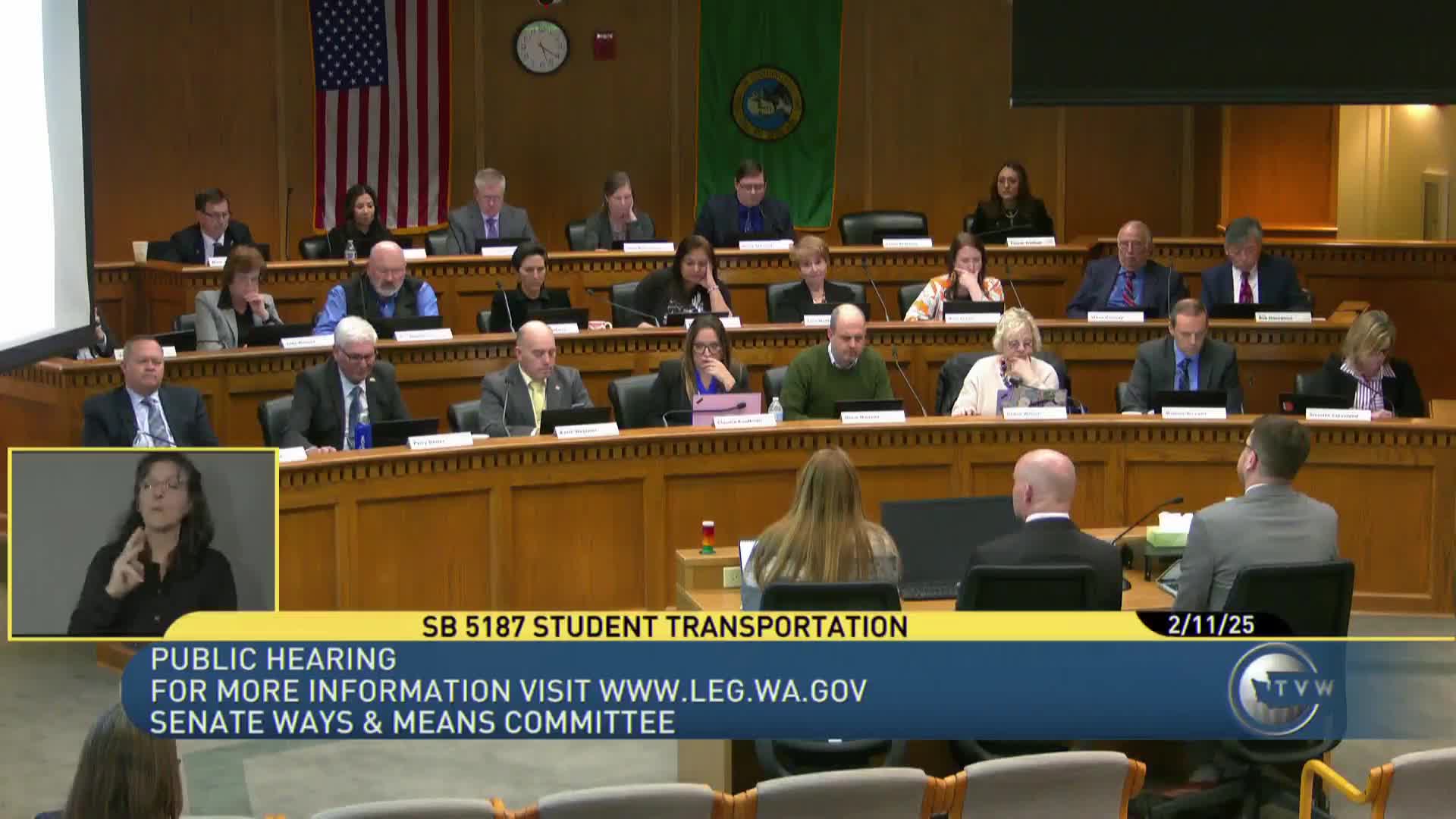
Supporters of Senate Bill 5187 told the Washington State Senate Committee on Early Learning & K-12 Education that the bill would make student transportation funding more transparent and would better identify families who need state-supported transportation.
At the committee hearing, Melissa Johnson, representing the Washington State Association of Head Start and Early Childhood Assistance Program (ECAP), said, “we support this bill because it identifies families most in need of transportation support,” and asked the committee to consider adding ECAP to the categories that should be studied under the bill. She told the committee ECAP families face substantial transportation barriers and that ECAP programs lack the financial capacity to reliably provide transportation for most families.
The bill would direct the Office of Superintendent of Public Instruction (OSPI) to update the STARS allocation formula used for student transportation funding. Lindsay Yocom, legislative representative for the Lake Washington School District board of directors, said the “STARS formula ... is unpredictable, insufficient, and lacks transparency,” and welcomed SB 5187’s steps to create predictability and full reimbursement for all passengers. Yocom said the bill’s immediate $66,000 in funding targeted to McKinney-Vento students was helpful while districts await a formula rewrite.
Angela Steck, president of the Washington State PTA, framed transportation as one of the “big three” funding gaps districts face and said, “Parents rely on student transportation and our school levies shouldn't be used to make up the state's shortfall.” Steck asked lawmakers to consider explicitly including students in foster care and students with disabilities whose transportation needs the current ridership formula does not capture.
Catherine Young, president of the Tacoma Special Education PTA, described schedule changes a district had used to reduce transportation costs that resulted in missed specially designed instruction for special education students: “Although this did, save money, it did cause problems.” Mary Templeton, superintendent in Lake Stevens, said the community wants a funding system that is “simple, transparent, sufficient, predictable, and equitable and fair,” and noted the scale of bus operations in her district — about 27 square miles and roughly 1,000,000 miles on district buses annually.
Witnesses provided population and service data intended to illustrate need: Johnson said roughly 15% of ECAP families were homeless during the enrollment year referenced; she reported 18% of ECAP children are on an Individualized Education Program (IEP), 8% are involved in the child-welfare system, and 4% are in foster or kinship care. She also said fewer than 20% of ECAP children are transported on school-district buses and an additional 9% have other transportation arrangements that are generally not affordable for most families.
Proponents told the committee SB 5187 would increase transparency in how STARS funds are distributed and allow better planning and reimbursement for districts. Public testimony on SB 5187 concluded and the committee moved on to consider Senate Bill 5009.